Sign up

You deserve to feel great, look great & LOVE your body

Enter your email for your FREE starter kit to get healthy & lose weight without dieting:

  • This field is for validation purposes and should be left unchanged.

30 Ways To Slow and Prevent Aging

by | Nov 18, 2009

Darya PinoToday is my 30th birthday and a perfect time to reflect on life, the universe and everything.

Despite being female and thus held to tough and often unrealistic physical standards, hitting the end of my third decade doesn’t cause me anxiety about either my appearance or place in the world.

In my experience, age is not an amount of time but a state of mind. As a child I always wanted to be a grown up, so I acted like one. It freaked my parents out sometimes, but that’s just how I was. In my mind, I still feel pretty much the same in that regard. I love to work hard and I thrive in positions of responsibility. Since both these traits get more important with age, I have actually enjoyed stepping into the adult role I’ve always felt I belonged in.

But that’s only one part of me.

In many other ways I’m as juvenile as ever. If you spend much time with me on Twitter (@summertomato) you’ve probably noticed I have the sense of humor of a 12-year-old boy. I blame my dad for that one. I’m also still shocked every time I hear that friends my age are getting married and having children. In my brain we’re not nearly old enough for that yet! But in reality, it is my friends who are normal and I’m the outlier.

Oh, and did I mention I’m still in school? Up until a couple years ago I carried a backpack with me everywhere, for better or for worse.

Darya's GunsAll these things give me a sense of agelessness, so it is hard to think of this birthday as anything but another day to do things I love. But part of my peace of mind certainly comes from the fact that I’m in pretty good shape physically–probably the best of my life. And at 30 this is definitely something to be proud of.

Summer Tomato readers know I attribute my good health almost entirely to my eating habits. I also spend a good amount of time in the gym, though I don’t workout nearly as much as I used to. But healthstyle extends to more than just diet and exercise.

Here I’ve compiled my favorite 30 habits to slow aging and keep you young in more than just your heart.

30 Healthstyle Tips To Keep You Young

  1. Be happy The physical damage caused to your body by stress has only recently become appreciated by the scientific community. Fill your life with things you love and get rid of almost everything else. Practice stress relieving activities like meditation and exercise, and learn to appreciate joy when you find it. Happiness does a body good.
  2. Eat vegetables There is good evidence that oxidative damage caused by toxins and metabolism contributes to the aging process at a cellular level. Foods (but not supplements) high in antioxidants seem to protect us from oxidative stress.
  3. Avoid sugar Sugar is a direct cause of aging and significantly reduces lifespan in organisms from yeast to primates. Not by a small amount either.
  4. Moisturize The appearance of your skin is largely dependent upon moisture. Help it out by using moisturizers to keep your skin soft and hydrated. Work with a professional to determine what type is best for you.
  5. Don’t raise your eyebrows Credit my mother for teaching me this one, it has been a lifesaver. As a kid she used to warn me about raising my eyebrows, saying it would give me wrinkles and I’d regret it. I thought she was crazy, but still learned to express myself without much forehead crinkling. As a result I have far fewer forehead lines than some people years younger than me.
  6. Sleep For me the most important determinant of how I look (and feel) on a given day is how much sleep I get. Seven hours is my ideal, but everyone is different.
  7. Eat fish Some evidence suggests that the omega-3 fatty acids found in fish are particularly beneficial to the skin.
  8. Wear sunscreen I love the sun and spend as much time in it as possible, but I never walk out the door without sunscreen on my face. UV radiation from the sun damages your skin and promotes aging.
  9. Don’t smoke Smoking is one of the easiest ways to look older than you really are and shorten your life at the same time. Avoid both primary and secondary smoke like the plague.
  10. Step out of your comfort zone Mental exercise seems to be one of the key elements of quality aging, but this doesn’t mean you should sit around all day doing crossword puzzles. Neuroscientist and cognitive aging specialist Dr. Adam Gazzaley suggests going out of your way to challenge yourself mentally, doing things like traveling and learning new languages even over the age of 60.
  11. Take vitamin D Some research suggests that vitamin D may be particularly important in slowing the aging process. The jury is still out on the value of vitamin D supplements for aging, but they seem to have enough other benefits that it’s worth the investment.
  12. Eat fruit Like vegetables, fruits have an enormous amount of antioxidants and help with hydration. Vitamin C in particular is thought to benefit skin.
  13. No foundation or powder makeup Generally I avoid putting any makeup directly onto my skin. I realize I have a very flexible work environment and this is not possible for every woman, but skipping the makeup does help maintain your skin’s hydration and elasticity. I do wear makeup occasionally, maybe once or twice per week. But in general I find that mascara and lip gloss are enough for most situations.
  14. Hydrate Your skin is very sensitive to water levels. Stay hydrated by sipping water and eating fruits and vegetables throughout the day.
  15. Whiten teeth I know this isn’t something you can find at the farmers market, but when you drink as much coffee and red wine as I do, minor (and admittedly superficial) fixes like teeth whitening can go a long way. If you don’t believe me, try and remember the last time you saw a 20-year-old with yellow teeth….
  16. Wear sunglasses If you’re a happy person (and I know you are), your wrinkles will most likely be caused by smiling and show up predominantly around your eyes. Block out extra sun (and look super cool) by always wearing sunglasses when you go outside.
  17. Eat beans and lentils Legumes are a fabulous source of minerals that can help keep your skin hydrated and looking young.
  18. Tea Afternoon tea time is one of the greatest discoveries I’ve ever made. Not only is tea full of antioxidants and other cancer-fighting compounds, a midday break can be just what the doctor ordered to sip away stress.
  19. Cardio I’m not the biggest believer in cardio exercise for weight loss, but it is still important for vascular health. Not to mention how awesome you feel after a good session. Cardio doesn’t need to kill you, but you should do it regularly.
  20. Strength training Building strong, toned muscles is one of the most effective ways to look younger than your years. Ask anyone who looks fabulous and they’ll swear by strength training. A little goes a long way.
  21. Eat intact whole grains Intact grains (not fake “whole” grains that are ground into flour) are an excellent source of vitamins, minerals and soluble fiber. They are also perfect fuel for those killer workouts.
  22. Olive oil It is hard to think of something more versatile, healthy and delicious than olive oil. It breaks my heart that dietary fat got such a bad rap the past few decades, since the benefits of healthy fats like olive oil are innumerable. Fat isn’t just “not bad” for you, it’s essential.
  23. Kill your television We all have things we enjoy watching (I’m partial to NBA championship teams), but if it takes up a significant amount of your time each week (>5 hrs) it may be time to reevaluate. How many years of your life do you really want to spend on your couch?
  24. Don’t stuff yourself Cutting back on calories is the single most effective way to slow aging and extend life. I don’t advise starving yourself, but it’s a good idea to avoid overeating in any situation.
  25. Eat nuts Nuts are the perfect snack food and are filled with anti-aging fats, vitamins and minerals. They are also great for suppressing appetite–just don’t eat more than a handful.
  26. Avoid dairy Studies of aging skin have shown that milk and milk products are associated with acne, which can lead to scaring and age spots.
  27. Avoid processed meats Processed meats are associated with many different health problems in humans. No need to get too hung up on this, but you may not want to eat deli meat every single day if you want to stay young.
  28. No processed carbohydrates Just like sugar, processed carbohydrates are a direct cause of aging and disease. I eat these things occasionally, but don’t let it happen too often.
  29. Coconut oil Fats come in all different shapes and sizes, and I try to incorporate a good mix of all of them. Medium-chain fatty acids like those found in coconut oil are starting to be recognized as important by researchers, but the evidence is limited. Coconut oil is also a healthy source of saturated fat for vegetarians. I always use coconut oil when cooking Southeast Asian food.
  30. Red wine Red wine has a powerful anti-aging compound in it known as resveratrol. Though it is unlikely that the dosage of resveratrol in red wine is high enough to impact lifespan, drinking alcohol in moderation is also associated with decreased risk of heart disease and other vascular problems. Cheers!

Do you have any anti-aging secrets?

Tags: , , , , , , , , , , , , , , , , , , , , , , , , , , , , , , , , , ,

Quick Fix: Summer Squash, Peppers & Zürsun Heirloom Beans Recipe

by | Oct 21, 2009
Squash, Peppers and Beans

Squash, Peppers and Beans

A few weeks ago I was contacted by someone from Zürsun Idaho Heirloom Beans and was immediately intrigued. I’m regularly approached with requests to review (aka endorse) products and my answer is almost always the same,

“Thanks, but no thanks.”

Companies that contact health bloggers like me are usually selling energy bars, supplements or some other kind of “functional food”–the exact same junk I’m always reminding you not to bother with. Not only do I think this stuff is useless, I actually consider it dangerous and contrary to your health goals.

If it has a health claim on it, you probably shouldn’t be eating it.

But heirloom beans and lentils are not junk food, and I jumped at the opportunity to sample what Zürsun had to offer. A few days later I received a shipment of assorted beans and lentils and have been thoroughly enjoying them ever since.

Heirloom beans are special, and if you’ve never tried them I highly recommend you do. The flavor and texture of high-quality beans does not compare to the cans you get at the grocery store.

To prepare, I soak my beans overnight then cook them 10-12 minutes in the pressure cooker (this is the one I use) with a bouillon cube–preferably beef flavored, but any will do. A big batch of beans can last weeks if you freeze it in 2 or 3 portions.

What has been the most surprising to me is how fantastic I’ve felt since I’ve started eating legumes nearly everyday. Though beans are famous for causing digestive problems, I have not had even the slightest issue with dried heirloom beans. I’ve read that this is probably due to the overnight soak, but I haven’t seen the science to back this claim.

My energy levels have been especially high (even for me!) and the past few weeks have been some of the best times I’ve ever spent in the gym. Oddly, I also weigh less than I have in my adult life (I was so surprised I double checked the calibration on the scale at the gym).

I don’t know if I can attribute all this amazingness to the beans, but I can tell you they have made for some tasty and satisfying meals.

I’m happy 🙂

My favorite bean so far has been the fawn bean. Zürsun calls these “rice beans,” probably because they are long and slender. Fawn beans are very versatile and I used them in salads, stir fries and on their own.

For me the simplest way to eat beans is to toss them in a pan at the last minute when cooking my usual vegetables. This makes for a simple, delicious, one-pan meal perfect for a busy week night.

In this recipe I used some of the season’s last zephyr squash and some Basque frying peppers. It might have been better with cilantro, but I only had basil so that’s what I used. It turned out delicious.

Summer Squash, Peppers & Zürsun Heirloom Beans

Serves 1 main course or 2 sides. Total time ~15 minutes.

Ingredients:

Zursun Beans & Lentils

Zürsun Beans & Lentils

  • 1 cup cooked Zürsun fawn beans
  • 2 medium zephyr squash or zucchini, cut in half and into 1/2 in. slices
  • 1-2 Basque frying peppers or 1/2 cup chopped bell pepper
  • 1 cippolini onion or shallot, diced
  • 1 clove garlic, minced
  • Chopped basil or cilantro

Heat a pan on medium flame and add 1 tbsp olive oil. Add onions and peppers and cook until starting to brown, about 5 minutes.

Add squash, salt and pepper to taste. Cook until the squash turns bright colored, has stopped sweating and is starting to gently brown on the edges, 4-5 minutes.

When the squash is nearly done, clear space in the center of the pan and add the garlic in a single layer. When it becomes fragrant (about 30 seconds), mix it in with the rest of the vegetables.

Add the beans to the pan and mix. Continue to cook until the beans are heated through. Do not allow the beans to sit long enough to stick to the bottom of the pan.

Toss in herbs and serve immediately.

This dish is great on its own or as an accompaniment to fish or light protein. You can also use also use this same basic recipe to cook any standard vegetables with beans or lentils. I made it one day with beet greens and it was awesome.

Do you ever cook beans together with vegetables?

Tags: , , , , , , , ,

For The Love of Food

by | Jul 24, 2009
For The Love of Food

For The Love of Food

Welcome to Friday’s For The Love of Food, Summer Tomato’s weekly link roundup.

This week I found yet another reason to eat fish for health, as well as some great discussions on the pros and cons of food industry regulation. For those of you who still don’t have a pressure cooker, Mark Bittman says you might still be able to prepare delicious bean dishes.

If you would like to see more of my favorite articles each week or just don’t want to wait until Friday, be sure to follow me on Twitter (@summertomato) or the Summer Tomato Facebook fan page. For complete reading lists join me on the social bookmarking sites StumbleUpon and Delicious. I’m very active on all these sites and would love to connect with you there.

Submissions of your own best food and health articles are also welcome, just drop me an email using the contact form. I am currently accepting guest posts at Summer Tomato for any healthy eating, living and exercise tips.

For The Love of Food

Did you write any fabulous food or health articles this week? Share your links in the comments!!

Tags: , , , , , , , , , , ,

Eco-Atkins Diet May Be Healthier Alternative for Weight Loss

by | Jun 10, 2009
Collards, Carrots and Lentils

Collards, Carrots and Lentils

A new study published yesterday in the Archives of Internal Medicine suggests that both weight loss and risk factors for heart disease can be improved following a vegan version of the low-carb, high-protein Atkins diet.

The “Eco-Atkins” diet focuses primarily on soy, nuts and wheat proteins (gluten) to increase the amount of vegetarian protein in the diet. Carbohydrates were restricted to 130 g/day, which is on the higher end of most low-carb diets. All starchy foods such as bread, baked goods, potatoes and rice were eliminated. Carbohydrates were provided in the form of whole, intact grains (barley and oats) and low-starch vegetables.

In a small (47 participants), short-term randomized controlled trial, this diet lowered bad LDL cholesterol by 20%, without negatively impacting good HDL cholesterol (statin drugs improve cholesterol levels by 30%). The diet also substantially lowered blood pressure and other markers of cardiovascular disease, such as triglycerides and apolipoprotein B.

The original meat-based Atkins diet has been shown to be effective for temporary weight loss (after 1 year the effects of the Atkins diet are diminished), but cardiovascular risk factors such as LDL cholesterol and blood pressure are not substantially improved under the traditional Atkins regimen.

Interestingly, a traditional Atkins-style diet based on animal protein was not used as a control in this study, so a true comparison of the diets cannot be made using the present data. Instead the researchers chose a control diet representative of a typical high-carb, low-fat vegetarian diet that included eggs and dairy products. Both diets tested in this study represented a 60% decrease in total calories.

Because of the study design, we cannot conclude that this diet is more effective than the Atkins diet for health, though you would predict it would be if future studies made this comparison. On the other hand, it does seem that a plant-based high-protein diet is more effective at improving health than a high-carbohydrate lacto-ovo vegetarian diet, at least in the short-term in a highly controlled environment.

This study took place over the course of 4 weeks, and all the food was provided for the particpants by the researchers. Thus, compliance in the program was very high. It is not clear if the participants would have had the same level of success if they were instructed to provide their own food to comply with the dietary programs.

Despite this, satiety levels were notably improved in the high-protein group and it would be expected that the increase in satiety would encourage greater compliance in a free living situation.

A small four week study, however, tells us very little about the effectiveness of this diet. While it is possible to improve risk factors such as cholesterol and blood pressure in such a short period of time, disease outcome is the true measure of a successful diet. Also, this study did not test the feasibility of the Eco-Atkins diet in the long-term, and it is likely many dieters would object to a strictly vegan regimen.

Interesting points raised by this preliminary study include:

  • Plant-based, high-protein diets may be more effective at improving cholesterol and other cardiovascular measures than traditional lacto-ovo vegetarian diets.
  • Short-term weight loss is primarily determined by the number of calories consumed, not macronutrient content.
  • Low-carb diets that include intact whole grains and plant-based protein can be effective at improving both weight and cardiovascular risk factors in the short-term.
  • Plant-based high-protein diets can increase satiety compared to high-carb vegetarian diets.

However, many questions must be addressed before this diet can be recommended to individuals trying to improve cardiovascular measures and lose weight.

New questions:

  • Can the Eco-Atkins diet be maintained in the long-term by normal individuals?
  • Does the Eco-Atkins diet continue to improve cardiovascular risk factors including weight loss after 4 weeks?
  • What would result from this study if beans and lentils were used instead of soy and gluten?
  • Does the Eco-Atkins diet improve disease outcome?
  • Does the Eco-Atkins diet extend life?
  • Does the Eco-Atkins diet affect quality of life?
  • Can these effects be attained through other diets that include some animal protein, more whole grains or more fat?
  • Is the effectiveness of the Eco-Atkins diet affected by an individual’s level of insulin resistance?
  • Can adding fish further improve the results of the Eco-Atkins diet?
  • Can a further reduction in carbohydrates improve the results?
  • Will you get these same results if the study is NOT funded by the soy industry?

In summary, the results of this study are interesting and encouraging, especially for those of us who think both carbohydrates and meat should be limited in a healthy diet. I very much look forward to future studies exploring this idea.

What concerns me most is the lack of marine omega-3 fatty acids (fish) in the Eco-Atkins diet, which could potentially improve cardiovascular measures even further. Fish is also important for cognitive health and may lower cancer risk.

I am also worried that a strictly vegan diet would not be feasible in the long-term for many Americans. Moreover, it is not necessarily the healthiest option available. Vitamin B12 deficiency is a particular concern, but could be addressed with supplements. Generally, however, I do not recommend relying on supplements for optimal nutrition.

Finally, this study was funded by a company that makes soy and gluten products. Personally I would have prefered to see these protein sources used in combination with other things such as beans and lentils. Many people question how much soy can be safely consumed and gluten intolerance is more common than ever, so wouldn’t it be interesting to know if there were safer alternatives? It really annoys me to see science being influenced by industry funding.

What do you think of the Eco-Atkins diet?

Tags: , , , , , , , , , , , , , , , , ,

How To Get Started Eating Healthy: Stock Your Freezer

by | Apr 15, 2009
Rice Balls

Rice Balls

There are many places you can turn when you’re feeling lazy or are too busy to cook a fresh meal, but instead of reaching for the take-out menu I prefer to turn to my freezer. For one thing, even the taqueria directly downstairs from my apartment cannot whip up something as quickly as I can. And their grilled veggie burrito (not to mention the carne asada burrito!) is substantially more expensive than anything I would make–I’m sure you can guess which is healthier too.

(This post is part four of the series How To Get Started Eating Healthy. Part one is Stock Your Pantry, part two is Essential Groceries and part three is Seasonal Shopping.)

Your freezer is an invaluable resource for storing foods that are best made in large batches. Frozen fruits and vegetables from the grocery store can also come in handy when you are in a pinch. Below is my personal list of freezer essentials, but please add your own in the comments and tell us how you use them:

  • Frozen rice balls The single most essential item in my freezer is my giant bag of frozen brown rice balls. When I first explained the best way to make rice, I mentioned that I prefer to make a large batch and freeze it in individual servings. This is a trick I learned from a former housemate that always cooked traditional Japanese food (thanks Kiyoshi!). He used white rice, but I think this method is even more valuable for whole, intact grains since they are not particularly easy to integrate into your meals unless you make them yourself. Whole grains take quite a while to cook, but if you make a lot and freeze them you only need to cook grains occasionally. In addition to rice, you can also freeze other grains like barley and steel cut oatmeal.
  • Cooked legumes To know me is to know that I love beans and lentils. Legumes are some of the healthiest food you can eat, and are among the best sources of protein on the planet. The only problem is they can take a long time to cook. Lentils cook pretty quickly (~20 minutes), but I like to make beans in large batches in the pressure cooker and freeze the rest in 1-2 tupperware containers that I thaw at my leisure. Lentils can be frozen as well.
  • Green legumes In addition to beans I have cooked myself, I also keep a stock of shelled, frozen soy beans and petite green peas in the freezer. These cook in just a few minutes and are delicious tossed with nuts, garlic and fresh herbs. My recipe needs some serious updating, but if you want an example of what I mean check out my Edamame and Peas Quick Fix.
  • Frozen fruit I always have a few bags of frozen wild organic blueberries for the days I run out of fresh fruit for my cereal. They thaw pretty fast (sometimes I put them in the microwave for 30 seconds) and are pretty tasty. They are great in oatmeal and pancakes as well.
  • Walnuts I keep my walnuts in the freezer to prevent the unstable omega-3 fatty acids from going rancid. Other nuts likely store well in the freezer too but tend to be more stable at room temperature than walnuts, which are particularly high in omega-3s.
  • Soups I love soup and cook it often. If you have ever browsed through James Peterson’s book Splendid Soups, you know why. The problem with soup is there is only one of me and the recipes tend to serve at least 4 people. Unless you want to eat the same thing all week long, freezing your left overs is your best bet. An added bonus is that you end up with a freezer filled with your favorite creations that can be eaten on lazy days.
  • Bread I do not eat bread often, but love to have it in the house just in case. But I never buy regular, sliced grocery store bread that is full of preservatives, dough conditioners and other bizarre ingredients that belong in the lab. Instead, I like to go to my local bakery (Acme or Tartine), get a fresh loaf, cut it up into single servings and freeze it in gallon freezer bags. You would be shocked at how nicely frozen bread reheats in an oven set to 325. Alternatively you can take it out a day early and thaw it in the fridge.
  • Meat Most of you already know that meat stores well in the freezer, but you can also store scraps and bones to make your own stock. Conveniently, you can also freeze your homemade stock.
  • Sauces During the summertime my local markets are practically giving away basil. It is such a wonderful herb, I cannot help making big batches of pesto all season. Leftover sauces can be frozen and taken out in winter when your favorite flavors are harder to find.
  • Spices I have recently started grinding my own spices, but like many things it is easier to do it in large batches. Extra spices store well in sealed containers in the freezer.

Your freezer is a great resource and I encourage you to be creative. It can make healthy eating much easier by giving you quick access to healthy foods, and also spares you from monotony when you cook in large batches.

How else can your freezer help you eat healthy?

Subscribe now to get more free healthy eating tips delivered to your inbox.

Tags: , , , , , , , , , , , , , , , , , , , , , , ,

How To Get Started Eating Healthy: Stock Your Pantry

by | Apr 8, 2009
Pantry

Pantry

Nothing has a bigger impact on your health than the food you choose to eat (unless you smoke cigarettes). A diet rich in whole vegetables, grains, legumes, fish and fruit can prevent and even reverse most of the diseases that devastate our society. The good news is that farm-fresh, seasonal produce happens to be some of the most delicious food on the planet.

Unfortunately, our culture does not make it easy to eat foods that are both healthy and delicious. Your typical grocery store is filled with processed, packaged junk that barely resembles the plants and animals it came from (usually corn and soybeans). Even the produce section is populated with clones shipped from halfway around the globe.

But eating healthy is not impossible. I manage to pull it off, despite a long-ish commute and impossible work schedule. All you need is a little planning and a road map.

For many people the most difficult thing about starting to eat healthy is learning how to prepare and cook food. It is very difficult to upgrade your healthstyle by eating in restaurants. You have got to be able to shop and cook for yourself.

This is the beginning of a series of posts designed to give you detailed instructions on How To Get Started Eating Healthy. It is the perfect place to begin if you are new to Summer Tomato. Once you have learned to integrate these instructions into your normal routine, nothing on this blog should pass over your head. You will be able to follow any recipe, conquer any ingredient, get healthy and love every minute of it.

For more free healthy eating tips be sure to subscribe to Summer Tomato.

Keep in mind I was once as clueless in the kitchen as I was at the farmers market. I found my healthstyle through trial and error and created Summer Tomato to share what I have learned.

If you are beginning with a barren kitchen and are not sure what you need to get started, check out the Summer Tomato Shop. Once you are there, use the navigation in the sidebar on the right and browse through Kitchen Gear.

Once you have all your pots, pans and cutting boards you need to Stock Your Pantry. I have created a list of essential items that should always be in your kitchen. Because these things all store well and can be purchased in large quantities, you do not need to buy them often. But check your supplies regularly and be sure you always have everything here:

    • Olive oil You really cannot cook anything until you have olive oil. I go through olive oil relatively quickly, so I am sure to buy large bottles. Look for cold-pressed olive oils in dark bottles. For cooking I try to get the highest quality oil I can find at a reasonable price. My current favorite is Whole Foods 365 Organic brand extra-virgin olive oil. I buy the full 1 liter bottle.
    • Sea salt Whenever I come across vegetables I do not like they tend to have two things in common: they are 1) over-cooked or 2) under-salted (or both). But salt is bad for you, right? Yes, it is bad to eat the inconceivable volumes of sodium present in processed and packaged food. But you would be hard pressed to ingest that much salt if you add it yourself. It is possible to over-salt your vegetables, but under normal circumstances you can determine the appropriate saltiness by taste. In contrast, processed food tastes gross (grosser, I should say) without salt. You can add a reasonable amount of delicious sea salt to natural foods to enhance their flavor without much worry. Sea salt helps make fresh vegetables taste amazing, and if you eat them you are substantially better off. (note: If you have very high blood pressure, potassium salt might be better for you. Talk to your doctor about your options.)
    • Pepper Pepper is an essential spice you should always have in your pantry. It has better flavor if it is freshly ground.
    • Vinegar Frequently the easiest way to salvage a struggling dish is to add some kind of acid. Acid has a slightly sour flavor that can help brighten a dish. Vinegar and lemon are the go to choices for most cooks, so you need to have them around. Vinegar (and oil) is also what I use to dress salads. Balsamic vinegar is particularly wonderful because of its sweetness. But if you don’t like it experiment until you find a vinegar you like. Red wine vinegar is my next recommendation. Rice vinegar is also handy to have around, particularly if you like cooking Asian cuisines.
    • Fancy olive oil Speaking of salads, I always keep a top-shelf, fancy olive oil in the house for when the dish I’m creating depends on olive oil itself for flavor. Salad is the most basic example, but there are many instances where a better oil is worth the investment. You should enjoy the taste of your food, a few extra dollars for an outstanding olive oil is more than worth it.
    • Soy sauce One of the easiest ways to change up the flavor profile of a dish is to add a splash of soy sauce. You should always have some. Keep it in the fridge after opening it though.
    • Whole grain cereal I have found it incredibly difficult to find cereals–even whole grain cereals–that aren’t loaded with sugar. Muesli is my best recommendation, but it usually needs some help in the flavor department. I add fruit to fix this. Oatmeal (stove top) is a perfect breakfast if you have time for it (10 minutes). Whatever you choose, make sure you find a cereal made of intact grains that you are happy to eat most every day. For variety, I alternate between cold and warm cereals and change the fruit I use with the seasons.
    • Assorted whole grains Intact grains are so old-fashioned these days they are pretty hard to come by. If you do not eat them at home, you will almost certainly never eat them. Brown rice and quinoa are the two I rely on most. Quinoa cooks easily in 15 minutes. Brown rice takes longer, but I make it in large batches and freeze it in single servings that microwave in 1 minute. I also keep whole grain couscous around, even though it isn’t a real whole grain. I just love it in Moroccan food.

    • Dried legumes Legumes are some of the healthiest foods on the planet, and are notoriously under-appreciated. Lentils and beans are not just a vegetarian protein source, they are essential to a healthy diet regardless of carnivory. One benefit of them being out of fashion is that they are incredibly cheap and can usually be purchased in an unadulterated form. Lentils are wonderful because they cook quickly, in about 20 minutes. There are many varieties of lentils with different purposes. I recommend starting with regular brown or French green lentils because they keep their shape well. Beans require soaking and still take at least an hour to cook, unless you have a pressure cooker (I couldn’t live without a pressure cooker now). You can buy canned beans if you prefer, but they are far more expensive and have inferior taste and texture.
    • Bouillon cubes I had never heard of these until I started cooking, but I use them pretty regularly now. Bouillon cubes are essentially dried, concentrated broth. I keep chicken bouillon around for couscous and soups. Beef bouillon tastes amazing and I love to add it to beans and richer dishes. They make veggie bouillon too. You can get these everywhere, probably even your local liquor store.
    • Boxed broth Since these keep for at least a year, it is good to always have a few boxes around. Soups are great to whip up for dinner when you are tired and don’t feel like cooking anything fancy. If you always have broth, you can always have soup. I buy the 1 qt chicken and veggie broths. The smaller boxes or cans are good for making sauces.

  • Canned tomatoes I keep at least one 28-oz can of diced tomatoes at all times. Canned tomatoes are the base of so many different cuisines and make for wonderful meals. Tomatoes are, ironically, one of the few canned vegetables that don’t repulse me.
  • Nuts You should see the shoebox I use to store all the nuts I buy, it is bursting at the seams. Nuts are healthy, filling and turn food from average to awesome. I throw cashews in stir frys, cook my chard with pistachios and have almonds for a snack almost every day at work. Get in the habit of cooking with nuts or adding them to salads rather than just eating them plain. My kitchen always has raw walnuts (store in the freezer, they go rancid the quickest), roasted unsalted pistachios and sliced almonds. Hazelnuts, macadamia nuts and peanuts are also wonderful. Go nuts!
  • Dried fruit With plump, juicy raisins in my oatmeal I do not need to add sugar or honey. Dried apricots are wonderful in Moroccan soups or couscous. Dates are a great after dinner treat. Dried fruits store well and come in handy, you should keep the ones you like around and be creative with them while cooking.
  • Canned fish My canned fish of choice lately is sardines. Sardines are incredibly rich in omega-3s and vitamin D. When skinless and boneless, they are also delicious on bread or in a stir fry. My second choice is canned salmon (again, please get boneless–even if it costs extra). Tuna is okay, but it is too high in mercury for me to eat it at the frequency I prefer (you should limit tuna to 1-2 servings per month, particularly if you are a woman of childbearing age). Salmon is high in omega-3s and lower in mercury than tuna. I eat canned fish 2-3 times per week.
  • Basic spices When I first discovered cooking I went to the seasoning aisle of my grocery store and bought every spice and herb I had ever heard of. This was a mistake. I have since learned that most of the ones I bought are much better fresh (e.g. parsley, sage, rosemary and thyme). But there are a few spices I still use a lot. I always keep Saigon cinnamon, cayenne pepper, chili flakes, coriander, cumin (seeds and powder), ground ginger, garlic salt and chili powder in the house. I recently got a spice grinder, so sometimes I grind my own. But these are spices that are good to have around.
  • Natural nut butter Almond butter on good bread is one of my favorite quick, filling midday snacks. It is high in calories, but very effective at curbing the appetite. I always keep an unopened jar in my pantry. If you buy the natural kind (which you should), refrigerate after opening.
  • Pasta I know it sounds sacrilegious, but I do keep pasta in my pantry because sometimes it is just the easiest option. A healthy-ish choice is Japanese soba noodles that are made from buckwheat rather than semolina. I do not have pasta very often, so I do not worry too much if I eat it occasionally.
  • Plastic wrap and zipper bags I know these aren’t food, but I consider them essential items that need to be stocked regularly. I also happen to keep mine in the pantry. Don’t forget to buy them!

Once you have these basic ingredients you are ready to start cooking for yourself. In future posts for the How To Get Started Eating Healthy series I will discuss items you need to regularly stock in your refrigerator and freezer. I will also explain how to shop seasonally and outline a few basic cooking techniques you can use to cook almost anything.

Please do not consider this list exhaustive. This is simply a blueprint for how to get started stocking your pantry to cook healthy food.

Subscribe now to get more free healthy eating tips delivered to your inbox.

Tags: , , , , , , , , , , , , , , , , , , , , , , , , , , , , , ,

North African Couscous With Beans and Cauliflower

by | Mar 16, 2009

Moroccan cauliflower stewA little over a month ago I published a recipe for a warming Moroccan vegetable tagine. As would be expected from a tagine, the recipe (modified from Mark Bittman’s blog Bitten) contained dried fruit and was spiced almost like a dessert (with cloves and cinnamon) but with a rich, savory undertone.

Last week I tried a thinner, spicier variety of North African soup. Again from the New York Times, this stew was loaded with beans and vegetables and is served on a bed of spiced couscous. More brothy than the tagine, this recipe packs a unique heat that gives it a completely different feel from its richer, sweeter counterpart.

Since North African cuisine is unfamiliar to most Americans, it is my pleasure to showcase its delicious versatility.

I changed the recipe slightly from the original version, mainly in the interest of time. Personally I have no patience for beans to cook, so I used a pressure cooker then added the beans to the soup later rather than cooking them in the broth itself (which takes hours). To replace the bean soaking water that the recipe calls for, I substitute 1 qt chicken (or vegetable or beef) stock and some of the bean cooking liquid. In my opinion, this change does not have a big impact on the flavor. It may even improve it.

Also, after following the original recipe I thought the soup tasted a little dull. I rescued it with the juice of a Meyer lemon, which really highlighted the depth of spice and flavor in the dish.

I made my harissa from a powdered mix I bought a few weeks ago from Tierra Vegetables at the Ferry Plaza Farmers Market. They told me it is the one used at Chez Panisse (when on the menu). I know, I’m spoiled rotten.

I will provide a recipe here for making your own. If you have a blender or food processor, the recipe is not terribly difficult to follow. You will make more than you need for one soup, but you can freeze the rest indefinitely. It is a wonderful spicy sauce that is great on meats or in stews. I realize that making harissa is a little intimidating, but it is amazingly delicious and is definitely worth the extra work. It really isn’t that hard either.

Alternatively, Whole Foods and other specialty stores often carry pre-made harissa.

North African Couscous With Beans and Cauliflower

Harissa:

  • 6 dried ancho chilies
  • 2 garlic cloves, peeled, crushed and minced
  • 1 tsp salt
  • 2 tbsp cumin seeds
  • 1 tbsp caraway seeds
  • 1 tbsp coriander seeds
  • 1 ripe tomato, peeled, seeded and coarsely chopped
  • 0.25 – 0.5 cup olive oil

Gently rinse chilies or wipe off dust with a damp cloth. Remove and discard the seeds and tops of the chilies and soak them in hot water for half an hour. Discard the soaking water, cut up the chilies and place them in a blender with all other ingredients except the olive oil. Blend into a smooth paste. Remove the paste from the blender and slowly mix olive oil into the mixture. DO NOT overwork the olive oil, it can become very bitter if you are not careful with it.

Stew Ingredients:

  • 1 large cauliflower, cut into bite-sized florets
  • 2 cups dried white beans, soaked in 2 qts water overnight
  • 1 qt chicken or vegetable stock
  • 1 cup frozen petite peas, thawed
  • 1 medium onion, diced
  • 4 large garlic cloves, minced
  • 2 tbsp tomato paste
  • 1 tsp coriander seeds (or 0.5 tsp ground)
  • 1 tsp caraway seeds (or 0.5 tsp ground)
  • 2 tsp cumin seeds (or 1 tsp ground)
  • 2 tbsp harissa (recipe above)
  • Meyer lemon juice to taste (half lemon)
  • 1 cup chopped fresh Italian parsley
  • 2 cups couscous (whole grain is slightly better)
  • 0.5 cube chicken bouillon
  • 1 tbsp olive oil
  • Kosher or sea salt to taste

Put beans in a pressure cooker and follow the instructions for cooking the kind of beans you are using. In the meantime if you are grinding your own spices, toast them lightly for a few minutes on a skillet then grind them into a fine powder in a spice grinder. Set aside. (You can use these same spices to add to the harissa, just double the amount then split it in half.)


In a large soup pot, heat olive oil and add onion. Cook, stirring regularly until the onions are tender and translucent, about 5 minutes. Add garlic, ground spices and 0.5 tsp salt. Cook and stir spices until fragrant, about 1 minute, then add the stock, 1 extra qt of water, the harissa and tomato paste (I recommend the kind in a tube, which keeps indefinitely once you open it). Bring the mixture to a boil then reduce to a simmer. Remove 0.5 cup of broth and set aside.

Add cauliflower florets to the simmering broth and cook, partially covered for 20 minutes. Your beans should be done by the time the cauliflower is tender. While the stew is simmering, follow the instructions on your box of couscous and substitute the broth you reserved for 0.5 cup of water, also adding the half bouillon cube.

There is something of an art to getting couscous to cook right. I usually end up adding slightly more dry couscous than the box calls for using the given amount of water. After boiling the liquid and removing it from heat, if when you add the dry couscous to the pot you cannot see individual grains under the liquid surface, then I would add slightly more couscous until you can just see it, like pebbles in shallow water. I know this is vague, but I always have to eyeball it to get it right. It’s not the end of the world if you’re off a little, since this is going into a soup anyway.

Also be careful while your couscous is steaming. Steam it (covered) exactly 5 minutes then fluff it immediately with a fork (be gentle with the grains). Over-cooking or over-watering your couscous will make it clumpy and gummy–not ideal.

When your simmering cauliflower is tender, add all the beans and 1 qt of their cooking liquid. Return the pot to a simmer and add lemon juice, salt and adjust harissa as desired. You may need to add the juice of the entire lemon. It should be bright and spicy. Stir in peas, parsley and simmer 5 more minutes.

To serve, scoop a large spoonful of couscous into the bottom of a bowl and a generous portion of the stew on top. Garnish with additional parsley and harissa.

I am very interested in your experiences with making or buying harissa. Any suggestions or recommendations are appreciated.

Tags: , , , , , , , , , , ,

Are You Bean Careful?

by | Dec 3, 2008

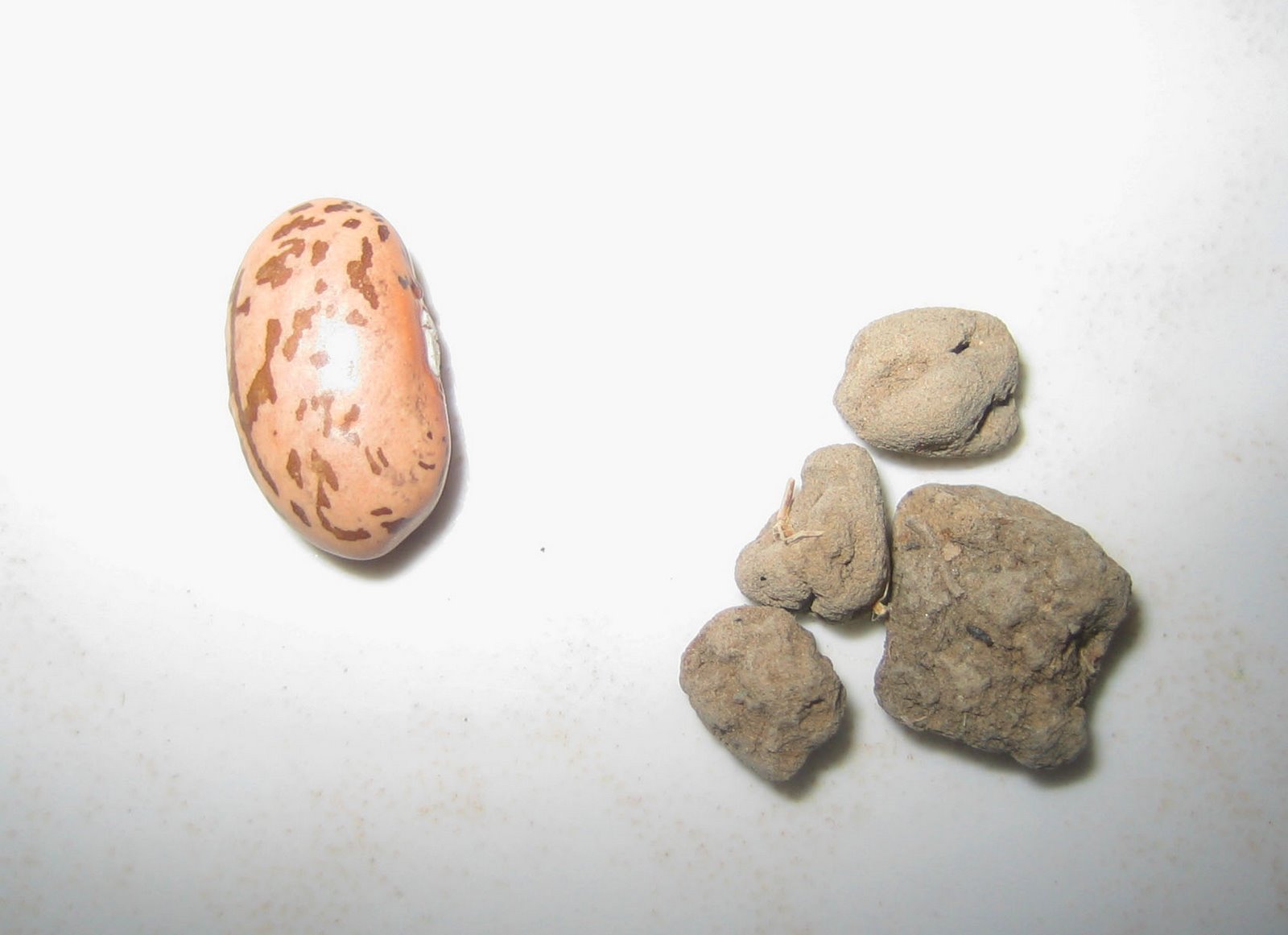
Yesterday I mentioned that if you are going to use dried beans for cooking you should pick them over for pebbles before using them. Today I want to show you that I’m not kidding.

For my apartment’s last Soup Night I decided to make a recipe I found in the New York Times. The recipe was for Andean Bean Stew With Winter Squash and Quinoa, and it called for a pound of dried pinto beans. Since I was cooking for 20 people I doubled the recipe and bought a full 2 lbs of dried beans.

That’s a lot of beans, folks.

Because of the huge volume I had to be extra careful when looking for pebbles. To pick through beans I like to lay them out on a large cookie sheet, as shown. You can sort through a smaller amount of beans on a solid-colored plate or even in a clear bag on the counter.

As you can see from the top picture, 2 lbs of beans from the bulk bin at Whole Foods yielded 4 not-so-small pebbles.

Finding these little guys didn’t take more than a minute or two, and I guarantee you my guests appreciated the extra effort.

Let this be your warning. I do not wish to send you into shark-filled waters if you happened to be inclined to go buy dried beans this weekend. The last thing I need is a bunch of angry emails from your dentists!

Lentils are known to harbor pebbles as well, so searching for small rocks is a good habit to cultivate with all dried legumes.

The Soup
On the food front, the recipe turned out absolutely amazing! Since doubling the recipe required two whole winter squash anyway, I chose one large butternut squash and one kabocha squash. Both were delicious, but I was particularly fond of the kabocha (just look at that color!). It was denser, but the texture was creamier and the flavor more sweet and nutty than the butternut.

Peeling the kabocha was no easy task, however. I always just use a vegetable peeler for butternut, but on the kabocha the skin was so tough this was not an option. Instead I boiled it whole for 3 minutes on each side (it floats) and took the skin off with a pairing knife. Alright, I admit I had a boy do the peeling.

Does anyone have an easier way to peel a kabocha?

The Andean stew was very hearty, but our guests were not shy about finishing every last drop. I highly recommend it, particularly for a cold winter weekend.

This picture was taken after the quinoa was added but before it finished cooking.

Don’t forget to bean careful!

UPDATE: I have since learned that a kabocha does not need peeling. If it is cooked through the skin is soft and edible. My new favorite trick is to cut one in half, scoop out the seeds and roast it face down for 40 minutes. Mmmm.

Tags: , , , , , , , , , ,

How To Cook Dried Beans Using A Pressure Cooker

by | Dec 2, 2008
Squash, Peppers and Beans

Squash, Peppers and Beans Recipe

I am not a vegetarian, but for convenience, financial and health reasons I do not cook a lot of meat. Consequently my dietary protein comes from many different sources, not the least of which is beans.

I realize that many of you have preconceived notions of beans and what goes along with eating them, but I am going to ask you to keep your mind open until I finish my explanation. If you read all the way to the bottom, you are more than welcome to unleash your fury in my comments section.

Let me begin by stating that I am not talking about canned kidney beans. I do not eat beans from a can unless I am desperately short on time. Not that there is anything wrong with canned beans: they are quick, healthy and relatively inexpensive. However, I have found canned beans to be very one dimensional in flavor and even less appealing in texture. They are also more prone to cause the digestive problems many people associate with “the musical fruit.”

Dried Beans

A little over a year ago my apartment acquired a pressure cooker that opened my eyes to the potential of dried beans. Dried beans, which are even less expensive than canned beans, can take hours to cook under normal circumstances. But a pressure cooker can cut this time to under half an hour and allows you to prepare large batches that can be stored frozen for months.

In my estimation, however, the best reasons to cook your own beans are taste, texture and variety. Home cooked beans taste worlds better than canned. First off, they do not have the characteristic slimy ooze of canned beans. (Definitely rinse your beans if you do buy canned). Dried beans also have a richer, more complex flavor without the metallic tinge you get with S&W. (Hint: Your beans will taste even more delicious when cooked in bouillon or broth.)

The mouthfeel of home cooked beans is also superior to canned. Different varietals have unique tastes and textures, so with each bean you try you embark on a new adventure. Some are silky and delicate, others rich and creamy. Larger beans tend to be heartier than smaller beans, but there is really no telling how they will taste until after you cook them.

While there are only five or six kinds of canned beans commonly available, the number of dried beans is innumerable. Rancho Gordo is an heirloom bean vendor I visit regularly at the San Francisco Ferry Plaza Farmers Market that has a fantastic variety of dried beans. Ever had a Black Calypso bean? Me neither, but I cannot wait to try them! Visit the Rancho Gordo website if you want to order online.

There are also fantastic bean selections at most health food stores, including Whole Foods. Check the bulk bins for the best deals.

Soaking Beans

One caveat of cooking your own beans is that they require a significant amount of soaking time. I recommended that you rinse them well and soak them overnight. All this requires is 5 minutes of planning the day before, and if you prepare large batches you do not have to soak beans very often. Be sure to pick over your beans for pebbles before cooking them.

Another bonus of rinsing and soaking beans is that it eliminates many of the sugars that your body cannot digest, thereby reducing (in my experience eliminating) unpleasant bodily byproducts. Toss out your soaking water when you are finished and add fresh water or broth for cooking.

Pressure Cooker Precautions

Pressure cookers can be dangerous if used improperly, so it is imperative that you follow the instructions carefully. In general, it is important to get a tight seal on the lid and be sure the pot is not over-filled (total volume should be less than half the volume of the pot). However, it is necessary to add sufficient liquid to the beans to prevent burning and dehydration. You also want to avoid adding salt until after your beans have cooked.

Follow the instructions on your pressure cooker to determine the appropriate amount of cooking time, usually 10-20 minutes. The contents of the pot are under a tremendous amount of pressure while cooking, so be sure to allow the pot to depressurize completely before attempting to remove the lid. This takes an additional 10-15 minutes.

Here is the pressure cooker I use.

I imagine that a slow cooker would be equally advantageous in cooking beans, but I have never tried it.

What are your favorite tricks to make beans more user friendly?

Tags: , , , , , , , , , , , , , , ,