Sign up

You deserve to feel great, look great & LOVE your body

Enter your email for your FREE starter kit to get healthy & lose weight without dieting:

  • This field is for validation purposes and should be left unchanged.

For The Love Of Food

by | Oct 12, 2012

For The Love of Food

Welcome to Friday’s For The Love of Food, Summer Tomato’s weekly link roundup.

Why food companies shouldn’t be regulating themselves for safety, GMO foods should be labeled, and too much exercise is a bad idea.

Want to see all my favorite links? Be sure to follow me on on Delicious. I also share links on Twitter @summertomato,  Google+ and the Summer Tomato Facebook page. I’m very active on all these sites and would love to connect with you. (And yes, I took that pepper heart pic myself).

Links of the week

What inspired you this week?

Tags: , , , , , , , , , , , , , , , ,

10 Simple Substitutions to Make Restaurant Meals Healthier

by | Aug 1, 2012
Photo by basheertome

Photo by basheertome

I pity the fool who puts health over pleasure every time they enter a restaurant, but if you eat out often all those French fries could get the better of you.

When nothing on the menu perfectly fits my preferences (particularly at low to mid-range places more tailored to the Standard American Diet crowd), I don’t hesitate to swap out whatever I don’t want with something better.

Whether it’s to avoid processed foods or simply add vibrance and color to my plate, here are 10 simple swaps to make the most of your restaurant meals.

10 Simple Substitutions to Make Restaurant Meals Healthier

1. Mixed greens instead of ice burg or romaine lettuce

I enjoy cobb salads, but for some reason they’re usually served with boring industrial lettuce. Most places these days carry mixed greens or spinach as well, and are usually happy to make the switch.

2. Fruit instead of toast

I’m not sure why breakfast spots think you need two giant pieces of toast on top of your potatoes, eggs and pancakes, but if you don’t want it they’ll often offer you fruit instead. This is one of the best upgrades you can get away with.

3. Salad instead of potatoes

Speaking of potatoes, while they are real food and have their place in a healthy diet, they’re so often fried in rancid industrial oils that it’s best to skip them. Swapping them out for salad or cooked greens is rarely a problem.

4. Avocado instead of mayo

Real mayonnaise, the kind made from egg yolks and olive oil is perfectly healthy (and delicious). Unfortunately that isn’t what most places are putting on your sandwich. Instead commercial mayos are typically made with soybean or canola oils, AKA hyper-processed industrial oils. It may cost a little extra, but avocado is a fantastic alternative to gooey up your lunch.

5. Cheese plate instead of dessert

One of the things I love about France is that it’s perfectly acceptable to have cheese after dinner instead of sugar. If everyone is ordering crème brûlée and you don’t want to be a party pooper, get the cheese plate instead. Good cheese is healthy.

6. Brown rice instead of white

I don’t mind white rice in small quantities, but if I’m stuck eating somewhere I know the food isn’t very healthy I swap out my white rice for brown (and order as many vegetables as possible) if the option is available.

7. Drink wine instead of cocktails

Dinner often starts with a drink selection. While wine certainly has calories, cocktails usually have hundreds more thanks to the liqueurs and syrups typically used. Mixed drinks have their place, but if you’ll also be eating  a few hundred calories then wine is a better choice.

8. Beans instead of rice

If I see beans or lentils anywhere on the menu I’ll often ask if the kitchen can use them instead of one of the faster digesting starches on my plate. Your waiter may be confused, but he’ll usually do it if you ask.

9. Olive oil and vinegar instead of sugary dressing

At some point in the past 20 years salad dressings started being made with ridiculous amounts of sugar and salt, probably to cover up the completely flavorless vegetables from the industrial food chain. Good ol’ fashioned olive oil and vinegar is a better choice, and most kitchens have them.

10. Anything instead of American cheese

Have you ever looked at the ingredients for American cheese? Besides water, the first ingredient is usually trans fat. The second is cornstarch. All the way at the bottom it says, “Contains: Milk.” Replacing it with real cheddar, gruyere, provolone, or even nothing would be healthier.

What are your favorite restaurant substitution tricks?

Tags: , , , , , , , , , , , , , , , , ,

10 Ways To Make Your Salad More Satisfying

by | Jul 18, 2012
Quinoa Salad

Quinoa Salad

One of my favorite things about the arrival of summer is all the beautiful, crisp salad greens at the farmers market. I absolutely love to eat salads, but how can you turn a salad into a full meal that is truly satisfying?

The trick is to make sure you add enough protein, fat and carbohydrates to your salad so it is still a perfectly balanced meal.

There are dozens of healthy additions you can use to make your salad more filling and delicious. Here are 10 of my favorites.

10 Ways To Make Your Salad More Satisfying

  • Warm ingredients Grilled or sauteed onions, peppers, mushrooms and meats wilt salad greens and make them slightly warm, adding depth and character to an otherwise boring salad.
  • Brown rice Adding 1/2 cup of warm rice to a salad makes it more satisfying to eat and keeps you full for longer. Use single serving rice balls and this simple addition will add less than 2 minutes to your salad prep time.
  • Nuts Walnuts and sliced almonds are my favorite, but feel free to try pecans, cashews, peanuts, pumpkin seeds or anything else that sounds interesting.
  • Beans Chickpeas, black beans, edamame and other legumes are inexpensive and delicious sources of protein and fiber to add some substance to a salad.
  • Avocado Half an avocado is sometimes exactly what a salad needs to take it to the next level.
  • Smoked salmon For a slightly more upscale salad experience top your greens with a few slices of smoked salmon.
  • Quinoa Mix in a small amount of quinoa as an accent or make it the base of a salad by adding cooked or raw veggies and greens. See my Mexican-style quinoa salad recipe.
  • Grilled meats Your salad is a great place for summertime BBQ leftovers.
  • Egg Boiled, fried or poached, an egg is a wonderful way to make your salad more substantial. See my Summer salad with poached egg recipe.
  • Sardines Canned fish is one of the easiest ways to get extra protein and omega-3 oils in your salad. Here are 6 reasons to eat more sardines.

How do you make your salads more hearty?

This article was originally published June 8, 2009.

Tags: , , , , , , , , , , , , , , ,

Is It Healthier To Eat Like A Caveman?

by | Mar 7, 2012

Photo by Lord Jim

“What do you think of the Paleo diet which advocates zero grain consumption?”

The Paleolithic diet is one of the most rapidly growing diet trends of the past several years. Followers of the Paleo diet argue that humans have not evolved to eat agriculture-based foods and can only achieve optimal health by consuming a hunter-gatherer style diet. Thus the Paleo diet is completely devoid of grains and legumes, and also shuns dairy, salt, refined sugar and processed oils. The diet is composed primarily of meats, fish, vegetables, fruits, roots, nuts and seeds.

(The Wikipedia article on the Paleo diet is actually pretty good if you’d like to read up on the details. I particularly like the Opposing views section.)

Like most diets the Paleo diet has a little bit of good science behind it, but also a lot of logical leaps and baseless assumptions. The evolutionary argument that humans are somehow maladapted to agriculture-based diets is particularly unconvincing (resting on many unproven assumptions), yet is the fundamental premise on which the Paleo diet bases its recommendations.

The reasoning behind the Paleo diet is less interesting to me, however, than the impact of the diet itself. Will “eating like a caveman” really help you be healthier?

Possibly, but not necessarily.

The most obvious advantage of the Paleo diet is the lack of processed foods. There is ample evidence that societies on traditional diets boast far better health than those on modern, Western diets–and the hallmark of modern diets is food processing. Paleo diets therefore are low in sugar, refined carbohydrates, trans fats, excess salt and pretty much everything else that leads to “diseases of civilization.”

Paleo diets are also abundant in healthy, nutrient-rich foods such as vegetables, fruits, nuts, fish and meats. I have no doubt that anyone willing to stick to a Paleo eating plan will have a healthy weight and remain virtually free of heart disease, diabetes, hypertension and may even have lower rates of cancer.

But the question still remains, is it necessary to eat Paleo to be healthy?

This is where I take issue with the Paleo philosophy. While a diet completely free of processed foods is undeniably healthy, the Paleo diet goes beyond this and demands considerable sacrifice.

Paleo diets do not allow for any grains or legumes. This pretty much eliminates every traditional cuisine on earth including Japanese, Italian, Indian and Greek. Not only is this a culinary tragedy, it ignores the fact that these cuisines feed some of the world’s healthiest and longest-lived individuals.

Traditional, global diets that exclude highly processed foods but also include grains and legumes have been some of the most successful for health. Diseases of civilization are only problematic in Western cultures where processed foods make up a large proportion of the calories and few whole food are consumed.

Proponents of the Paleo diet argue that it is necessary to eliminate grains and legumes because they contain “antinutrients,” substances that can interfere with the body’s absorption of other important vitamins, minerals and proteins. However, well-nourished individuals who eat a varied diet of unprocessed foods (including grains and legumes) are not nutrient deficient and are generally healthy.

Given that it is possible to thrive on a diet that includes some grains, legumes and even small amounts of processed foods, one must question if giving up the culinary joys of travel and global cuisine are really worth the sacrifice.

In my experience, food substitutions and modified recipes designed to mimic traditional meals can sometimes be tasty but can never replace true authenticity.

Another contention I have with the Paleo diet is the assumption that the same eating patterns will work for everyone. People’s lives differ in countless ways. We each have different levels of daily activity, demands on our time and food preferences. We also have different genetic backgrounds, which can result in significant differences in metabolism and hormone levels. These individual variations make dietary needs different for each of us.

Because of our individual differences, there is undoubtedly a percentage of the population that thrives on the Paleo diet and finds it easy to stick to and achieve results. Hooray! However there may also be a segment of the population (myself included) that finds living without grains and legumes to be chronically unsatisfying and unsustainable.

Try telling a foodie they can never eat cheese or drink wine again and see how far you get pitching a Paleo diet.

If you currently eat a typical Western diet with little variety and many processed foods, tend to have better success following rigid diet plans, and have no qualms about giving up or modifying traditional meals to meet your dietary demands, then you might have luck following the Paleo diet. However there is no reason to believe it is the only path to good health.

The best diet is the one that works for you. Finding a healthstyle you can embrace and enjoy is essential if you want to build a lifetime of healthy habits.

Do you follow a Paleo diet? What do you think?

Originally published February 22, 2010.

Tags: , , , , , , , , , , , , , , ,

5-Minute Lunch: The Tastiest, Easiest, Healthiest Bean Salad on the Planet

by | Feb 22, 2012
Heirloom Bean Salad

Heirloom Bean Salad

This is a recipe that I rely on often, particularly when I’m short on time but don’t want to eat something unhealthy. As I’ve mentioned like a zillion times during my show, I think beans are one of the absolute best go-to foods when you want something tasty and satisfying.

Don’t worry, this is not one of those nasty 3 bean salads your well-meaning aunt brings to barbecues. When you start with good quality, dry beans they bring an amazingly creamy texture to a dish and are absolutely delicious. And if you prepare them properly by soaking them for a few hours beforehand, you also won’t get any of the digestive issues most of us associate with canned beans.

On that note, the title isn’t quite accurate. It assumes that, like me, you’ve spent a bit of time early in the week making a big batch of beans to add to the meals you make through Friday. That said, preparing the beans only takes 2-3 extra minutes of prep time, but there are a couple hours of waiting between the essential steps. If you use a pressure cooker it is even faster.

In a pinch, feel free to substitute lentils, which can be used similarly but cook up in only 20-30 minutes, depending on the size.

Today I made this recipe using only ingredients I already had in my fridge. I did this intentionally to show you how easy and versatile it is. But feel free to substitute any of the vegetables with ones you have or like better. It doesn’t matter which beans you use either, a simple black bean is also very lovely if you can’t find fancy heirloom beans.

This dish turns out different every time I make it, depending on what I have in the house, my mood and, of course, the season. In the summer, for example, I tend to use cucumber, French radish and a handful of arugula. Also feel free to experiment with different oils, vinegars, citrus, herbs, salts and spices (smoked paprika is a great addition).

I use this dish most often for a light lunch or substantial snack. It can be served warm or cold, or can be made into a full meal by adding a fried egg on top (or other protein) with a side of greens. This recipe is for a single serving, but it scales easily.

Heirloom Bean Salad With Winter Vegetables

Serves 1

Ingredients:

  • 3/4 cup cooked Rancho Gordo Pinquito beans
  • 2 small carrots or 1 medium carrot, thinly sliced
  • 1/4 cup sliced lo bok or daikon
  • 1/2 green onion, finely chopped
  • 2 tbsp freshly diced parsley
  • 1 tbsp olive oil or nut oil
  • 2 tsp rice or red wine vinegar
  • salt
  • pepper

If your beans aren’t already cooked, soak them overnight or at least 6 hours. Discard the soaking liquid, rinse several times then cook in beef, mushroom or vegetable stock until tender.

Place appropriate amount of beans in a bowl and add sliced vegetables, green onion and parsley. I tend to go heavy handed on the herbs because they add such a wonderful freshness, but feel free to experiment with the amount you like.

You’re welcome to mix the vinaigrette beforehand, but if you’re lazy like me feel free to just add oil and vinegar directly to the bowl, along with some salt and pepper and any other spices you choose.

Gently stir with a spoon, taking care not to damage the beans. Adjust salt and pepper and enjoy.

Tags: , , , , , , , , , ,

Are Grains Necessary? – Office Hours – Summer Tomato Live

by | Aug 30, 2011

Why “healthy” can backfire, are grains really necessary and some weight loss troubleshooting tips.

August 30, 2011 | Join us today at noon PST as we discuss the latest food news stories and I answer your burning food and health questions.

To watch live and join the discussion click the red “Join event” button, login with Twitter or your Vokle account. There is no password for this event.

I encourage you to call in with video questions, particularly if your question is nuanced and may involve a back and forth discussion. Please use headphones to call in however, or the feedback from the show is unbearable.

To keep up with live events, get access to exclusive content and have Darya personally answer your food and health questions, sign up for the Tomato Slice newsletter.

Tags: , , , , , ,

Farmers Market Update: Summer Tomatoes!

by | Aug 14, 2011
Gigantic Tomato

Gigantic Tomato

This is by far my favorite time of year to go to the farmers market, it’s truly amazing. (If you’re interested in joining me next week, there are still a few slots left in my two market tours, 8am and 10am).

More than any other time of year the market is overflowing with life and bounty. The fruits are sweet, juicy and abundant, making it hard to decide which delicate morsels to cradle into my bag and try to get home undamaged.

O'Henry Peaches

O'Henry Peaches

Sea of Strawberries

Sea of Strawberries

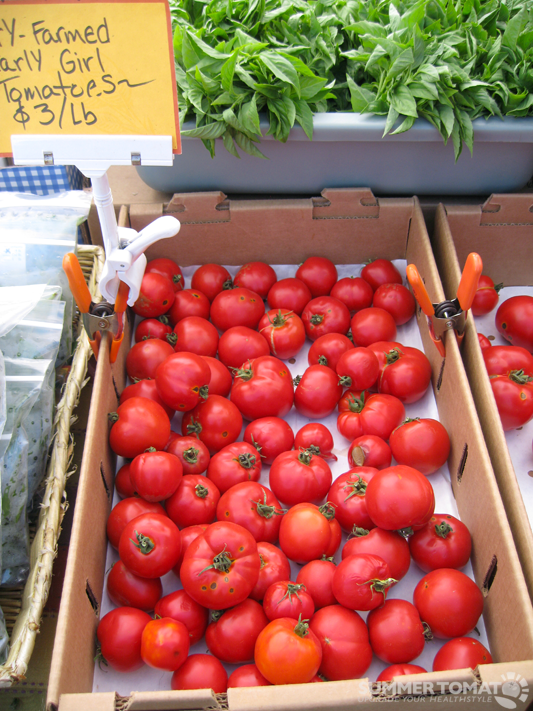
We’re finally entering late summer, which means all the best summer tomatoes are finally here. The dry farmed early girls are my favorite, because they’re easiest to get home and amazingly sweet and rich in flavor.

Early Girl Tomatoes

Early Girl Tomatoes

But today I was also blown away by these giant heirloom tomatoes. They were as big as pumpkins!

Heirloom Tomatoes

Heirloom Tomatoes

While we’ve had sweet peppers for several weeks now, the spicy chilies are just starting to appear. I got some jalepenos, but I’m excited to see Thai chilies are available as well.

Thai Chilies

Thai Chilies

Eggplants, my gateway vegetable, are also a late summer delicacy. As a former eggplant hater, I find that the long thin plants are easier to work with and often taste better than their rounder cousins. The light purple color of these were particularly striking this week.

Eggplant

Eggplant

Late summer is also the time for corn, which not coincidently pairs exceptionally well with all the above vegetables. I love it raw off the cob or pan cooked quickly with summer squash and peppers. But I’m going to experiment with some new techniques using the ones I bought today.

Corn

Corn

Summer Squash

Summer Squash

Of course cooking is more fun with the abundance of summer herbs. This time of year I always have cilantro, dill and basil on hand.

Fresh Dill and Cilantro

Fresh Dill and Cilantro

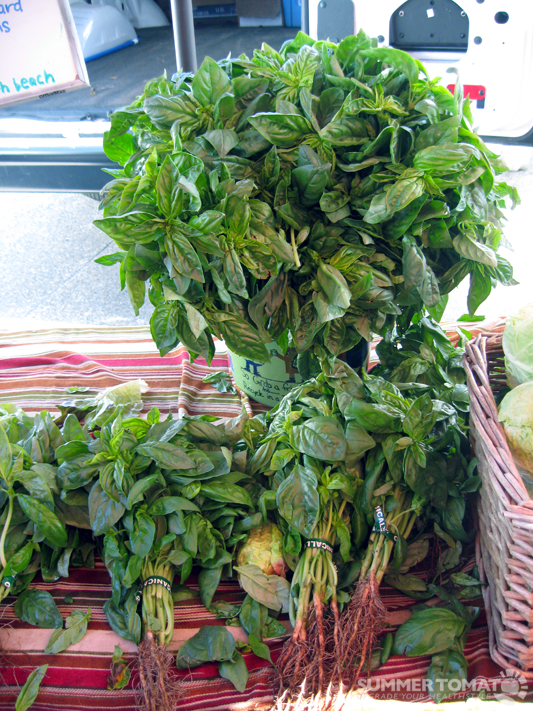
If you love basil, look around your farmers market for vendors that sell it with the roots attached. You can bring it home and put it into a vase with water. I’m still using one I bought several weeks ago with one of my market classes. Just be sure to change the water 1-2x per week, and that the plant has access to light. I tried keeping some in my kitchen but it always wilted in one day if I didn’t move it near a window.

Rooted Basil

Rooted Basil

This is also my favorite time of year for salads. I make a big one most days for lunch, and the huge variety of greens like spinach and radicchio help mix it up and allow me to make something that tastes different every day. I love how the bloomsdale spinach is so deeply colored that it almost looks blue.

Radicchio

Radicchio

Bloomsdale Spinach

Bloomsdale Spinach

Fresh legumes including peas, green beans and shelling beans are staples in my kitchen this time of year as well.

Cranberry Shelling Beans

Cranberry Shelling Beans

Though I don’t talk about it much, melons (particularly the heirloom varieties I often find at the market) are a completely different experience when I get them directly from farmers. The rich complexity of the smell alone is intoxicating, and the flavor is nothing like the typical honeydew, cantaloupe and watermelon I’ve had from the grocery store.

Watermelon

Watermelon

Lastly, the grapes are finally here. They’re particularly sweet and crisp this year, which is how I love them.

Red Flame Grapes

Red Flame Grapes

Today’s purchases (~$55):

What did you find this week at the farmers market?

Tags: , , , , , , , , , , , , , , ,

Summer Tomato Live – Episode #2 – Darya’s Healthstyle

by | Mar 10, 2011

Thanks to all of you who participated in the latest episode of Summer Tomato Live, your questions were great and I had a blast.

The recording of the show is above, and you’ll notice quickly that I had to re-record the audio since I had some trouble during the recording. Sorry about that, I’ll get this technical stuff right eventually.

The next live show is scheduled for Wednesday, March 16, at 6:30pm PST, and the topic is Habit forming and habit breaking. The following episode will be about healthy vegetarian and vegan diets, which I’ll try to make interesting for omnivores as well.

The episode will also be available soon on iTunes.

Today’s show notes:

Sponsors:

My go-to recipes:

My tricks for cooking without pasta:

Time saving tricks:

Exercise tips & alternatives:

How to:

Recommended healthstyle gear:

Let me know if there are any other links you’d like me to include.

Tags: , , , , , , , , , , , , , , , , ,

Summer Tomato Live – Episode #1 – The Four Hour Body [video]

by | Feb 16, 2011

Last night was the first episode of Summer Tomato Live where we discussed the new best-selling book, The Four Hour Body by Tim Ferriss. Thanks everyone for watching and submitting your questions, the show was a huge success and we had a great conversation.

[note to self: get haircut]

The entire show is available above. Normally the videos will be available a week after the live broadcast, but for this first episode I want to give everyone a chance to see what the show is about in case you’re interested in subscribing.

I’ve partnered with Foodzie and Zürsun Heirloom Beans to provide free samples of Zürsun cranberry beans (great for Slow Carb Dieters) as well as a free Foodzie Tasting Box ($20 value) to the first 150 subscribers. Spaces are filling up quickly, so sign up soon if you want the bonuses (for more info about the show and newsletter read this). US shipments only.

Subscribe to Summer Tomato Live ($3.99/mo)

The next live show is scheduled for Wednesday, March 2, at 6:30pm PST. The reason I’m choosing a different day of the week is so that Tuesday night karate class or any other regularly scheduled activity won’t be a barrier to subscribing. If this system doesn’t work for you, please let me know. If a fixed day is better for most people, we can try to make that happen.

Wondering what the next show is about? Me too! Please vote for the next Summer Tomato Live topic (if you’re reading this in an email, please click over to the blog post to vote in the poll):

[poll id=”8″]

Poll closes Friday at midnight PST.

Show notes from episode #1:

The book: The Four Hour Body by Tim Ferriss, a #1 New York Times best-seller.

Slow Carb Diet: How to Lose 20 lbs. of Fat in 30 Days… Without Doing Any Exercise (note: In the book there is one extra rule than is listed in this original post, “Don’t eat fruit.”)

Recommended pressure cooker: Fagor Splendid 6-Quart Pressure Cooker

Useful links:

Please add any tips or suggestions you have about the show in the comments. Thanks!

Tags: , , , , , , , , , , , , , , ,

How To Eat Healthy When You Have No Time

by | Dec 7, 2009
Photo by liquene

Photo by liquene

I’m always pretty busy, but these past couple weeks I have been especially slammed with work. I have a big thesis committee meeting coming up in lab that I want to be very well-prepared for. I also launched a 25-page free healthy eating guide last week, all amidst my 30th birthday and Thanksgiving in different cities.

I’ve had a lot of people ask me how I do it all (I stay focused and work hard), but some of you have asked an even more interesting question:

How do I have time to eat healthy?

The most truthful answer is that I always have time to eat healthy, because it is not something I consider optional. Healthy eating doesn’t really take any more time than unhealthy eating, it just requires a little more foresight. Luckily I have automated my healthstyle so that healthy eating is actually easier for me than eating junk.

However, when time is especially strained I do make a few adjustments to save on prep time and clean up.

Here are a few tricks I’ve been using to have healthy meals in under 15 minutes.

8 Quick Healthy Eating Tips

  1. Focus on single vegetable meals. If I were asked to make the quickest meal I could think of, I would grab a bunch of kale, a clove of garlic, some sea salt and maybe some pistachio nuts, put them in a pan and cook them for about 7 minutes. You can do this with chard, spinach, fennel, broccolini or any other green vegetable. For protein and carbohydrate I throw in some beans or lentils at the end. These aren’t the most creative meals in the world, but they are healthy, filling, quick and delicious enough to make friends jealous. I could live on these dinners for weeks at a time, and they only leave one pan to clean.
  2. Count on legumes. As mentioned above, it is important to have something other than vegetables in your meals or you will get really hungry. Nuts are a great addition to anything, but the most bang for your buck is beans and lentils. I make huge batches of these once or twice a week and throw them in virtually everything I cook. A pressure cooker makes legume preparation a piece of cake. If I’m really in a hurry I will just dress some legumes with vinaigrette, maybe throw in some herbs or fruit and call it lunch.
  3. Eat salads. I also add beans and lentils to salads to make them more substantial. It takes less than 5 minutes to slice up some Napa cabbage, toss in some beans, cut up a pear and sprinkle on walnuts with olive oil and balsamic vinegar for a quick lunch. Salads don’t require cooking and I just eat it out of the bowl I make it in.
  4. Scramble eggs. By far the fastest cooking protein you can get is eggs. Scrambling 2-3 eggs takes about 2 minutes. Saute some spinach with a little garlic (you can use the same pan if you cook the greens first) and you have a healthy homemade meal in under 10 minutes. This works for breakfast, lunch or dinner.
  5. Eat breakfast for dinner. Eggs aren’t the only food that can break the typical American meal pattern. If cooking at night really isn’t an option, sometimes I will just double up on my normal breakfast of muesli, fruit and plain yogurt and have it for dinner. Sure I’d rather eat leafy greens, but intact grains are sure better (and faster) than the burrito place down the street.
  6. Cook in large batches. In addition to legumes I also make intact whole grains in big batches and freeze them in single servings. These can be thawed in the  microwave in 1-2 minutes and added to any meal (stirfry, salads, soups, etc.) to make them more satisfying. During the autumn and winter I also rely on roasted winter squash like kabocha for additional vegetables/carbohydrates. My favorite is to cut a kabocha squash in half, remove seeds, rub the inside with olive and sea salt and roast, face down for 30-45 minutes at 400F. Three or 4 slices of winter squash make a plate of greens a lot more interesting. Store your cooked squash in a tupper and add it to various meals throughout the week. I like kabocha, red kuri and delicata squashes because, unlike butternut, you can eat the skin (no peeling).
  7. Have a reliable takeout option. The only trouble I sometimes run into is not having enough ingredients in the house to make a solid meal before heading out. For times like this I rely on a local artisan market, Bi-Rite, that has awesome healthy prepared foods. I’ll pick up a pint of lentil, chickpea or quinoa salad from their deli fridge and a piece of fruit, then I’m good to go. It is worth it to hunt down a place like this near your home or work that you know you can count on to pick something up in a pinch. Whole Foods has great prepared food options if you can find one near you.
  8. Carry fruit and nuts. The worst case scenario is that you get stuck outside the house with nothing but vending machines within walking distance. If you always have trail mix or nuts in your bag you can usually put off a meal until you can find something healthy. Don’t leave home without it.

What tricks do you use to eat healthy when you have no time?

Tags: , , , , , , , , , , , , , , ,