Can You Live Longer By Cutting Calories?

by | Mar 30, 2011

Photo by Werwin15

Photo by Werwin15

The science of aging is among the most dynamic and provocative in modern biology. Over the past two decades we have seen a virtual explosion in research investigating the molecular and behavioral systems that control the aging process. But the more researchers uncover about the science of aging, the more questions emerge.

Dietary restriction has long been considered the most potent regulator of aging. Restricting food intake by any means induces a series of metabolic changes in organisms from yeast to primates that serve to extend life. Studies are currently underway to investigate the ability of dietary restriction to extend life in humans.

Several biological changes are known to occur upon the onset of dietary restriction including a decline in reproductive ability, increased stress resistance and a slowdown of some metabolic processes.

Insulin signaling was among the first molecular pathways to be identified in the regulation of aging, and offered a direct tie between diet and the aging process.  In 1998 UCSF scientist Cynthia Kenyon showed that removing an insulin receptor gene (daf-2) in worms could double their lifespan. Her lab later showed that removing another insulin signaling gene (daf-16) could extend life even longer. I spoke to Kenyon about the relationship between diet and aging for this article.

Blocking insulin signaling in these worms did not just prevent the worms from dying and allow them to age longer. Instead the aging process actually slows so that older worms continue to behave like young worms. Also, as these experiments were repeated in different animals, it was shown that lowering insulin signaling also helps protect animals from stress and diseases such as cancer and heart disease.

Insulin is released as a direct response to glucose in the blood. This means that any time you eat a meal with carbohydrates, you are increasing your insulin signaling and likely accelerating aging. But this does not mean that you will live forever if you stop eating carbohydrates.

Interestingly, protein metabolism also contributes to accelerated aging, but through a different mechanism. Even more intriguing is that restricting protein increases lifespan to a greater extent than restricting sugar.

So is it simply calories that promote aging?

Probably not. For one thing, the effect of a calorie from protein is greater than a calorie from carbohydrate, making it unlikely that a calorie is the basic unit of impact. Second, there is evidence that calories are not required to accelerate aging.

Recent studies have shown that the mere act of smelling food can reduce lifespan. The mechanism for this effect is still unknown, but seems to be tied to respiration.

According to Kenyon it is clear that “sensory perception influences lifespan,” at least in worms and flies.

Thus it is likely that aging is controlled by the interaction of several pathways, including metabolism, respiration and stress. Importantly, however, lifespan seems to be dependent on a handful of specific pathways rather than global changes in cellular function or breakdown. The idea that aging is an inevitable function of time must be put aside given the evidence that it is controlled at a genetic and environmental level.

This makes sense when you think about it. Different organisms exhibit vastly different lifespans and rates of aging that are too great to be explained by some kind of universal cellular breakdown. A more parsimonious hypothesis is that organisms differ in specific genetic factors that, combined with environmental influences, regulate lifespan.

So how should we mortal humans react to these findings?

The genes linking diet and aging are highly conserved through evolution, indicating that there is a great chance human aging is sensitive to diet. Indeed, insulin-related genes have been found to be important in long-lived human populations. This suggests that the pathways discovered in worms and other organisms have similar functions in humans.

What is not clear is how much influence diet has on lifespan and to what extent we are able to manipulate it. It is already known that abnormal insulin activity in humans is linked to higher disease rates, especially “diseases of civilization” such as heart disease, hypertension, type 2 diabetes and cancer. And these diseases are clearly associated with diets rich in processed foods, especially refined carbohydrates.

The effect of protein consumption on lifespan in humans has yet to be investigated. Envisioning an experiment that would test the influence of smelling food on human aging is difficult to even imagine.

Although direct evidence is not available, there is good reason to suspect that a diet with low glycemic load may extend human lifespan. In November 2009, Kenyon’s lab reported that adding glucose to a worm’s normal diet shortens lifespan, but has no effect on the long-lived worms that lack insulin signaling genes daf-2 and daf-16. This discovery prompted Kenyon herself to adopt a low-carbohydrate diet.

Despite this there is still not sufficient evidence to recommend a calorie restricted diet for humans to extend life, largely because optimal nutrition levels for a given individual are unknown. However, most people would benefit vastly by eliminating processed foods and refined carbohydrates from their diets as much as possible.

Focusing on fresh, whole foods, enjoying an occasional glass of wine, avoiding smoking and getting regular exercise can add 14 years to the life of an average person. Maintain a healthy weight as well and your outlook gets even better.

Would you change your diet to be healthier and live longer?

Originally published February 3, 2010.

Tags: , , , , , , , , , , , , , , , , ,

How To Lose Weight, Meditate Like a Monk and Hone Your Super Powers: The Magic of Lucid Dreaming

by | Mar 28, 2011
lucid dreaming

Photo by eschipul

Over the past year I’ve become interested in mindfulness as a weight loss tool. In my experience, mindless eating is one of the biggest problems with food culture in the US.

When you eat as a reaction to environmental cues (rather than internal cues) you’re more likely to stick your hand into the chip bowl, eat so fast your blood sugar spikes like a rocket and gorge yourself on enough food to feed a small village.

Mindful eating can help you slow down, make better choices and stop eating when you’re no longer hungry. But practicing mindfulness isn’t as easy as it sounds.

Recently I asked friend and renowned life hacker Tim Ferriss if he had any thoughts or advice on meditation (my attempts have been frustrating at best). To my surprise his reply was, “if you want to develop mindfulness I recommend experimenting with lucid dreaming.”

Seriously?

I was intrigued, so when George Gecewicz asked me if I was interested in a guest post about lucid dreaming and mindfulness, I was eager to accept.

George is a young guy in New York’s Capital Region who likes to design websites and has been lucid dreaming for about a year. To see more about George’s projects visit heyitsgeorge.com

For more about lucid dreaming from Tim Ferriss, check out Lucid Dreaming: A Beginner’s Guide.

How To Lose Weight, Mediate Like a Monk and Hone Your Super Powers: The Magic of Lucid Dreaming

by George Gecewicz

If you’re in the middle of a dream and suddenly realize you’re dreaming, you have become lucid. While always fun, exciting, trippy, weird, sexy, and/or scary, there’s more to be gained from learning to lucid dream than just the exhilaration of flying around and doing whatever you want.

Lucid dreaming is a form of mindfulness, and the awareness you gain from practicing it can be applied to improve your daily life. For example, eating mindfully can be one of the most effective ways to make better food choices and control portions. It can also bring a more complete sense of well-being, allowing you to get the most out of experiences and enjoy elements of your life that you may otherwise take for granted. Tibetan Buddhists even use lucid dreaming as a form of meditation to explore their inner selves.

Learning to lucid dream is not difficult and you can get started today.

How to Lucid Dream

1. Keep a dream journal

As soon as you wake up, ask yourself what you were dreaming about and write it down. Try to focus on the details. Close your eyes and move as little as possible. As things start coming back to you, write them in your journal, record them into your phone, or draw pictures. You will be going over your recorded dreams later, so use whichever method brings back the most vivid memories and images for you.

2. Keep a “reality sign” and do reality checks

Keep some type of constant text or number structure with you at all times. This can be a Post-It note with some words or number on it, a math formula on your cell phone, anything that you have to read. My personal favorite is an old, dead watch, with the hour hand and minute hand stuck in the same spot.

Check this reality sign every two hours or so, and get used to observing that the text, numbers, minute hands, etc. are in the same spot. Eventually you will learn to check your reality sign in the dream world, and details like written words and the hands of a dead watch will not be constant. For example, let’s say you have a piece of paper with the word “TOMATO” on it. If you check it, and the letters are now arranged to spell “OOMATT”, you’re in a dream.

3. Wake up, then go back to sleep

If you have to get up at 8:00am set an alarm to wake you up 2-3 hours earlier, like 5:30am. Wake up with your early alarm, stay awake for at least 10 minutes, and then go back to sleep. Go over your dream journal in this period and try to focus on the images of these dreams. Check your reality sign once or twice and doze off. The next two or so hours will be ripe for lucid dreaming, and can often increase the occurrence of lucid dreams dramatically.

Work on this and be patient. It took me more than three weeks of recording dreams, doing reality checks, and playing around with short periods of wakefulness before I finally went fully lucid. Try and remember to stay calm if you happen to realize you’re dreaming. The first two times I went lucid, I was so surprised and excited that I woke myself up.

Once you do begin to lucid dream, you can start using your dream awareness to enhance your waking awareness. Here are some basic tips to get you started.

Expand Your Mindfulness

1. Use your new imagination

It’s still largely speculative if there are legitimate health benefits of lucid dreaming, but I can say from personal experience and talking with fellow dreamers that your ability to project images in your brain, focus on details, and be intensely aware of minutiae do improve. This comes from the above steps alone, even if you never go lucid.

For example, projecting the imagery of your dreams before bed and in periods of wakefulness is useful because it teaches you how to focus on one sense. Use this same intensity when you examine tastes, sights, sounds, feelings, and other sensations in the real world to maximize mindfulness. In this way, lucid dreaming does to your ability to focus what eating well does to your health.

2. Ween off your reality signs

Reality signs are important to get your dream skills off the ground, but view them sort of like training wheels. Eventually, as you become more aware of your subconscious reality, you’ll be able to recognize the subtle differences in general between the waking world and your dream world.

Focusing on these differences and relying less on your dream signs is one of the best ways to practice mindfulness. You’ll really start to taste your food, look at the sky, focus on your physical body, and be aware of your thoughts much more intensely, and you’ll notice their awesomeness compared to the weak sensations of the dream world. You’ll know you’re getting good when you look at tree branches a few hundred yards away and use those as your reality signs, not text written on paper. It’s pretty cool.

3. Get inspiration

Look to media, new experiences, art, and other resources to get inspiration for what you do in your lucid dreams. Basically, try gathering “material” that you want to recreate in a dream.

Let’s say you’re doing something really awesome: skydiving, spending time with your significant other, eating a delicious meal, reading a really clever book, etc. Focusing intensely on what’s going on will make recalling these sensations a breeze, which creates a greater state of mindfulness. This applies to anything you might want to “relive” and allows you to get the most out of any enjoyable experience.

Lucid dreaming is incredibly powerful. It’s also free, easy, safe, educational, and really fun. Be patient, stick to it, and good luck!

I’ll be down in the comments answering any questions you might have.

Tags: , , , , , ,

Farmers Market Update: Osaka, Japan

by | Mar 27, 2011
Osaka Market Customer Line

Osaka Market Customer Line

Huge thanks again to Joan Bailey for sharing another Japanese farmers market with us, this time from Osaka. (The first was Tokyo). I absolutely love Joan’s narrative descriptions of the Japanese markets and all the unique offerings, it makes me hunger to do more traveling.

I also asked Joan for a brief update on the situation in Tokyo, where she lives. You can read more about the what is happening there at the bottom of her post.

Joan lives, farms and gardens in Tokyo. Follow her from seed to harvest to market at Popcorn Homestead and Everyday Gardens as well as Twitter.

Farmers Market Update: Odona Farmer’s Market in Osaka

by Joan Bailey

Our final fling in Osaka before returning to Tokyo was a trip to the Odona Farmer’s Market. I’d missed it on a visit to the city in early January, and since we’d self-evacuated there after the March 11th earthquake it seemed as good a time as any to do a bit of exploring. (Nothing like a farmer’s market to scare off the aftershock-radiation blues, I say.)

Japan’s third largest city, Osaka lies about 320 miles south of Tokyo. A charming city with slightly rougher edges than its sleek northern cousin (think Chicago versus New York), it offers the market-goer a veritable cornucopia of shopping locations year-round.

While not the largest in the city, the Odona Market was certainly one of the busiest I’ve seen in Osaka so far. Named for the posh department store whose front sidewalk it fills, market vendors benefit from being on a direct path to Yodoyabashi Station in a major business-shopping-touristy area. Even as we arrived shortly after the market opened a number of serious shoppers were already on the scene and one stall had already sold out of their supply of dried beans.

Seafood Stall

Seafood Stall

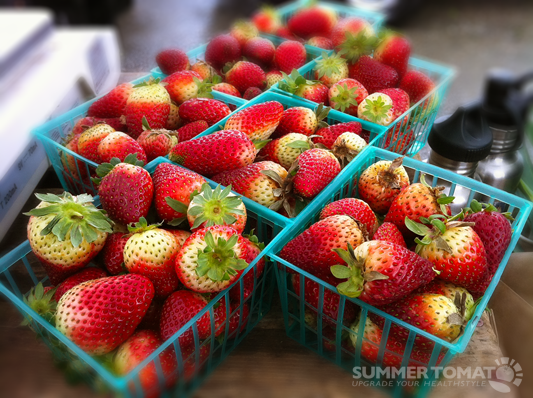
Bundled up against a brisk March wind that whipped along the high-rise lined street, shoppers and vendors alike surveyed a scene of fantastic winter bounty. Citrus, a wide assortment of winter greens and vegetables mingled with some early spring favorites like nanohana (a signature spring green) and strawberries, heaps of onions, beautiful brown eggs, white and brown rice, homemade mochi, miso, tsukemono (pickles), cakes, jam, tea, assorted mushrooms, and even bubbling styrofoam crates of fresh (a.k.a. living) seafood were on offer.

Throwing myself into the fray of bicycling housewives, cane-toting grandmothers bent at the waist, black-suited office workers, and young mothers towing uniformed school children, I started shopping.

Narakiyorisa Farmers

Narakiyorisa Farmers

Starting at the end farthest from the station, I first visited Narakiyorisa Farms from nearby Minami Awajishi. Like most vendors this afternoon, three people worked the stall. Two stood behind to answer questions and handle sales while a third stood out front welcoming customers, answering questions, and monitoring restocking needs. While their onions, broccoli, and nanohana tempted, it was the big bag of homemade mochi that had me sidling up for a closer look.

Mochi

Mochi

Mochi, made from pounded rice, can be eaten savory or sweet, grilled or plunked in a bowl of hot miso. Really, the possibilities are endless, and while the texture puts some folks off (a bit gooey and chewy) it is one of my favorite things ever. The varieties are nearly endless, as are the regional variations in flavor, shape and style, and I never pass up an opportunity to purchase it at market. In hindsight, I wish I’d also grabbed some of their dried onion soup. Made with their own onions and a selection of herbs and spices, it did sound like a perfect treat for a chilly spring evening. Instead, I snapped up a bag of their pickled daikon for our journey home. I know what I’ll buy next time!

Just down the line from Narakiyorisa I stopped at a table overflowing with vegetable goodness. Sourced from a number of area farms I was greeted by tight round heads of red cabbage, brilliant white daikon, celery stalks, and bright early strawberries; however, it was Kaizukashi Sobura’s shiitake mushrooms that stole the show. Raised on the outskirts of the city, my mouth watered at the site of those fat little fellows. Before I knew it they were in my bag as the perfect souvenir – light as well as tasty – to carry home.

Strawberries

Strawberries

Since Osaka hosts a number of markets (at least five that I know of) spread throughout the week at varying locations, it’s perhaps no surprise that I ran into two growers I met during my January roamings. Numa-san and her bottles of homemade yuzu, tomato, and orange juices were easy to spot. Last time I had purchased Shishiyuzu (a softball sized yuzu) for marmalade, and this time I gave serious thought to the large bags of yuzu seeds for sale. Showing me the sample jar of them soaking in alcohol (the rubbing, not drinking variety), she recommended the mixture as a refreshing and cleansing spray for face or hands. (A single yuzu holds a huge number of seeds, so discovering a use for all of them would take some of the tedium out of the marmalade process.) I opted instead for her homemade daifuku mochi. After tasting a sample of her komugi (mugwort) mochi with perfectly sweetened anko (sweet adzuki bean paste) centers, I was helpless.

Yuzu Seeds

Yuzu Seeds

Koroku and Nakama Farms split their time between a Saturday market on one of the river walks and the Odona Market. Located in Izumi and Nara (one of Japan’s ancient capital cities and home to some of the most spectacular architecture in the country) respectively, the real attraction of their stall are their heirloom vegetables. (Heirlooms can be hard to find in Japan, even at farmer’s markets. Like the US, most people only know one kind of tomato, soy bean, or squash, despite a long and deep tradition of regional varieties.)

Two kinds of renkon (lotus root), some of the first sansai (mountain vegetables) I’d seen this year, joined a mix of greens. Sensuji, a hardier looking version of mizuna that resembles kale a bit in texture and taste, and Yamatomanna, an older and mixed version of nanohana (rape), had me striking up a conversation in my bad Japanese in short order. Both can be quickly steamed and tossed with soy sauce and sugar like shingiku or thrown in traditional winter dishes like nabe (a dream of a boiled dinner) for a bit of green crunch in a season when it is most desired.

Remembering that we were traveling that evening, I chose instead a bag of hasaku or, as the farmer called them, Japanese grapefruit. Sour with a spark of sweetness, they nearly glowed in their newspaper lined crate at the front of the stall, and they looked like a cheerful gift to bring back to somewhat stressful Tokyo.* It would travel well, and the season for citrus will begin to come to a close shortly. It seemed only prudent to make the most of the opportunity.

Sakezuke

Sakezuke

As the sun began setting and lights flickered on at the stalls, I stopped at Yamato-Shokuhin’s stall to sample their sakezuke. Pieces of eggplant, cucumber, ginger, and daikon are set in sake lees (the dregs of the sake making process) for a period of time, which preserves and flavor them. It’s a fermentation/pickling process similar to what we do with sauerkraut or even quick refrigerator pickles. Usually served in tiny bowls amongst a myriad of other tiny bowls full of delightful and surprising flavors, sakezuke is just one part of a pickle tradition that varies from region to region, town to town. This little flavor of Osaka would come to Tokyo, but this time just for us.

What I bought:

  • Daifuku Mochi from Numa-san
  • Hasaku from Kiroku Farm
  • Regular mochi and pickled daikon from Narakiyoisa Farm
  • Shiitake mushrooms from Kaizukashi Sobura
  • Ginger and cucumber sakezuke from Yamato-Shokuhin

We’ve since returned to a calmer Tokyo. The aftershocks are gradually lessening, although up north in the Tohoku region where the damage is worst, they continue. Our concerns about radiation and earthquakes, while valid, seem tiny in comparison to what is happening there. Supplies to the evacuation shelters continue to be a challenge, although organizations like Second Harvest work to meet it and care for survivors. And while there are also valid worries about radiation contaminated vegetables from Ibaraki, Fukushima, and Chiba prefectures, it perhaps pays more to worry about the farmers themselves. The majority of them are small growers who willingly destroyed valuable spring crops to protect themselves and those they feed. Now, more than ever, it pays – for the farmer as well as the consumer – to buy vegetables from local growers at small stands or at farmer’s markets.

Tags: , , , , ,

For The Love Of Food

by | Mar 25, 2011

For The Love of Food

Welcome to Friday’s For The Love of Food, Summer Tomato’s weekly link roundup.

The internet was overflowing with nutrition BS this week. It’s so often the same issue, people mistaking one special case for general health and safety. But the body is complicated and there is always more to consider. I also found some great articles defending salt and olive oil, and a brilliant demonstration of why portions matter.

I read many more wonderful articles than I post here each week. If you’d like to see more or just don’t want to wait until Friday, be sure to follow me on Twitter (@summertomato) or the Summer Tomato Facebook fan page. For a complete list of my favorite stories check out my links on Digg. I’m very active on all these sites and would love to connect with you.

Links of the week

What inspired you this week?

Tags: , , , , , , , , , ,

Vote for Summer Tomato Live Episode #5

by | Mar 25, 2011

It’s time to choose our next topic for Summer Tomato Live. Episode #5 is scheduled for Monday, April 11, at 6:30pm PST. Please vote for the topic you’d like me to cover.
[poll id="10"]

Episode #4 is scheduled for next Tuesday, March 29, at 6:30pm PST, and we’ll be discussing healthy vegetarian and vegan diets. To participate live, sign up for the premium newsletter Tomato Slice.

For more information on the newsletter and live show, please read this.

Your regularly scheduled link love post will be up shortly

Tags: