Sign up

You deserve to feel great, look great & LOVE your body

Enter your email for your FREE starter kit to get healthy & lose weight without dieting:

  • This field is for validation purposes and should be left unchanged.

How To Tell Green Garlic From Green Onions

by | Feb 15, 2010
Green Garlic

Green Garlic

Believe it or not, young spring greens are already starting to turn up at the farmers market.

Green garlic is one of the unique spring treats we’ll be able to find for the next several months. The same species as regular garlic, green garlic has not yet matured into the pungent bulbs most of us are accustomed to. While the flavor is still recognizable as garlic, it is more subdued and delicate when still green. This gentler version is ideal for pairing with the subtle tastes of springtime.

Look for green garlic at your local farmers market from now until the end of spring. The only issue is, green garlic can look a lot like green onions if you don’t know how to tell the difference.

Your first clue is the slightly purple tint that can sometimes appear on the stalks of green garlic.

Green Garlic

Green Garlic

Green Onions

Green Onions

But the only fool proof way to tell the difference is to examine the shape of the leaves. You are probably already familiar with the tube shaped green ends of green onions. Green garlic is distinct in that the leaves are flat instead of round.

Flat Garlic Leaves

Flat Garlic Leaves

Try green garlic sauteed in scrambled eggs, sliced raw into salads or mashed up with goat cheese as a spread.

What is your favorite way to use green garlic?

Tags: , , , , ,

Last Minute Foodie Gift Ideas

by | Dec 14, 2009
Photo by danesparza

Photo by danesparza

Sometimes the stars just do not align for getting your holiday shopping done early. I know I haven’t started mine yet. But there are still plenty of easy-to-find, yet super valuable gifts out there for your favorite foodies.

Personally I try to avoid giving gifts that require guessing someone else’s taste or style. Instead I rely on things that are either super useful, completely novel or just ridiculously cool.

At this stage of the game your best bets are things you can order online and have delivered in the next week, gift subscriptions, or books that you can find just about everywhere.

Here are some of the coolest tricks I have up my sleeve for 2009.

Last Minute Gift Ideas That Aren’t Lame

1. Artisan foods from FoodzieFoodzie_Facebook_Logo

Decadent food is one of the easiest ways to make someone happy. But Summer Tomato readers know that I do not take my indulgences lightly. If I’m going to eat something that isn’t healthy, I want it to be beyond awesome–the healthy food I eat is just too delicious to bother with anything less.

That’s why Foodzie is so cool. If you don’t live in San Francisco, New York or LA, finding high-end artisanal foods can be a challenge. But now thanks to Foodzie, anyone can have Bacon Jam or Single Malt Scotch Bars delivered to your doorstep. Just be sure to order in the next day or 2 or your orders won’t make it before Christmas without extra shipping costs.

2. The Omnivore’s Dilemma, by Michael Pollan[amazon-product align=”right” bordercolor=”#ffffff”]0143038583&fc1[/amazon-product]

As you might imagine, I’ve read A LOT about nutrition and have tried almost every diet myself. One of the most profound lessons I’ve learned in this research is that while the content of your diet is certainly important, how you think about and approach food is one of the most influential factors in your long-term health and happiness.

By far the best book I’ve read on food philosophy is Michael Pollan’s landmark work The Omnivore’s Dilemma. This book is remarkably well-written, meticulously researched and an overall pleasure to read. It is also the perfect gift for the curious yet unconvinced soon-to-be healthy eater.

If you are still looking for more, check out his practical guide for following these principles, In Defense of Food.

3. How To Cook Everything, by Mark Bittman[amazon-product align=”right” bordercolor=”#ffffff”]0764578650&fc1[/amazon-product]

For someone who has decided to start cooking but doesn’t know where to begin, this book has everything you need to know. Mark Bittman is the brilliant author of the New York Times food column, The Minimalist, that includes fantastic 2-3 minute cooking videos also available as a podcast.

Bittman demystifies the kitchen by explaining basic cooking concepts and fundamentals in this classic cookbook. There is even a vegetarian version for those who aren’t interested in the perfect roasted chicken.

4. Splendid Soups, by James Peterson[amazon-product align=”right” bordercolor=”#ffffff”]0471391360&fc1[/amazon-product]

The only other cookbook I consider indispensable is Splendid Soups, by James Peterson. Soup is pretty close to perfect food, especially during these cold, stormy winter months. Soup is also perfect for dinner parties and potlucks, since it stays warm all night and doesn’t require a set “dinner time.”

I recently re-ordered this cookbook for myself (my last copy actually belonged to a former housemate) even though I have most of my favorite recipes memorized. I’ve benefited so tremendously from this book, I just feel better if it is always in my kitchen.

5. Cuisinart Hand Blender[amazon-product align=”right” bordercolor=”#ffffff”]B0006G3JRO&fc[/amazon-product]

This makes a great bundle gift with Splendid Soups, since a purée is often the last step in soup-making magic. Though it is possible to make a wonderful soup in a regular blender or food processor, it is exponentially easier if you have an immersion hand blender. You can also use an immersion blender for smoothies and other blended foods, like hummus.

The Cuisinart hand blender is especially awesome because it comes with attachments that transform it into either an electric beater or a mini chopping food processor as well.

For $50 this is some of the best value you can get out of a kitchen gadget.

6. Fagor Pressure cooker[amazon-product align=”right” bordercolor=”#ffffff”]B00023D9RG&fc1[/amazon-product]

My pressure cooker is the one special piece of cooking equipment that I cannot live without. The reason is that the first time I tasted beans made from scratch I knew I could never go back to canned. But beans are such an essential part of my healthstyle that the 1-4 hr cook time is a bit too inconvenient to be practical for real life.

Enter the pressure cooker. A pressure cooker cuts bean cooking time down to under half hour. It’s also great for grains and a ton of other foods. Fagor is the only brand I recommend bothering with. You don’t want to mess around with high-pressure cooking unless you are sure about your gear.

7. Audible membership

I rave about Audible every chance I get. If you’ve never heard of it, think Netflix but for audiobooks. While a monthly audiobook subscription isn’t for everyone, for those of us with commutes or jobs with extensive manual/technical (aka mindless) work, Audible is a godsend.

Though audio is still not my favorite way to “read,” it is perfect for those books in which I only have a passing curiosity. If I find a book I love (which happens often), I will buy a hard copy as well. Sometimes I listen to a book more than once. Rarely am I disinclined to finish one.

Audible is a great way to finally read all those food and health books you’ve been meaning to get to.

Have I mentioned I love Audible?

8. Zagat subscriptionzagat_twitter_bigger

Yelp is great if you want to find the best tailor near your house or need a place to get your pets groomed, but I never use Yelp for restaurant recommendations. There are very few people I trust in food taste, and in my experience Yelp reviews reflect the typical American appetite for cheap, big and cheesy. Thanks, but I’ll pass.

When I’m curious about the best Korean food in SF or if I’m traveling to a city I’m not familiar with Zagat is where I turn. I never hesitate to renew my subscription and recommend it to anyone looking for reviews by people who actually know what they’re talking about.

9. Bialetti stovetop espresso maker[amazon-product align=”right” bordercolor=”#ffffff”]B0001WYDP0&fc1[/amazon-product]

I’m something of a coffee purist, and of all the home brew methods I’ve tried (most of them) the Bialetti stovetop espresso maker is my favorite. It’s relatively inexpensive and has the added charm of being a little old-school.

This is how everyone makes coffee at home in Italy.

10. CSA membership

Busy people have trouble finding the time to buy fresh fruits and vegetables every week. CSA, or Community Supported Agriculture brings fresh, seasonal produce to you. The idea behind a CSA is that you subscribe to a farm or collection of farms and pay a certain set price (varies by farm) for a box of their goods. For your fee you are provided with a week or two worth of fruits and vegetables of the season.

Buying someone a subscription to a CSA is a great way to encourage healthy eating and support local farmers. All CSAs are a little different, so you need to find ones in your area and contact them to work out the details. Most deliver to your house or a nearby pick up point and allow some filtering for your particular food preferences.

There are also meat and dairy CSAs, which you will become more interested in after reading The Omnivore’s Dilemma.

Visit Local Harvest to find CSAs in your area.

Good luck with your shopping and happy holidays!

Tags: , , , , , , , , , , , , , , ,

How To Eat Healthy When You Have No Time

by | Dec 7, 2009
Photo by liquene

Photo by liquene

I’m always pretty busy, but these past couple weeks I have been especially slammed with work. I have a big thesis committee meeting coming up in lab that I want to be very well-prepared for. I also launched a 25-page free healthy eating guide last week, all amidst my 30th birthday and Thanksgiving in different cities.

I’ve had a lot of people ask me how I do it all (I stay focused and work hard), but some of you have asked an even more interesting question:

How do I have time to eat healthy?

The most truthful answer is that I always have time to eat healthy, because it is not something I consider optional. Healthy eating doesn’t really take any more time than unhealthy eating, it just requires a little more foresight. Luckily I have automated my healthstyle so that healthy eating is actually easier for me than eating junk.

However, when time is especially strained I do make a few adjustments to save on prep time and clean up.

Here are a few tricks I’ve been using to have healthy meals in under 15 minutes.

8 Quick Healthy Eating Tips

  1. Focus on single vegetable meals. If I were asked to make the quickest meal I could think of, I would grab a bunch of kale, a clove of garlic, some sea salt and maybe some pistachio nuts, put them in a pan and cook them for about 7 minutes. You can do this with chard, spinach, fennel, broccolini or any other green vegetable. For protein and carbohydrate I throw in some beans or lentils at the end. These aren’t the most creative meals in the world, but they are healthy, filling, quick and delicious enough to make friends jealous. I could live on these dinners for weeks at a time, and they only leave one pan to clean.
  2. Count on legumes. As mentioned above, it is important to have something other than vegetables in your meals or you will get really hungry. Nuts are a great addition to anything, but the most bang for your buck is beans and lentils. I make huge batches of these once or twice a week and throw them in virtually everything I cook. A pressure cooker makes legume preparation a piece of cake. If I’m really in a hurry I will just dress some legumes with vinaigrette, maybe throw in some herbs or fruit and call it lunch.
  3. Eat salads. I also add beans and lentils to salads to make them more substantial. It takes less than 5 minutes to slice up some Napa cabbage, toss in some beans, cut up a pear and sprinkle on walnuts with olive oil and balsamic vinegar for a quick lunch. Salads don’t require cooking and I just eat it out of the bowl I make it in.
  4. Scramble eggs. By far the fastest cooking protein you can get is eggs. Scrambling 2-3 eggs takes about 2 minutes. Saute some spinach with a little garlic (you can use the same pan if you cook the greens first) and you have a healthy homemade meal in under 10 minutes. This works for breakfast, lunch or dinner.
  5. Eat breakfast for dinner. Eggs aren’t the only food that can break the typical American meal pattern. If cooking at night really isn’t an option, sometimes I will just double up on my normal breakfast of muesli, fruit and plain yogurt and have it for dinner. Sure I’d rather eat leafy greens, but intact grains are sure better (and faster) than the burrito place down the street.
  6. Cook in large batches. In addition to legumes I also make intact whole grains in big batches and freeze them in single servings. These can be thawed in the  microwave in 1-2 minutes and added to any meal (stirfry, salads, soups, etc.) to make them more satisfying. During the autumn and winter I also rely on roasted winter squash like kabocha for additional vegetables/carbohydrates. My favorite is to cut a kabocha squash in half, remove seeds, rub the inside with olive and sea salt and roast, face down for 30-45 minutes at 400F. Three or 4 slices of winter squash make a plate of greens a lot more interesting. Store your cooked squash in a tupper and add it to various meals throughout the week. I like kabocha, red kuri and delicata squashes because, unlike butternut, you can eat the skin (no peeling).
  7. Have a reliable takeout option. The only trouble I sometimes run into is not having enough ingredients in the house to make a solid meal before heading out. For times like this I rely on a local artisan market, Bi-Rite, that has awesome healthy prepared foods. I’ll pick up a pint of lentil, chickpea or quinoa salad from their deli fridge and a piece of fruit, then I’m good to go. It is worth it to hunt down a place like this near your home or work that you know you can count on to pick something up in a pinch. Whole Foods has great prepared food options if you can find one near you.
  8. Carry fruit and nuts. The worst case scenario is that you get stuck outside the house with nothing but vending machines within walking distance. If you always have trail mix or nuts in your bag you can usually put off a meal until you can find something healthy. Don’t leave home without it.

What tricks do you use to eat healthy when you have no time?

Tags: , , , , , , , , , , , , , , ,

What’s Worse: Pests or Pesticides? [Poll]

by | Dec 2, 2009
Photo by star5112

Photo by star5112

It’s never fun to find an unwelcome critter in your food, but if you spend much time shopping at farmers markets or buying organic produce it is something you need to get used to. Without pesticides, sometimes there are pests.

But… usually not.

Before you get too grossed out and dash to your kitchen to throw away your organic apples, I want to make it clear that the vast majority of the food I buy (~90% purchased direct from farms) is perfectly clean and insect free. But unlike sprayed and irradiated conventional produce, occasionally there will be a bug. And sometimes there will be many bugs.

But as scary as this can be the first time it happens, bugs really aren’t so bad. Most critters can be easily rinsed off under the sink. Some of the smaller, more persistent little buggers can be coaxed out with a short bath in water spiked with a splash of vinegar.

Herbivorous insects pose no real threat to humans beyond mild annoyance. Yes, they can add an unpleasant crunch to your food if you don’t find them in time, but generally they contribute no flavor and–as many of my Twitter followers pointed out–they may add a little protein to your diet.

Twitterbugs6

Twitterbugs1Twitterbugs2

I somehow doubt that insects really provide a significant protein source, though I’ve heard they can contribute substantial vitamin B12 for vegetarians who ingest them accidentally in rural societies (couldn’t find a credible reference). But the point is that whatever insects do add to your diet probably doesn’t impact your health in a negative way.

That is, if you even notice them. Chances are you have never actually tasted an unwanted creature in your food (I know I haven’t), but they are probably there sometimes and you’ve probably eaten them.

Let’s be honest, the problem with finding bugs in your food isn’t how they taste. The real obstacle is our perception of bugs. In our society bugs are considered gross, so we don’t want to eat anything they have touched.

Twitterbugs4

But not all cultures consider bug eating repulsive (see photo). And after you’ve dealt with a few insects yourself, eaten your food anyway and come out unscathed, you realize there isn’t really anything to worry about.

Twitterbugs5

Only once have I encountered a situation where a vegetable was infested beyond salvation. These were some baby cabbage I had left for too long in the fridge. Over the course of a week the insects multiplied and completely took over. It wasn’t pretty.

But instances like these are rare and, in my case, it was self-inflicted.

True insectophobes, however, will not be comforted by this argument. I am entirely sympathetic to this viewpoint–at one time in my life I used to joke that I was afraid of butterflies (OK, live ones still creep me out when they get too close).

But what scares me even more than eating bugs is the alternative.

Twitterbugs7Twitterbugs8

We don’t yet know the extent of the damage done to our health by pesticides, but the history (dioxins, malathion, etc.) hasn’t been encouraging. The environment we live in is also significantly impacted by pesticide use.

Even if cancer and polluted lakes are a bit too abstract for you, there is still the bland, one-dimensional flavor of food produced on factory farms to consider. Taste is what really won me over when I first changed my eating habits.

I don’t mean to imply that it is never okay to eat conventional produce, just that there are serious issues to consider regarding where your food comes from.

Pests and pesticides can both be a little scary (I forgot to mention the live wasp that once crawled out of my spinach), but at this point it seems we do have to choose one or the other.

Which scares you the most? Vote now!

[poll id=”6″]

Tags: , , , , , , , , ,

Farmers Market Update: How To Transport Soft Fruits and Vegetables

by | Aug 9, 2009
Summer Tomatoes

Summer Tomatoes

In my opinion there is no better time of year to go to the farmers market.

With tomatoes, stone fruits, berries and melons all in peak season, I realized this week I have to be more selective about what I buy or I will easily spend too much money and buy more than I can eat.

This brings up two important issues: what to choose and how to get it home.

Over the course of the summer I have been working on perfecting the art of getting soft produce like peaches, berries and tomatoes home from the market in one piece. It turns out plums don’t do well in the same big bag as melons and sweet peppers.

This video includes my quick tips for making sure you get your soft fruits and veggies home safe.


For the past few weeks I’ve focused primarily on buying stone fruit, but today I wanted to try as many melons as I could carry. I’m happy to report that my tomatoes all made it home safe despite the extra load.

Today’s purchases:

  • Charentais melon (Happy Boy Farms)
  • Yellow watermelon (Happy Boy Farms)
  • Italian parsley (Happy Boy Farms)
  • Edible flower salad mix (Happy Boy Farms)
  • Galia melon (The Peach Farm)
  • Heirloom tomato (The Peach Farm)
  • Sunburst squash (The Peach Farm)
  • Heirloom tomatoes (Tomatero Organic Farm)
  • Early girl tomatoes (Tomatero Organic Farm)
  • Cherry tomatoes (Tomatero Organic Farm)
  • Zephyr squash (Tomatero Organic Farm)
  • Eggs (Tomatero Organic Farm)
  • Corn (G&S Farms)
  • Sugar snap peas (Iacopi Farm)
  • Baby artichokes (Iacopi Farm)
  • Poblano peppers (Happy Quail Farms)
  • Sweet Italian peppers (Happy Quail Farms)
  • Mediterranean cucumbers (Happy Quail Farms)
  • Dinosaur kale (Green Gulch Farm)
  • Cippolini onions (Dirty Girl Produce)
  • Italian basil (Dirty Girl Produce)
  • Frisee (Star Route Farms)
  • Wild arugula (Star Route Farms)
  • Peach (Balakian Farm)
  • Garlic (Knoll Farm)

Did your tomatoes make it home in one piece?

Tags: , , , , , , , , ,

Farmers Market Update: What’s the point?

by | Jun 28, 2009
Green Tomatoes

Green Tomatoes

Healthy eating starts with fresh, seasonal produce, preferably from your local farmers market.

Years ago when I started my column at Synapse and began advocating seasonal vegetables as the best path to health, one of the most common questions I got was, “How do I know what’s in season?”

In response to this I wrote my first Farmers Market Update, and this has become one of the cornerstones of Summer Tomato.

There are many reasons I write these updates every week, but occasionally it is important to step back and make sure my objectives are met with each post.

Here are the main goals I aim to achieve with my Farmers Market Updates:

Education

As mentioned above, I hope that by reading these Farmers Market Updates you will get a feel for what is in season. Even if you are shopping at your local supermarket, seasonal produce is your best bet.

Follow along to get a general idea of what you should be eating this time of year.

Inspiration

For me just seeing the beautiful vegetables, fruit and other goodies at the farmers market makes me want to spend the rest of the weekend in the kitchen–and I’m not exactly the domestic type. With Farmers Market Updates I hope to inspire you to find your own local markets and look for the best seasonal produce you can find.

Going to the farmers market is by far the best part of my week and I wish you could all experience it with me. I realize not everyone has the Ferry Plaza Farmers Market to wake up to on Saturday mornings, but your own farmers market is still better than anything you will find at a big chain store.

There is nothing like spending a little time with the local farmers that grow the food you eat. Every meal you prepare with these ingredients is special, even if it isn’t exotic.

Demonstration

I’m the first to admit that cooking can be scary and the thought of it overwhelming. Most of us were never taught how to use a stove, let alone poach an egg. But we are extremely proficient at using Google to help us figure things out, right?

Cooking is no exception.

I make a point of finding things at my farmers market that I do not know how to cook. Why? Because exploring new foods is one of the most important things in making healthy eating fun and enjoyable. You can even rediscover foods you think you don’t like by buying them at the height of season and learning to cook them properly.

I promise, liking things is more fun than not liking things 😀

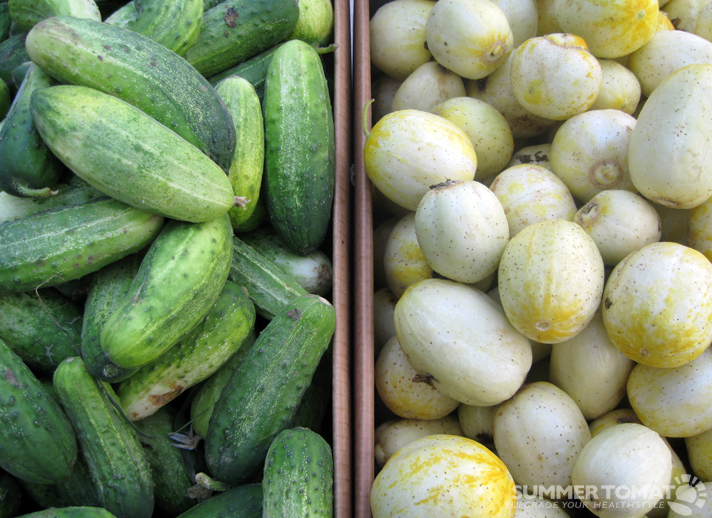
I try to convey this sense of adventure in my Farmers Market Updates. This week, for example, I bought all the flavors I associate with Thai food even though I do not have a specific recipe in mind. I also purchased some lemon cucumbers simply because they looked cool.

You do not need to know how to cook something before you buy it. Vegetables are cheap, just get what looks good and figure the rest out later. Email me if you need suggestions!

———-

Farmers Market Update

Cucumbers

Cucumbers

Brown Turkey Figs

Brown Turkey Figs

Summer officially started this week in San Francisco (according to me). With melons and figs popping up all over the place, there is no way I can keep sitting here and telling you it is springtime.

Woohoo!

Thai Basil

Thai Basil

Purple & White Peppers

Purple & White Peppers

Summer tomatoes are already fabulous, summer squash are as sweet as can be (especially the yellow Zephyrs!) and who knew there were so many kinds of cucumber? Green garlic has morphed into the bulbous “fresh garlic.” Green beans are starting to appear and there are 2 kinds of basil. Not one, but two!

Darya is happy.

Cucumbers

Cucumbers

Fresh Garlic

Fresh Garlic

Check out my first Farmers Market Update video from my new apartment. It is just under 3 minutes.

Today’s Purchases:

What did you find at the market this week?

Tags: , , , , , , , , , , , , , , ,

For The Love of Food

by | Jun 12, 2009
For The Love of Food

For The Love of Food

Welcome to Friday’s For The Love of Food, Summer Tomato’s weekly link roundup.

We have lots of fantastic articles this week from Lifehacker‘s food week: Eat To Live. Also featured are several healthy shopping guides including ones for fish, seasonal produce and pesticide-free foods.

If you would like to see more of my favorite articles each week or just don’t want to wait until Friday, be sure to follow me on Twitter (@summertomato) or the Summer Tomato Facebook fan page.

Submissions of your own best food and health articles are also welcome, just drop me an email using the contact form. I am also currently accepting guest posts for any healthy eating and exercise tips.

Note: If you have not received any Summer Tomato email updates this week please check your spam folder and mark my email address as “not spam” in your contacts. Please let me know if you have any problems with this adjustment.

For The Love of Food

What great articles did you read or write this week? Leave your links in the comments.

Tags: , , , , , , , , , , , , , , , , ,

Farmers Market Update: BYOB (video post)

by | May 17, 2009

Bring your own bags is the new message from the San Francisco Ferry Plaza Farmers Market. As of next weekend, the Saturday farmers market at the Ferry Building will no longer be providing free plastic bags to shoppers. Instead they encourage you to bring your own bags or purchase the reusable or biodegradable BioBags they will be selling at the information booth. Their goal is to help the environment by cutting down plastic bag waste generated by the market.

The Center for Urban Education about Sustainable Agriculture (CUESA) that runs the farmers market is leaving it up to individual vendors to decide how to deal with the change. Most of the vendors I spoke to will offer BioBags–some will provide them for free while others are charging $0.20 – 0.25 per bag. For your convenience you should plan on bringing a large tote bag to carry your items. For things like lettuces and berries, you should consider bringing your own small bags or expect to purchase environmentally friendly bags at the market.

Apricots and Strawberries

Apricots and Strawberries

Blueberries

Blueberries

The farmers market is a completely different place than it was just 4 weeks ago. You can still find delicate greens and spring garlic, but we now have all kinds of berries, cherries and other stone fruits that make it feel more like summer every day. Do yourself a favor and go find some blueberries from Triple Delight!

Also this week was the first appearance of my favorite frying peppers in the world, Pimientos de Padrón! I bought some and they were AMAZING. I love them early in the season because the spiciness level is perfect for me.

Bagged Padrones

Bagged Padrones

Colorful Heirloom Tomatoes

Colorful Heirloom Tomatoes

Maybe the best news of all is that the tomatoes are finally sweet! The heirloom I bought this week from Bruin Farms was the first of the season where I actually had trouble getting it from the cutting board to a serving bowl without eating it all first. I didn’t even need salt. That’s how you know it’s good 😉

Organic Artichokes

Organic Artichokes

Squash and Dandelion Greens

Squash and Dandelion Greens

Let me know how you guys like my second attempt at video. I didn’t have a camera man this time, so I limited the filming to my kitchen after I got home with all my goodies. Feedback welcome!!

Today’s purchases:

What did you find at the market?

Tags: , , , , , , , , , , , , , ,

What’s For Dinner? Ask Your iPhone

by | May 11, 2009

locavore-app

Healthy eating can sometimes seem like a daunting task. You know you should be eating local, seasonal ingredients and lots of vegetables, but how do you know what to get? Once you have it, how do you cook it?

Enter iPhone. I can confidently say that my iPhone has made my life more convenient than any single electronic device since my first laptop. Sure plain cell phones are great, but honestly text messages annoy me more than they improve my quality of life.

An iPhone offers so much more than calls and texts, especially when you delve into the world of applications or “apps.” Apps are third party software programs that can be downloaded to your phone to perform specific (usually awesome) functions. Apps are what set iPhone apart from all other phones. Today I’m going to tell you about two apps in particular–Locavore and Epicurious–that can be used together to help you decide what to do for dinner.

Locavore ($3) is an app that finds all the farmers markets near you along with the produce in season in your area. It does this according to your physical location on earth using the built in iPhone GPS. Isn’t that brilliant? (Yes, I’m totally jealous that I didn’t make this app myself.)

I get questions every week about how to find a good farmers market in a given area. Honestly I had never had an answer much better than “Google it.” With Locavore’s “Markets” feature, you get a list of farmers markets in your area ranked by their distance to you. If you click on the market you want to visit it gives you all the essential information, such as what time of year it runs and its hours of operation. Locavore also allows you to browse by region (U.S. only) or specific food to find seasonal availability.

The farmers market information used by Locavore is from a website called Local Harvest. Even if you do not have an iPhone Local Harvest is a fantastic resource for finding farms, markets and CSAs near you. When you have located the market you would like to go to be sure to check near the bottom of the information paragraph for the last time the site was updated. In my experience farmers are not particularly tech savvy and often forget to update their websites. I always recommend calling before you go, just to confirm the market still exists and hasn’t changed its hours.

In the Locavore app, once you have found your market you can check the “In Season” feature. This will give you a list of items that are supposed to be in season in your area (information gathered from the Natural Resources Defense Council website).

Unfortunately, the list is more an approximation of reality than a true market browse through. I’ve been following my own market on Locavore since I first downloaded the app several weeks ago, and I’d say it is about 90% accurate. Definitely I have seen the list include some items that are not available and I would not expect to be available this time of year in my area (e.g. boysenberries). Also, my market is large and specialized enough that there are always unique finds that the NRDC does not know about.

You can, however, get an idea of items that should be easy to find. To avoid hunting down ingredients that may not be available, be sure to check the pie graph icons to the left of each item. These represent the number of months left until that specific vegetable or fruit goes out of season (again, this is approximate and depends substantially on the weather). If there is less than one month left, you probably shouldn’t plan your entire meal around that one ingredient since there is a good chance it won’t be there. If the pie is full (green), that means you can find the item year round in your area. In general, the Locavore produce list is fairly thorough and accurate and can be used to create a seasonal dinner menu.

One of the coolest features of Locavore is its connection to the recipe website Epicurious. If you find a seasonal ingredient you would like to try but need ideas on how to prepare it, simply click the item and a page will open to show you all the states it is available along with the its Wikipedia listing (in case you aren’t sure exactly what it is) and a link to Epicurious. If you follow the Epicurious link it takes you to a list of recipes using your ingredient. Click the dish that sounds the most delicious and get a complete recipe and shepicurious-appopping list. Use this to make sure you get all the ingredients you need at the market.

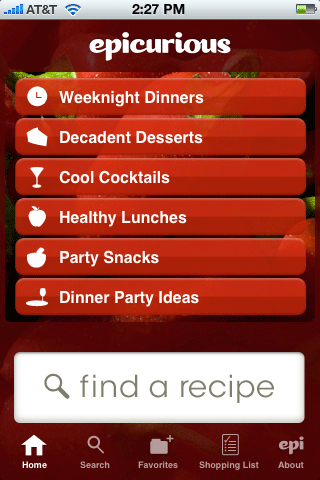
Conveniently Epicurious has its own app (free) if you already know the ingredient you want to use and do not need to find a farmers market. You can search by meal, event or specific ingredient, and create shopping lists for your favorite recipes. As you can imagine, I’m particularly fond of the “Healthy Lunches” option. Another bonus is the Epicurious app contains the entire contents of the Big Yellow Cookbook by Gourmet.

Overall Locavore and Epicurious are both fantastic apps for anyone interested in cooking local, seasonal meals. Together they are a powerful resource for finding ingredients and cooking the best seasonal meals possible.

Have you used either the Locavore or Epicurious iPhone apps?

Tags: , , , , , , , , , , , ,

Who Can You Trust For Diet Advice?

by | May 1, 2009
3D Brain MRI

3D Brain MRI

Last time I gave you a list of 10 people you can’t trust for diet advice, but many of you were left wondering who can you trust? As I alluded to before, it is extremely difficult to give a generic answer to this question because, frankly, there is no single group of people I can point to and say, “These people always do it right.” This is never true.

Where To Start

In the comments on Wednesday, reader Steve Parker M.D. (blogger and author of The Advanced Mediterranean Diet – visit his new Diabetic Mediterranean Diet Blog) said he mostly relies on primary scientific literature for his information. “Primary” literature is the original study where the actual scientific data is published and analyzed. This is very different from a newspaper article or press release (what a newspaper article is based on).

Without a doubt going straight to the source is the best way to get the facts regarding food, health and nutrition, and this is exactly what I do.

The Catch

It would be wonderful if we could all read the science directly and decide for ourselves how to eat for health and weight loss. But unfortunately, most people do not have access to these studies unless you are on a university campus or pay the exorbitant subscription fees (hundreds of dollars) for each individual scientific journal (there are thousands).

Moreover, unless you have extensive training in biological sciences (more than a bachelors degree), these papers will make no sense to you anyway. Some people try to get around this by reading only the abstracts, but reading an abstract to comprehend a scientific paper is like trying to understand a Seinfeld episode by reading the TV Guide (only more irresponsible).

This is the root of the problem.

Scientific experimentation and analysis is incredibly complex and requires decades of training. Therefore the general public needs the data translated into plain English and explained in simplified concepts. It is tempting to believe that anyone with the appropriate education and a knack for writing can provide this service, however the nuances of data interpretation make this very tricky business. It is frighteningly easy to spin ideas and make claims the data does not really support. This is even scarier when you think of health and how many lives are at stake.

The difficulties that arise from this issue are far reaching. At the most extreme, we have seen that research funded by industry is biased toward a favorable result for the company conducting the research.

Another potentially dangerous scenario is the misinterpretation of data by press rooms and journalists, who then translate these false ideas to a wide audience. Finally there are well-meaning people who do their best to alert the public to important health concerns, but simply misinterpret the science for one reason or another.

Who Is Qualified?

Scientists Although I myself may be biased, I am inclined to trust the opinions of well-respected (highly published) scientists in the field of food and nutrition. Luckily, several of these people have written wonderful books clearly explaining the basics of food and health. Although I am probably the only person under 50 to have ever read these books, they are wonderful resources that I recommend whole-heartedly.

Here are my favorites:

Eat, Drink and Be Healthy by Dr. Walter Willett

Mindless Eating by Brian Wansink

What To Eat by Marion Nestle

Smart journalists Despite my tirade above, scientists are not the only ones with good diet advice. Some journalists have the intelligence and tenacity to uncover all the necessary information and convey it to their readers. To know if you have found this kind of journalist you must read their work and make critical judgments about the logic and conclusions drawn from the data provided.

I have read more bad than good books by journalists, so please be skeptical of what you find. Note: extended book reviews are on the future agenda at Summer Tomato (for short summaries please read the captions under the books in the Summer Tomato Shop).

So far the most thorough analyses I have read from any journalist are the works of Michael Pollan. I also think the work of Gary Taubes is essential reading.

These are the best books on food and health ever written:

The Omnivore’s Dilemma by Michael Pollan

In Defense of Food by Michael Pollan

Good Calories, Bad Calories by Gary Taubes

Trained nutritionists and dietitians I have also been impressed by many of the nutritionists I have encountered (especially Dinneen at Eat Without Guilt – find her on Twitter @EatWithoutGuilt). Nutritionists and registered dietitians are specialized in nutrition, food and eating. These professionals are skilled at working closely with an individual to develop personal eating plans. Although they are not specifically trained to read and interpret scientific studies, their education ensures substantial familiarity with the literature on nutrition, putting them ahead of most medical doctors.

Conclusion

In general you should be more skeptical than accepting of diet advice–particularly if the recommendations sound very strange or unnatural to you. However there are many good resources if you are careful to choose them wisely.

I am always looking for more book recommendations. See what I have read in the Shop and leave your additions in the comments.

Thanks to everyone who has participated in this lively conversation!

Tags: , , , , , , , , , , , , , , , , , , , ,