Sign up

You deserve to feel great, look great & LOVE your body

Enter your email for your FREE starter kit to get healthy & lose weight without dieting:

  • This field is for validation purposes and should be left unchanged.

Is Coconut Palm Sugar A Healthy Sugar Substitute?

by | Mar 12, 2012

Photo by Robyn’s Nest

Artificial sweeteners and sugar substitutes can be very appealing to people looking to cut their calories or control blood sugar, and I get a lot of questions about them. Generally I don’t recommend processed or sweetened foods and encourage people to break free from regular sugar consumption, but I recently discovered coconut palm sugar and decided to look into it.

Coconut palm sugar has garnered attention as being a low-carb sugar substitute that is more nutritious than typical granulated sugar. Because of its complex flavor it is also gaining a reputation in foodie communities, with establishments like the popular Samovar Tea Lounge in San Francisco switching 100% of its sweeteners over to coconut palm sugar.

Pure coconut palm sugar is a natural product made from the nectar of the coconut palm tree. There are several different varieties of palm (Palmyra, date, etc.), and “coconut palm” specifically refers to the coco nucifera plant.

Most of the “palm sugar” commonly sold in Asian markets is not pure coconut palm sugar but is blended with other fillers such as white cane sugar. Pure certified organic coconut palm sugar is sold under the brand name Sweet Tree in the US, and can be found at some natural food stores.

The information in this article applies only to 100% pure coconut palm sugar. Check your labels carefully.

Pure coconut palm sugar reportedly has a naturally low glycemic index (GI)–a measure of how food impacts blood sugar–which has led some people to claim that it is a valuable sugar substitute for people with diabetes or those looking to control blood sugar (the low-carb camp). Indeed, a lower GI may be a good indication that a food is safer for diabetics, though it is not a guarantee.

When I first saw that coconut palm sugar has a low GI I figured it would be composed largely of fructose, similar to the popular sweetener agave nectar (and high-fructose corn syrup). Fructose does not impact blood sugar because it is transported directly to the liver and converted to fat. For an explanation of this mechanism, check out Dr. Lustig’s video on the dangers of fructose.

I was surprised to find, however, that coconut palm sugar is reportedly very low in fructose, and its main sugar component is sucrose (aka table sugar). What confuses me is that the GI of coconut palm sugar is supposed to be 35, while the GI of sucrose is 64. Something doesn’t add up.

I could only find a summary of how GI was measured and not the published study itself. Also, this information was only available on the website of a company that sells coconut palm sugar. This doesn’t mean the number is inaccurate, but it is a little suspicious and I’d like to see the study repeated by another credible source or two before taking it as fact.

(UPDATE: At one time I found reports of newer tests that found discrepancies with the reported GI of Sweet Tree products, but the page has since been taken down)

The number of calories in coconut palm sugar is almost identical to the number in regular table sugar and its closer relative, brown sugar. But coconut palm sugar is notably higher in various micronutrients, probably because it is less processed than industrial sugars.

But does anyone really eat sugar for health benefits?

There are a number of good reasons to consider using coconut palm sugar as a substitute for white or brown sugar in your kitchen. For me the most obvious benefit is that it tastes amazing, similar to brown sugar but with a rich complexity I’ve never tasted in industrial sugars.

Overall coconut palm sugar is a tastier and possibly healthier substitute for granulated or brown sugar. I wouldn’t go so far as to call it a health food, or even low-carb just yet.

Substitute coconut palm sugar for traditional sugar at a 1:1 ratio in normal cooking and baking.

Have you tried coconut palm sugar? What do you think?

Originally published March 10, 2010.

Tags: , , , , , , , , , , , , , ,

Is It Healthier To Eat Like A Caveman?

by | Mar 7, 2012

Photo by Lord Jim

“What do you think of the Paleo diet which advocates zero grain consumption?”

The Paleolithic diet is one of the most rapidly growing diet trends of the past several years. Followers of the Paleo diet argue that humans have not evolved to eat agriculture-based foods and can only achieve optimal health by consuming a hunter-gatherer style diet. Thus the Paleo diet is completely devoid of grains and legumes, and also shuns dairy, salt, refined sugar and processed oils. The diet is composed primarily of meats, fish, vegetables, fruits, roots, nuts and seeds.

(The Wikipedia article on the Paleo diet is actually pretty good if you’d like to read up on the details. I particularly like the Opposing views section.)

Like most diets the Paleo diet has a little bit of good science behind it, but also a lot of logical leaps and baseless assumptions. The evolutionary argument that humans are somehow maladapted to agriculture-based diets is particularly unconvincing (resting on many unproven assumptions), yet is the fundamental premise on which the Paleo diet bases its recommendations.

The reasoning behind the Paleo diet is less interesting to me, however, than the impact of the diet itself. Will “eating like a caveman” really help you be healthier?

Possibly, but not necessarily.

The most obvious advantage of the Paleo diet is the lack of processed foods. There is ample evidence that societies on traditional diets boast far better health than those on modern, Western diets–and the hallmark of modern diets is food processing. Paleo diets therefore are low in sugar, refined carbohydrates, trans fats, excess salt and pretty much everything else that leads to “diseases of civilization.”

Paleo diets are also abundant in healthy, nutrient-rich foods such as vegetables, fruits, nuts, fish and meats. I have no doubt that anyone willing to stick to a Paleo eating plan will have a healthy weight and remain virtually free of heart disease, diabetes, hypertension and may even have lower rates of cancer.

But the question still remains, is it necessary to eat Paleo to be healthy?

This is where I take issue with the Paleo philosophy. While a diet completely free of processed foods is undeniably healthy, the Paleo diet goes beyond this and demands considerable sacrifice.

Paleo diets do not allow for any grains or legumes. This pretty much eliminates every traditional cuisine on earth including Japanese, Italian, Indian and Greek. Not only is this a culinary tragedy, it ignores the fact that these cuisines feed some of the world’s healthiest and longest-lived individuals.

Traditional, global diets that exclude highly processed foods but also include grains and legumes have been some of the most successful for health. Diseases of civilization are only problematic in Western cultures where processed foods make up a large proportion of the calories and few whole food are consumed.

Proponents of the Paleo diet argue that it is necessary to eliminate grains and legumes because they contain “antinutrients,” substances that can interfere with the body’s absorption of other important vitamins, minerals and proteins. However, well-nourished individuals who eat a varied diet of unprocessed foods (including grains and legumes) are not nutrient deficient and are generally healthy.

Given that it is possible to thrive on a diet that includes some grains, legumes and even small amounts of processed foods, one must question if giving up the culinary joys of travel and global cuisine are really worth the sacrifice.

In my experience, food substitutions and modified recipes designed to mimic traditional meals can sometimes be tasty but can never replace true authenticity.

Another contention I have with the Paleo diet is the assumption that the same eating patterns will work for everyone. People’s lives differ in countless ways. We each have different levels of daily activity, demands on our time and food preferences. We also have different genetic backgrounds, which can result in significant differences in metabolism and hormone levels. These individual variations make dietary needs different for each of us.

Because of our individual differences, there is undoubtedly a percentage of the population that thrives on the Paleo diet and finds it easy to stick to and achieve results. Hooray! However there may also be a segment of the population (myself included) that finds living without grains and legumes to be chronically unsatisfying and unsustainable.

Try telling a foodie they can never eat cheese or drink wine again and see how far you get pitching a Paleo diet.

If you currently eat a typical Western diet with little variety and many processed foods, tend to have better success following rigid diet plans, and have no qualms about giving up or modifying traditional meals to meet your dietary demands, then you might have luck following the Paleo diet. However there is no reason to believe it is the only path to good health.

The best diet is the one that works for you. Finding a healthstyle you can embrace and enjoy is essential if you want to build a lifetime of healthy habits.

Do you follow a Paleo diet? What do you think?

Originally published February 22, 2010.

Tags: , , , , , , , , , , , , , , ,

Thanksgiving Healthy Eating Tip: Slow Down

by | Nov 14, 2011

Photo by Photo Monkey

Worrying about carbs, calories and diets is one of the most unproductive things you can do on a holiday that celebrates thankfulness. Instead of giving you a list of healthy side dishes or tips on how to cut out calories, this Thanksgiving I offer just a single piece of advice: slow down.

The actual content of your Thanksgiving dinner matters very little in the grand scheme of things. A few hundred calories here or there can make a difference when projected over weeks and years, but for one meal the impact is negligible. Your body will adjust naturally and you’ll burn off those extra calories the next day, so don’t worry about it.

But for people trying to get healthy or lose weight, not worrying about food can feel very strange. There is always the fear that if you aren’t vigilant and conscious of what and how much you eat you may gorge yourself stupid and all your hopes of fitting into your favorite jeans by the end of the year will be ruined.

Overeating is certainly a possibility when food anxiety is a constant force in your life, but Thanksgiving is a perfect opportunity to start getting over it. Really. It may seem counterintuitive that such a food-forward holiday can be stress free, but let’s not forget that the real point of Thanksgiving isn’t turkey or pie, but being thankful.

Since most of us won’t be harvesting our own meals this year (hats off to anyone who is), it is silly to pretend this particular dinner requires more thankfulness than any other meal we eat. Turkey, stuffing and cranberry sauce are tradition, but do not necessarily reflect our 21st century needs and values.

With the emergence of modern media, there are other essential pieces of our lives that we can no longer afford to take for granted. Free time is one. Exercise is another. But most important of all these is our real, human, non-Twitter relationships, particularly those with family and friends. It is far too easy to neglect these basic elements of our existence when we have so many other obligations and distractions, but failure to nurture them can severely affect our overall quality of life.

If you care about your health and want to keep your eating under control on Thanksgiving, why not focus your attention on strengthening relationships and spending time with the people you care about? Instead of worrying about yourself and what you want to accomplish, ask people about themselves and discuss mutual interests.

Let food be part of the celebration, but not the purpose of your day.

Once food is no longer the center of attention the only thing you need to keep in mind is to eat slowly–it is pretty tough to overeat if you are biting and chewing at a snail’s pace.

Slow eating helps you eat less food and appreciate it more. It also helps you make wiser food choices, since decisions about what to put on your plate are made less impulsively.

But slow eating does require some conscious effort. If you are in the habit of shoveling food in your mouth without taking time to put down your fork and chew (or breathe), it is easy to slip back into this pattern. Also, if people around you are all guzzling their food in a fury, you might feel a natural compulsion to keep pace and match their eating speed.

I’ve written before about how to become a slow eater, but at large family dinners some of these tactics can be particularly useful. Start by actively trying to keep conversations engaged while you eat. Chewing and talking are (hopefully) mutually exclusive, so the more you converse the longer it will take you to get through your meal.

Making an effort to put your fork down between bites is another effective way to slow your pace at the dining table. To give your hands something to do between bites, reach for your glass and take regular sips of your water (it is best not to rely exclusively on wine for this tactic) or wipe your lips with your napkin.

And don’t forget to chew.

Trying to eat slowly is much easier than trying to summon the will power to skip the mashed potatoes and biscuits. And slowly savoring the foods you love is far more enjoyable than inventing a clever recipe to replace the sugar or fat in your pumpkin pie.

Spend time with people, enjoy your meal and have a wonderful Thanksgiving.

How do you approach health and food on Turkey Day?

Originally published November 23, 2009.

Tags: , , , , , , , , ,

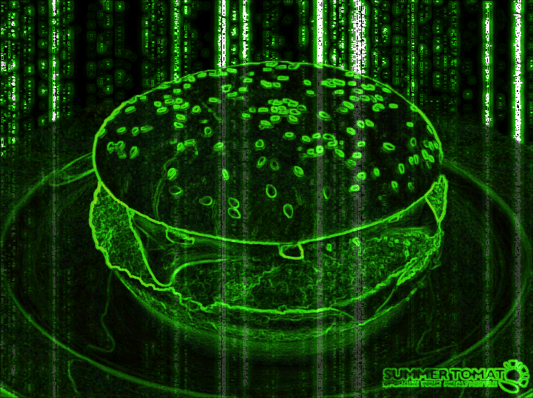
Are You Eating In The Matrix?

by | Oct 12, 2011
Do You Think That's Food You're Eating?

Do you think that's food you're eating?

Or to put it another way, do you know the difference between real food and food that was designed to fool you into believing it is real?

It might not be as easy as you think.

(Spoiler Alert! If you haven’t seen the original Matrix film yet, crawl out of your cave and go watch it real quick before reading. We’ll wait.)

In the classic film The Matrix, machines of the future create a sophisticated computer program that produces an alternate reality for their human slaves. The program, the Matrix, placates humans into believing they are living normal lives while their bodies are imprisoned in suspended animation.

The Matrix is plugged directly into the brains of humans. They live the Matrix, breathe the Matrix, eat the Matrix. They’ve grown up with it, and have never known any other world.

Now think about a Twinkie or a McNugget. Can you remember life without them? I can’t. These products have always been a part of my world, even though it has been a long time since I’ve eaten them. I have vivid childhood memories of both products–after school snacks with friends, my 10th birthday party–and my memories are happy.

But I’ve learned to refer to Twinkies and food from McDonald’s as products and not foods because, when you think about it, they really aren’t foods. Sure you can eat them, but that just makes them a novelty–something akin to beating up your friends in Mortal Kombat.

“Do you believe that me being stronger or faster has anything to do with my muscles in this place?” -Morpheus

Real food nourishes your body by providing essential building blocks for your cells and organs. The human body evolved alongside real food and is adapted to digest it.

Edible products on the other hand were specifically designed to fool your brain and sensory perception, but your body, cells and organs have no idea what to do with them.

Twinkies and McNuggets are engineered. They do not come from the earth and are not food. Twinkies were created in the Matrix.

Do you think that’s food you’re eating now?

This may sound like rhetorical foodie fluff, but please humor me and entertain the metaphor for a little while longer.

Food should nourish your body and contribute to your overall health. Even foods that are considered fattening–bacon comes to mind–provide nourishment so long as they are based in reality.

But what is a Twinkie? What is a Pringle? What is a McNugget?

BigMacs may look, smell and vaguely taste like food, but if what you are eating is not sustaining your health and is possibly making you sick, isn’t it time to question whether it is food at all?

These are products that were created in a laboratory. They may have started as raw materials from plants, but the plants were never grown to be eaten. Industrial corn, soybeans and the cattle raised on them have been processed and redesigned to the point where they’ve been stripped of anything that allows for them to be reasonably classified as food.

Shouldn’t we then stop calling this stuff food?

Most people will initially reject this idea. Of course food is food. But I’d argue that this opinion is just another product of our environment. Haven’t we always lived in the Matrix of industrial agriculture?

We have coexisted with McDonald’s for so long it seem preposterous to speculate it doesn’t meet the definition of food.

But let’s take a closer look:

Food –noun:

1. Any nourishing substance that is eaten, drunk, or otherwise taken into the body to sustain life, provide energy, promote growth, etc.
2. More or less solid nourishment, as distinguished from liquids.
3. A particular kind of solid nourishment: a breakfast food; dog food.
4. Whatever supplies nourishment to organisms: plant food.
5. Anything serving for consumption or use: food for thought.

(emphasis mine)

With the exception of the last point, which is clearly philosophical, all these definitions include the word nourishment.

Nourishverb (used with object)

1. To sustain with food or nutriment; supply with what is necessary for life, health, and growth.
2. To cherish, foster, keep alive, etc.: He had long nourished the dream of living abroad.
3. To strengthen, build up, or promote: to nourish discontent among the workers; to nourish the arts in one’s community.

(emphasis mine)

If it doesn’t provide nourishment, it is not food.

But relying on dictionary definitions is both semantic and impractical. It also becomes confusing when companies market products that are not real food but have added back nutrients to give the appearance of nourishment.

The important question is how do we break free?

Being convinced that these products are not food is not enough. Like the Matrix, McDonald’s is so closely tied to your perception of reality that it can fool you even when you know it isn’t real.

Remember, when Neo makes his first attempt to jump across the building roofs. He doesn’t make it.

“Everybody falls the first time.”

That’s because the Matrix feels so real that not believing it is almost impossible. Likewise, knowing that edible products are not food and that they will in fact make you less healthy is often not enough to prevent you from eating them. Your senses are easily fooled.

But better decisions are not impossible and your food world doesn’t need to be 100% black and green. Even small steps in the right direction, back into reality, can improve your health.

The first small changes you try also make subsequent steps easier.

Unplugging from the industrial food Matrix does not need to happen all at once, but you can extract yourself from it eventually. The first step is starting to see it clearly.

“I’m trying to free your mind, Neo, but I can only show you the door. You’re the one that has to walk through it.”

Are you eating in the Matrix?

For your viewing pleasure: Morpheus is fighting Neo!

This post was inspired by commenter Martin Levac who gave me permission to roll with his awesome idea.

Originally published November 11, 2009.

Tags: , , , , , , , , , ,

How Mindful Eating Can Help You Eat Less

by | Aug 8, 2011
Red Flame Grapes

Red Flame Grapes

Today’s guest post is by Jyoti Mishra Ramanathan, a fellow UCSF neuroscientist who studies attention and distraction in the human mind. In her article Jyoti reveals how attention impacts our experience of food and how we can harness this power to help us eat less without feeling deprived.

Learning to be a mindful eater will permanently change your relationship with food and is essential for upgrading your healthstyle.

Mindful Eating and Portion Control

by Jyoti Mishra Ramanathan

I grew up in India where life revolves around food. One wakes up to plan breakfast and as soon as that is over plans lunch, then immediately prepares for a typical 3-4 course dinner. When I visit aunts or my grandma, I’m barraged with food at every moment: eat this, eat that! Oh! You aren’t eating enough! Oh! Do you not like my dishes?

If you don’t accept all or any food that comes your way, it is seen as a sign of disrespect. And if this isn’t enough to make you over-eat, remember too that food is sacred in India. How could one waste the grains on one’s plate when there are millions around us suffering from hunger? Consequently, I grew up believing it is normal to forever be bursting at my seams–to eat to the point where taking another bite might even make me sick.

But a few years ago my eating habits changed.

I was at a meditation workshop and one evening we were told we’d be given one grape for dinner. This sounded impossible. However, I obediently sat cross-legged with the other attendees and was handed my single juicy purple grape.

As I popped it in my mouth, I was told to shut my eyes and sense the grape in its totality: I rolled my tongue around it becoming aware of the soft and smooth exterior of the tiny fruit, I imagined its rich purple color, and then as I slowly bit into it, I savored every trickle of juice that I could extract from the grape.

The process took me a full five minutes and never in my life have I remembered eating such a delicious grape, although it was from no extraordinary vine. Miraculously, I felt full as well.

Try the grape exercise. I do not promise the satisfaction of a full meal, but it is a beautiful exemplar of mindful eating that consequently taught me portion control.

4 Simple mindful eating tips

1. Never eat distracted, i.e. while watching TV or running to catch the bus. Observe the deliciousness on the plate, the colors, textures, flavors and smells, savoring each bite. As the meal makes its way to the stomach, start to notice the fullness in your tummy. I found that there is an initial satiation simply from this sensory overload of observant eating.

One could stop here, but this is not enough nourishment and hunger tugs again relatively soon. But as you slowly chew on your food and enjoy each bite, you experience a real fullness that completely satisfies your hunger. This sensation precedes the contentment of the taste buds, which may still desire a few extra bites of that rich chocolate cake. But as I learned to identify the hunger satiety point at each meal, I found I could also control the desires of my taste buds.

2. Do not visit a restaurant starving. It is harder to control how much you eat when faced with novel delicacies at a restaurant, especially when you get there on an empty stomach. My best defense against this is to eat a small snack right before. My favorite is a quick salad.

At home I always keep miscellaneous salad ingredients on hand: mixed greens, cheese, raisins, walnuts, candied almonds, grains like quinoa, blueberries, avocado, sundried or cherry tomatoes, baby carrots, figs, grilled chicken strips, smoked salmon, etc. Mix-and-match any of these in varying proportions and add some homemade dressing. Each time you will have a novel salad that never gets boring. After a light snack it is much easier to have restraint while ordering and eating, keeping both waistline and budget in check.

3. Share a meal. My husband and I more often than not share an appetizer, entrée and dessert at a restaurant. This is not because we can’t afford more. We simply enjoy sharing–describing the new tastes to each other, immersing ourselves in the experience and appreciating new food. In these happy moments satiety emerges effortlessly.

Try this even when out with a group of friends: order for 3 with a group of 4 and share. If there is still food left over and there are no pets or family at home, I offer my extras to the homeless. I just gave away a carrot cake a couple of nights ago and the delight in those eyes was like someone who had just found a treasure!

4. Don’t aim for 100% full. Hara Hachi Bu is Japanese for eating until 80% full. Okinawan islanders practice this and are known to be one of the longest living people on the planet. Their longevity is attributed to this moderate calorie restriction in combination with consuming plenty of fruits and vegetables, which protect against free radicals that damage your body’s cells.

Conclusion

In summary, there are many benefits to portion control: feeling better right after a meal, long-term health, weight management, saving cash by eating less and perhaps even living longer.

Practice mindful eating to make portion control a reality for you.

How do you control your portion sizes?

Originally published September 2, 2009.

Tags: , , , , , , , , , , , ,

8 Reason Breakfast Makes Your Life Better

by | Jul 20, 2011

Yogurt, muesli and blueberries

I should admit right now that I’m a born again breakfast eater. In the past I always told myself that skipping breakfast meant one less meal adding calories to my day, and I was proud to have eliminated this annoyance from my life.

For the last several years, however, I have grown to love breakfast and am something of an evangelist. Breakfast may seem like an odd thing to try to covert people to, but once you see my reasons you may become a believer yourself.

8 Reasons Breakfast Makes Your Life Better

  • It’s easy. Breakfast doesn’t take much time or energy to prepare; I’m half asleep when I pour my cereal, rinse my fruit and boil my coffee every day. It also requires minimal planning. Just buy everything you need every week or two and you are good to go. What’s your excuse?
  • Health wins. We all must deal with the internal struggle between eating healthy and eating not-so-healthy. Throughout the day breakfast is by far the easiest battle in which health can triumph, since there is no outside social pressure and unhealthy options are harder to attain. I recommend taking winning odds whenever they are presented.
  • Hunger check. If you eat a satisfying breakfast before heading into work you are less likely to be tempted by the junk food that haunts most office environments. Likewise, you will have better self-control when it comes time to decide what to eat for lunch.
  • Whole grains. For my own healthstyle, intact whole grains are the most difficult to get in my diet. Unsweetened oats, plain brown rice and quinoa aren’t exactly staples on American restaurant menus. But without grains I feel constantly hungry and my workouts suffer. If I eat them at breakfast I am guaranteed at least that one serving during the day. (For tips to get more whole grains at dinner, check out my easy frozen brown rice balls).
  • Higher metabolism. Eating healthy food has a positive effect on your metabolism. Not only does what you eat for breakfast affect how your body reacts to different foods for the rest of the day, it also influences your metabolic rate in the long term. Be careful though, highly processed and easily digested foods have a negative effect.
  • Healthy habits. Healthy behavior begets more healthy behavior. According to some studies, this is especially true of breakfast eaters. Waking up and eating a healthy breakfast encourages you to pack a healthy lunch and plan your day around wholesome food. It feels really good to do healthy things, but we easily forget this when presented with free donuts on an empty stomach during a mid-morning meeting. Build your healthy habits when it is easy and help them stick around for the long haul.
  • Self-esteem. I think it is important to reiterate how good it feels to do healthy things for your body, and as a bonus it extends to how we feel about ourselves. Most of us feel proud and confident when we know we are doing the right thing. Why not start out each morning on the right foot?
  • Deliciousness. Of all the reasons I just listed, this one probably has the biggest sway with me personally. My breakfasts are absolutely delicious and I adore waking up and eating such yummy food. It is worth going out of your way to find healthy foods you enjoy eating, that way good food has as much pull on you as the less healthy junk. This will make your food decision making a whole lot easier.

Once you have convinced yourself that eating breakfast is important and worthwhile, it helps to know what constitutes a healthy one. I have written about breakfast before, focusing on the difference between fake “whole grains” as sold to us by processed food manufacturers and real intact whole grains.

Recently I have switched to a new favorite breakfast: plain yogurt, muesli and fruit.

I love this new combo for a few reasons

  1. I tried yogurt because I was having digestive issues for a few weeks and was hoping the probiotics in the yogurt (I eat even more probiotic foods now) might help. It totally did, and I’m sold on this method for improved digestion (despite my mild lactose intolerance).
  2. Coarse and chewy muesli is perfect on yogurt and I was able to completely cut out the fake whole grain flakes that bothered me about my old breakfast. Woohoo!
  3. The added protein and fat from the lowfat plain yogurt helps me feel satisfied longer in the day and adds a creamy luxury to my morning.

Be sure that when you are choosing your healthy breakfast you find foods with no added sugar. For example, fruit and vanilla yogurts are notorious for having obscene amounts of sugar (especially vanilla) putting it more on par with ice cream than health food. Likewise, most store bought granolas are loaded with sugar, molasses, honey, agave, concentrated fruit juice and other sweeteners. This is why I prefer muesli–completely unsweetened grains with bits of dried fruits, nuts and seeds.

When choosing plain yogurt I recommend lowfat instead of nonfat yogurt, because it is much more palatable and satisfying. Nonfat plain yogurt tends to be too tangy for me. Also, you need the fat to help with nutrient absorption and satiation.

My breakfast

  • 1 c. Plain lowfat yogurt
  • 1/4 c. Dorset muesli
  • 1/4 c. fresh fruit

What is your favorite healthy breakfast?

Originally published August 17, 2009

Tags: , , , , , , , , , , , , , , , ,

8 Inspiring Places To Find Recipe Ideas

by | Apr 27, 2011
Foodie Inspiration

Foodie Inspiration

Healthy eating and cooking for yourself go hand in hand. If you have the resources it is possible to eat healthy while dining out, but restaurants that don’t use processed foods can be difficult to find and tend to be pricey. They also limit you to a handful of different dishes that can become monotonous if you rely on them for most of your meals.

But keeping your healthstyle interesting can be a challenge even if you cook for yourself. Although shopping in season inevitably rotates you through new ingredients over the course of the year, we can still slip into the pattern of making the same dishes over and over again. And while repetition can be easy and comforting, it can also be problematic.

Monotony and boredom are your enemies if you are trying to make healthy eating a way of life; junk food will be extra tempting simply because it’s more interesting than the same boring meal you’ve had 10 times before.

To keep yourself from getting in a cooking rut you must actively seek inspiration for new dishes and flavor combinations. This is true for both kitchen newbies and seasoned chefs, and it gets easier with practice. The more you learn to outsource your creativity and experiment, the better you get at finding meal ideas in your daily life.

Inspiration can come from anywhere. These are some places I often find new ideas, but you are only limited by your imagination.

8 Places To Cook Up Recipe Inspiration

1. Farmers markets

My number one source of inspiration is always the beautiful produce and other goodies I find each week at the San Francisco Ferry Plaza Farmers Market. Not only do I often find interesting new ingredients to experiment with, I also find familiar foods that look so fresh and delicious I can’t help but buy them and turn them into something wonderful.

If you are thinking about buying something but do not know how to cook it, ask the vendor for ideas or common preparations. I recommend you get anything that looks new and interesting, since most vegetables are relatively cheap and Google puts a universe of recipes at your fingertips.

2. Restaurants

Most major cities (San Francisco especially) are home to amazingly talented and innovative chefs of all different styles and flavors. Steal their ideas! If you have a memorable meal while out on the town, take mental notes on the flavors and textures that capture its essence. You don’t have to be able to recreate it exactly at home, but you can definitely borrow the concept, simplify it and adapt it to your own skills and needs.

For example, I was recently struck by a dish at a spectacular restaurant that was composed of beets with dill–a flavor combination I had never tried. The dish was technically complicated and I wouldn’t bother attempting to make it the same way, but later that week I did roast some beets and change up my usual recipe to include dill instead of mint (sans chèvre). Turned out fantastic.

3. Food blogs

The number of outstanding food blogs today on the interwebs is staggering, and I love to skim through them looking for wonderful recipe ideas. I can’t even begin to list all my favorite sites here, but I try to highlight at least one mouthwatering recipe each week in For The Love of Food posts.

4. Travel

Nothing inspires enthusiasm for new flavors and recipes like traveling to a different locale. Eating traditional cuisines–the way they are supposed to be made–is one of the most intimate and meaningful ways to engage with a culture. Learn a few of the cuisine’s basic ingredients and cooking techniques and you can bring a tiny bit of your experience home with you. Think of this process as a procedural photograph you can use to remember your trip.

Again, you don’t have to recreate dishes exactly the same way in your own kitchen. Sometimes just a single special ingredient can evoke an entire cultural experience.

5. Friends

We all have that friend who is an amazing cook (love you guys!). Not only does this person sometimes hook you up with delicious treats, chances are your foodie friend also loves to talk about food and cooking. This is a goldmine for new ideas and sometimes even a little help and guidance. Maintain a healthy, food-centric relationship with this person and watch the inspiration roll in.

(Hint: If you don’t have a friend like this come hang out with me on Twitter @summertomato)

6. Books

Cookbooks are wonderful but, to be honest, I rarely use them. The reason is that I’m usually too busy to bother lugging the giant things off the shelf and thumbing through them for something specific. I usually either wing it in the kitchen or search online for what I need.

Literature, however, can be a huge inspiration for me to try out new things in the kitchen. It wasn’t until I read The Moor’s Last Sigh by Salman Rushdie that I really started exploring Indian cooking. The Last Chinese Chef helped me learn to appreciate the depth of Chinese cuisine. And I cannot eat enough Spanish tapas when I’m reading Hemingway.

7. Podcasts and radio

I love Mondays because all my favorite food podcasts are waiting on my iPhone for me to listen to on my commute. Both entertaining and educational, foodie podcasts never fail to inspire me to try new foods and cooking methods. They also make me a better cook by describing tips and techniques I am unfamiliar with.

8. TV

Although I do not watch TV regularly, there was a time when I would catch a periodic episode of Top Chef or other foodie show. What I enjoyed most about these programs was the times they would explain the decision making process that goes into creating a dish. But even if culinary improvisation isn’t in your cards, you can at least borrow their ideas (just like at a restaurant) and make similar meals for yourself at home. The recipes used are often posted online.

You can also get meal ideas from TV dramas and sitcoms. Remember Seinfeld’s Soup Nazi? That’s where I first learned about mulligatawny.

Recipe inspiration can come from anywhere, but if you aren’t looking for it a stroke of genius may pass you by.

Where do you get your inspiration in the kitchen?StumbleUpon.com

Originally published February 24, 2010.

Tags: , , , , , , , , , , , , , , ,

How Healthy Is Deli Meat?

by | Apr 18, 2011

Photo by Daryl Marquardt

People trying to cut calories and refined carbohydrates out of their diet often turn to deli meats as a high protein, low fat alternative. But is this really a good idea?

While refined carbohydrates increase your risk of diabetes and heart disease, so do processed meats including sausage, bacon and deli meats. It is unlikely to be the fat (or even the saturated fat) in these products that do the damage, since processed meats are consistently shown to be more dangerous than saturated fat alone.

In fact, what the food manufacturers replace the fat with often ends up being much more risky.

What’s in them?

Take a quick look at the ingredients of a Louis Rich turkey variety pack:

Smoked White Turkey: White Turkey, Water, Salt, Contains less than 2% of Modified Corn Starch, Sodium Lactate, Sugar, Sodium Phosphates, Sodium Erythorbate (Made From Sugar), Sodium Diacetate, Sodium Nitrite, Garlic Powder.

Smoked Turkey Ham: Turkey Thigh Meat, Water, Contains less than 2% of Salt, Sodium Lactate, Sugar, Sodium Phosphates, Sodium Erythorbate (Made From Sugar), Sodium Diacetate, Sodium Nitrite, Flavor.

Turkey Bologna: Turkey Ingredients (Mechanically Separated Turkey, Turkey), Water, Modified Corn Starch, Contains less than 2% of Salt, Sodium Lactate, Corn Syrup, Dextrose, Flavor, Enzyme Modified Skim Milk, Sodium Phosphates, Sodium Erythorbate (Made From Sugar), Sodium Diacetate, Sodium Nitrite, Extractives of Paprika.

Turkey Cotto Salami: Turkey Ingredients (Turkey, Mechanically Separated Turkey), Water, Turkey Hearts, Contains less than 2% of Salt, Sodium Lactate, Sugar, Sodium Phosphates, Spice, Sodium Erythorbate (Made From Sugar), Garlic Powder, Sodium Diacetate, Sodium Nitrite, Flavor.

What exactly is “flavor”? I’ll let you ponder that one.

These meats are pumped full of starch, sugar, salt, preservatives and other random ingredients. Given the quality of the meat they use (“mechanically separated turkey”?) it’s not hard to understand why. All that added “flavor” is needed to make these products taste like juicy meat again.

The low fat versions are even worse, containing higher amounts sugar and salt to make up for the lack of natural fat flavor.

Why is this bad?

The extra starch and sugar are not good since they are, after all, the processed carbohydrates we want to avoid. However these are still a relatively small contribution to total calories. The bigger issues with processed meats are the added sodium and preservatives.

Processed meats have been associated with increased risk of several cancers, particularly those of the digestive system. It has been suggested that the presence of nitrates and nitrates used in the preservation methods are a potential cause, however the data remains inconclusive. Confusing the matter further is that vegetables are the primary source of nitrates in the human diet and some have suggested that in this context they may be a beneficial nutrient.

Heart disease has also been clearly associated with consumption of processed meat, though the reason for the connection is still unknown.

Then there’s the issue of quality. There are a lot of questionable ingredients in highly-processed deli meats like these from Louis Rich. It is unclear if the health risks are the same whether the meats are cured and preserved with high-quality ingredients (charcuterie vs. standard deli meat) or when the meat is preserved without the use of nitrates and nitrites.

What to do

Though it is difficult to point to the exact reason processed meats are dangerous, there is enough evidence associating them with serious health problems to warrant limiting them in your diet. Most of the studies that found associations with processed meats and cancer considered 5 or more servings a week to be a high dose.

To be on the safe side I recommend limiting your intake of processed meats to less than 4 servings per week.

For alternative snack ideas check out Healthy Snacking 101.

Tags: , , , , , , , , , , ,

Fishing For Answers: How To Choose Fish and Seafood

by | Dec 8, 2010

By sektordua

By sektordua

“This is a request for a Summer Tomato series on fish, and seafood in general. This topic is even more difficult to navigate than organic vs. non-organic and it would be great to learn about it in detail.”

I don’t think there is anything more complicated in the food world than fish and seafood. There are so many life or death issues it’s enough to make you want to close your eyes, plug your ears and live out the rest of your life in a cave on Mars.

But this isn’t really one of those issues we can ignore.

Fish and Your Health

There’s no denying it, fish is good for you.

The latest data I’ve read suggests that vegetarians have more cancer than fish eaters, though both have less cancer than meat eaters. There are also well-documented and significant heart and brain benefits associated with seafood consumption.

Omega-3 fatty acids are usually given the credit for the heart-healthy benefits of fish. The most beneficial omega-3 fatty acid, eicosapentaenoic acid (EPA), as well as docosahexaenoic acid (DHA) are only found in seafood. Vegetarian forms of omega-3s including α-Linolenic acid (ALA) can be converted to EPA and DHA in the body, but the conversion rate is very low and likely insufficient.

Personally I think healthy eating is a lot more difficult if you do not eat fish. (Please direct mild-tempered disagreements to the comments below). Yes, you can be healthy if you are vegetarian or vegan, but it is much more work in my opinion.

The fish and health issue seems to be even more important (and more complicated) for pregnant women. Children of mothers who eat less seafood during pregnancy score lower on cognitive tests than those whose mothers ate the most fish. But at the same time, mercury contamination is a serious concern for pregnant women that requires special attention. Mercury is toxic to neurodevelopment and can injure a developing fetus.

Mercury contamination has in fact become so common that regular, non-pregnant consumers also need to be concerned. Recent testing in New York City revealed that most of the top sushi restaurants serve fish that exceeds the FDA safety recommendations for mercury.

Another health and fish issue is polychlorinated biphenyls (PCBs). These things are all sorts of bad for you. I’ve written extensively on mercury and PCB contamination in fish over at Synapse.

For more on omega-3s, mercury, PCBs and the whole mess, Marion Nestle’s What To Eat is a good resource.

For health, the basic guidelines I follow include:

  • Eat fish 2-3 times per week.
  • Avoid large fish that accumulate mercury like tuna, shark and swordfish.
  • Avoid farmed fish that contain PCBs.
  • Seek fatty fish such as salmon, mackerel and sardines.
  • Avoid fresh water fish caught by friends. Lakes and rivers are almost all contaminated with high mercury levels.
  • Enjoy vegetarian omega-3 fatty acid sources such as walnuts, flax and soy.

I don’t take omega-3 supplements, but it is an alternative if you do not eat enough fish. Be sure to get supplements derived from marine sources (and don’t take them before interacting with other humans–icky burps).

All that, and we haven’t even touched on the environmental sustainability issues yet.

*deep breath*

*exhale*

Ok.

Fish and the Environment

I’m going to start with the disclaimer that I am NOT EVEN ALMOST an expert in this stuff. I read about it sometimes and keep up with the basics, but environmental issues aren’t my expertise.

That being said, it is not clear that anyone understands the true damage that the fishing industry is doing to either the environment or the future of the fishing industry. The outlook is not good, but it does seem that there are a few groups that are aware of the problems and taking actions to improve the situation.

The Monterey Bay Aquarium, the group I trust most in these matters, recently issued The State of Seafood Report if you’d like to read more.

New York Times food writer and author of Fish: The Complete Guide To Buying and Cooking, Mark Bittman, chimed in on the issue a few months ago in an article explaining the nearly impossible task of choosing fish these days.

To make matters worse, a new report suggests that many eco-friendly fish labels aren’t exactly accurate.

It’s difficult to say how to handle seafood sustainability and I certainly do not have all the answers, but I’ll tell you what I do.

Things I consider when buying and eating fish for sustainability:

  • Buy from trusted sources. Since I personally cannot keep up on all the fish sustainability issues, I am sure to shop at places that do. Most small, high-end seafood vendors in San Francisco do a good job of at least telling you where their fish comes from, and will often include sustainability labels.
  • Shop at Whole Foods. Though they aren’t perfect, Whole Foods does a great job of labeling the origin of their animal products. This is leaps and bounds over most grocery stores.
  • Eat wild Alaskan salmon. The Alaskan fishing regulations are mostly sustainable. I’ve heard this challenged, but Alaskan is still superior to Atlantic or farmed salmon. Did you know that all farmed salmon is dyed pink? Eeeew.
  • Eat sardines. These little guys are sustainable, healthy and delicious. I prefer fresh sardines, but I even enjoy the boneless skinless sardines from cans. Pair with dry-as-a-bone white wine. Yum yum.
  • Never, ever eat bluefin tuna. These magnificent animals are on the verge of extinction. Don’t do it!
  • Eat fish at responsible restaurants. In SF, many of the high-end restaurants proudly label the origin of their fish on the menu. This is not always true, however, especially in Japanese restaurants. Nobu in Manhattan is still serving bluefin tuna.
  • Never shop at Asian fish markets. Cheap fish = bad news. Sorry. I know a lot of people rely on these, but personally I do not trust them. Many of the fish sold at these stores are shipped in from China (if they deny it they are likely lying to you). Remember when China was putting poison in baby formula? Don’t assume the fish from there is either safe or sustainable.
  • Avoid tuna. Do you still order maguro (tuna) at sushi restaurants? How boring and unethical. Try getting something that you’ve never heard of that may be less likely to be over-fished. And don’t be afraid to ask where it came from.
  • Ask the Monterey Bay Aquarium. When in doubt, visit their Super Green List for the best seafood choices at the moment.

Shellfish

Interestingly, shellfish are common on the Monterey Bay Aquarium’s best choices list. The reason for this is that many kinds of shellfish can be farmed sustainably with very little environmental impact. This is good news, but doesn’t make shellfish a perfect choice.

Oysters, scallops and shrimp are still among the most common sources of food poisoning in the U.S. every year. Oysters alone are responsible for 15 deaths annually. That means your sources for these items are just as important as they are for any other fish, but mostly for your own protection.

The biggest issue is usually refrigeration (but it is not always), so your best bet is to go with trusted sources that are not likely to skimp on costs and resources. Better yet, buy them live and prepare them yourself.

Taste and Other Adventures

As important as all these issues are, the dominant thought in the back of my mind is always: I love seafood, can I have some?

And yes, sometimes this thought wins out over health, environment and sustainability. But I really do try to do the right thing as often as possible, because I want to continue enjoying seafood for many, many more years.

It is not uncommon to hear these days that we could lose our fishing industries within my lifetime, and no one wants that.

No matter how much we want to deny these issues, they effect us all. Even vegetarians have an interest in preserving the oceans and wild fish populations, since entire ecosystems are dependent upon them.

This is one place where we all need to do our part and be conscientious consumers.

Please share your thoughts, this stuff is complicated!

Originally published November 4, 2009.

Tags: , , , , , , , , , , , ,

Intact Grains vs. Whole Grains

by | Nov 29, 2010
Photo by Venex_jpb

Photo by Venex_jpb

If there is a single subject that befuddles the health-conscious eater, it is undoubtedly carbohydrates.

Most of us have seen the impressive results of at least temporarily restricting carbs, but studies examining the long-term effects of carbohydrate restriction are often ambiguous. Also, while some experts argue fervently for a low-carb lifestyle, some nutritionists still warn about the dangers of eating too much fat or protein.

So how do we know what to believe?

A full examination of the science behind carbohydrate metabolism is beyond the scope of a single blog post, and is in fact not entirely understood by the scientific community (for a thorough review of this topic read Gary Taubes’ book Good Calories, Bad Calories, which I have reviewed here).

However, there are a few things we do know about carbohydrates that are worth pointing out.

Lesson 1: Refined grains contribute to nearly every chronic disease in modern civilization.

It is universally agreed in the nutrition community that refined, processed carbohydrates are the worst things to eat on the entire planet.

And it is impossible to overstate how remarkable this is.

The nutrition community is one of the most disagreeable bunches in all of science. But across the board–from vegans like Colin Campbell to carnivores like Robert Atkins–not a single one of them considers processed carbs to be nutritionally neutral. They all consider them dangerous.

Without question, refined carbohydrates contribute to poor health.

Lesson 2: Vegetables protect against nearly every chronic disease in modern civilization.

Where things start to get more complicated is with unrefined carbohydrates, and the various iterations of this definition. There is ample evidence that the carbohydrates contained in vegetables are not harmful, and possibly beneficial.

To call these vegetable carbohydrates “fiber” is to oversimplify the science, but suffice to say that vegetables are good for you and contribute to your good health.

This is also generally agreed upon.

Lesson 3: Whole grains are different from intact grains.

Few people will argue against my first two points. But bring up whole grains and you will unleash a fury of controversy. Some people believe whole grains to be the cornerstone of any healthy diet, while others consider them superfluous and possibly detrimental to good health. You can find dozens of PhDs and MDs to back up your claims no matter what camp you align with.

So why is there so much disagreement? What does the science say?

The problem is that nutrition science conducted in free-living humans is virtually impossible to interpret. This is largely because the studies are so difficult to control and people’s behavior and self-reporting are so unreliable. Another problem is that the definition of “whole grains” has been watered down to a point where it is virtually meaningless.

One reason whole grains are hard to identify is because the US Food and Drug Administration (FDA) has created a definition that is friendly to food companies, but not to consumers.

The FDA requirements for a manufacturer to use the term “whole grain” on its label (along with the respective health claims) are as follows:

“Cereal grains that consist of the intact, ground, cracked or flaked caryopsis, whose principal anatomical components – the starchy endosperm, germ and bran – are present in the same relative proportions as they exist in the intact caryopsis – should be considered a whole grain food.” (emphasis added by me)

Get it? To be considered “whole,” grains do not actually have to be intact.

Thus food manufacturers create products using this loose definition to their advantage, demolishing grains as normal, then adding back the required ratios of grain parts (germ and bran) to meet the standard.

This is how products like Froot Loops get spiffy health labels claiming they lower heart disease when any unbiased nutrition scientist would agree that, with 41% sugar by weight, Froot Loops almost certainly contribute to heart disease.

On the other hand, there is compelling data that intact whole grains contribute to better health.

Lesson 4: Eating grains is a personal choice, not a nutritional imperative.

The good news is that it is really easy to tell the difference between fake “whole” grains and intact whole grains. If a food actually looks like a grain (i.e., it retains its original form and bran covering), then it is an intact grain. If it looks like a Cheerio, chip, loaf of bread or pasta with a “whole grain” label, then it is a fake whole grain.

People following a primal or paleo diet will argue that this difference is irrelevant and that all grains (and legumes?!) are unnecessary for good health. Personally I disagree, but remain fairly neutral on the personal choice of removing grains from the diet entirely.

Grains do not appear to be necessary for survival (Inuit tribes survive without them), but optimal nutrition may require slightly more effort than would be necessary following a traditional balanced diet.

This is generally how I feel about all healthy, restrictive regimens such as vegetarian, vegan and raw diets. You can make it work for yourself if you are willing to make sacrifices and put in the effort.

However you should be aware that for many people, myself included, cutting whole grains out of your diet completely is extremely difficult and, if you ask me, unnecessarily painful.

Conclusion

When making food choices about grains, the critical question is not whether or not a food is “whole” grain but whether the grain is intact. For this reason, it matters very little if you substitute “whole grain” products for regular refined products such as pasta.

Examples of intact grains are oats, barley, brown rice, whole wheat, quinoa (sort of) and faro. White rice is not a whole grain, and is closer to a refined grain than a whole grain.

For optimal health, processed and refined grains should be eaten very sparingly. Small amounts such as those eaten in traditional cultures can be part of any healthstyle, but including them is a personal choice that will depend on your own goals and preferences.

The irony is that if you are able to remove processed foods from your diet, the way you eat could probably be described as low-carb. But this label really undermines a healthstyle based on real food.

Though I eat relatively few grains compared to most Americans, I cringe when I see the shining example of low-carb living, The Atkins Diet website, with images of fake pancakes and pasta plastered all over it. If that is what low-carb is, I want nothing to do with it.

Processed food is still processed food, whether the carbohydrates have been synthetically removed or not. Stick to eating real food and you’ll never have to worry about carbs.

Do you count your carbohydrates?

Originally published November 25, 2009.

Tags: , , , , , , , , , , , , , , , , , , , , , ,