Sign up

You deserve to feel great, look great & LOVE your body

Enter your email for your FREE starter kit to get healthy & lose weight without dieting:

  • This field is for validation purposes and should be left unchanged.

Finding The Courage To Roast A Chicken

by | Aug 8, 2012

Photo by Ms. Glaze

I wish I had a dollar for every time I heard a foodie proclaim that roasting a chicken is the easiest thing in the world and the perfect place for new cooks to start.

Please.

I can think of at least a hundred things easier to cook than roasted chicken, with salad being the undisputed champion (and eggs being the runner up).

Buying and cooking a whole chicken requires a number of steps that can make a new cook uncomfortable. First you have to know where to get the chicken—and if you want a pasture-raised, antibiotic-free bird (as you should) this isn’t always straight forward. To make the purchase you must also be comfortable talking to the butcher even though there’s a good chance you have no idea what you’re talking about. You also have to be willing and able to deal with raw meat, which makes many people queasy in and of itself. Lastly, cooking meat requires special equipment such as a meat thermometer and roasting pan, which newbies might not have access to.

So no, roasting chicken is not the easiest thing on earth. But if you can get over all those things, it really isn’t that hard either.

Being a food writer, I’m a little embarrassed to admit that I roasted my first chicken last month, and my second last night. I have a zillion excuses for why I hadn’t done it before. I think the main one is that a whole chicken just sounds so big, like too much work and too much food. But I was inspired by Ruth Reichl’s recipe in her book Garlic and Sapphires, so I finally built up the courage to make it happen.

I’m happy to report that both birds turned out amazing. The difference in flavor between a real farm fresh chicken and the massive “boneless skinless” breasts I grew up eating is truly phenomenal. That alone is reason enough to try the recipe, in my opinion.

I don’t want to poach Ruth’s entire recipe for chicken and roasted potatoes, but for the bird you basically just preheat your oven to 400 degrees, put the excess fat under the skin on top of the breast meat, put a fork-punctured lemon into the cavity, coat the skin with salt, pepper and olive oil and cook for one hour or until the temperature is 170 degrees in the thigh. I improvised a little since there wasn’t much excess fat on my first chicken and added a pad of butter on each side as well. I also chopped some fresh rosemary and rubbed it under the skin. The second time I forgot the lemon and it turned out fine.

Sure it’s simple, but I know I’m not the only one intimidated by the idea of buying and cooking an entire chicken. I was at the park last night when I decided to run to the store and pick up something for dinner. When a friend asked me what I was planning to make, her response was pure shock, “You’re going to cook a WHOLE chicken! Darya, can I please take cooking lessons from you?”

She seemed so impressed I couldn’t bring myself to admit it was only my second attempt and I had no idea if I could pull it off again. Then I realized she would probably like to know.

Thanks Elle for the reminder that even the “easy” stuff takes some courage if you’ve never done it before.

UPDATE: Since writing this post in 2011 I’ve roasted at least 50 chickens and used the bones to make stock. The first step really is the hardest.

What “simple” dish intimidates you in the kitchen?

Originally posted July 6, 2011.

Tags: , , , , , , , , , ,

Farmers Market Update: Midsummer in San Francisco

by | Aug 5, 2012
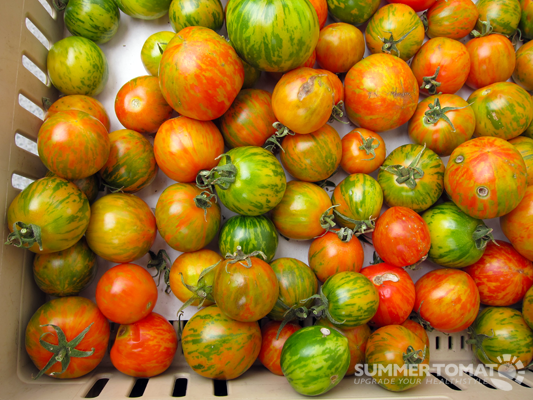
Red Zebra Tomatoes

Red Zebra Tomatoes

I checked the weather report this morning and apparently most of the US is experiencing 100+° weather. You may be suffering, but I’m jealous of all of you. It was 57° here in SF this morning, and I wore a wool sweater and windbreaker to the farmers market, but once I got there I really wished I’d had my scarf and hat. Burrrrrrr!

The grass is always greener, right?

Thumbalina Carrots

Thumbalina Carrots

I love sun and heat, but the one advantage I had this morning was that pictures turn out much better on overcast days. Since no one told the sunny farms around the Bay Area that it isn’t actually summer here, we had all the bright, beautiful produce a warm summer would promise. We just have to eat it in the cold.

Golden Beets

Golden Beets

It has actually been weeks since I’d last been to the market, due to the extensive travel schedule I’ve had this summer. And despite my shivers it was sooooooo nice to be back.

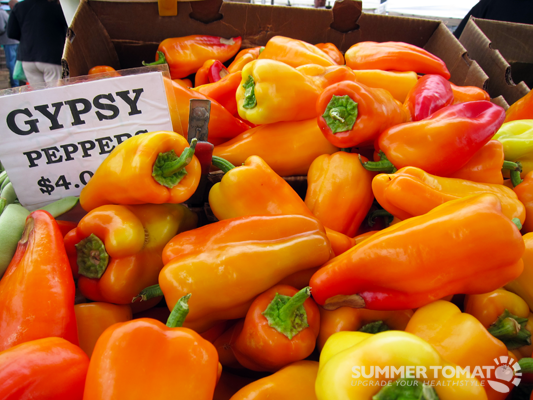
Gypsy Peppers

Gypsy Peppers

Gosh vegetables are beautiful this time of year. Have you ever tried purple beans?

Purple and Green Beans

Purple and Green Beans

Needless to say I bought everything I could carry in two Mercado bags, doing my best to take advantage of the produce peaking this time of year. Stone fruits like peaches, nectarines and plutos (plums) are working their magic right now.

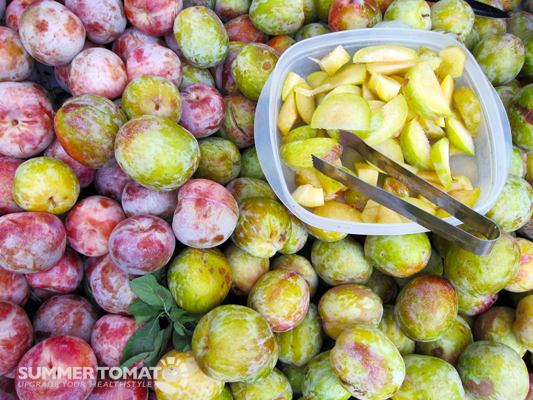
Pluots

Pluots

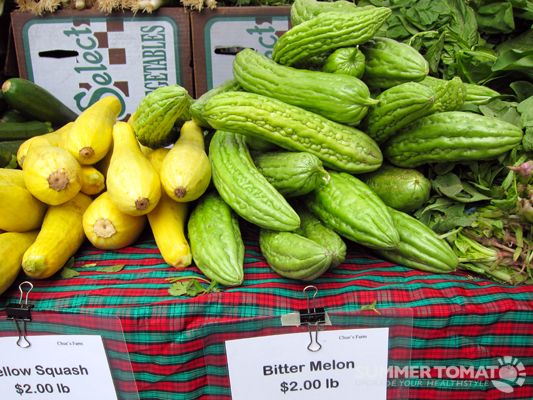
Summer squash is something I look forward to all year. I was particularly excited today to find bitter melon, a vegetable I ate a lot of in Okinawa earlier this year.

Squash and Bittermelon

Squash and Bittermelon

Honestly I may have purchased more than we can eat, but we’ll do our best.

Today’s purchases (~$40):

What did you find at the market this week?

Tags: , , , ,

10 Simple Substitutions to Make Restaurant Meals Healthier

by | Aug 1, 2012
Photo by basheertome

Photo by basheertome

I pity the fool who puts health over pleasure every time they enter a restaurant, but if you eat out often all those French fries could get the better of you.

When nothing on the menu perfectly fits my preferences (particularly at low to mid-range places more tailored to the Standard American Diet crowd), I don’t hesitate to swap out whatever I don’t want with something better.

Whether it’s to avoid processed foods or simply add vibrance and color to my plate, here are 10 simple swaps to make the most of your restaurant meals.

10 Simple Substitutions to Make Restaurant Meals Healthier

1. Mixed greens instead of ice burg or romaine lettuce

I enjoy cobb salads, but for some reason they’re usually served with boring industrial lettuce. Most places these days carry mixed greens or spinach as well, and are usually happy to make the switch.

2. Fruit instead of toast

I’m not sure why breakfast spots think you need two giant pieces of toast on top of your potatoes, eggs and pancakes, but if you don’t want it they’ll often offer you fruit instead. This is one of the best upgrades you can get away with.

3. Salad instead of potatoes

Speaking of potatoes, while they are real food and have their place in a healthy diet, they’re so often fried in rancid industrial oils that it’s best to skip them. Swapping them out for salad or cooked greens is rarely a problem.

4. Avocado instead of mayo

Real mayonnaise, the kind made from egg yolks and olive oil is perfectly healthy (and delicious). Unfortunately that isn’t what most places are putting on your sandwich. Instead commercial mayos are typically made with soybean or canola oils, AKA hyper-processed industrial oils. It may cost a little extra, but avocado is a fantastic alternative to gooey up your lunch.

5. Cheese plate instead of dessert

One of the things I love about France is that it’s perfectly acceptable to have cheese after dinner instead of sugar. If everyone is ordering crème brûlée and you don’t want to be a party pooper, get the cheese plate instead. Good cheese is healthy.

6. Brown rice instead of white

I don’t mind white rice in small quantities, but if I’m stuck eating somewhere I know the food isn’t very healthy I swap out my white rice for brown (and order as many vegetables as possible) if the option is available.

7. Drink wine instead of cocktails

Dinner often starts with a drink selection. While wine certainly has calories, cocktails usually have hundreds more thanks to the liqueurs and syrups typically used. Mixed drinks have their place, but if you’ll also be eating  a few hundred calories then wine is a better choice.

8. Beans instead of rice

If I see beans or lentils anywhere on the menu I’ll often ask if the kitchen can use them instead of one of the faster digesting starches on my plate. Your waiter may be confused, but he’ll usually do it if you ask.

9. Olive oil and vinegar instead of sugary dressing

At some point in the past 20 years salad dressings started being made with ridiculous amounts of sugar and salt, probably to cover up the completely flavorless vegetables from the industrial food chain. Good ol’ fashioned olive oil and vinegar is a better choice, and most kitchens have them.

10. Anything instead of American cheese

Have you ever looked at the ingredients for American cheese? Besides water, the first ingredient is usually trans fat. The second is cornstarch. All the way at the bottom it says, “Contains: Milk.” Replacing it with real cheddar, gruyere, provolone, or even nothing would be healthier.

What are your favorite restaurant substitution tricks?

Tags: , , , , , , , , , , , , , , , , ,

How To Make Cauliflower Taste As Good As French Fries: Roasted Curried Cauliflower

by | Jul 30, 2012
Roasted Curried Cauliflower

Roasted Curried Cauliflower

I’ve resisted publishing this recipe for months because I was worried it was too simple for an entire blog post. But every time I cook it for someone (which I do all the time because it is so easy and delicious) they ask me for the recipe so they can try it themselves. Now I can just send them a link 🙂

What’s weird is that this is just roasted cauliflower, it couldn’t sound any less glamorous. But for some reason roasting cauliflower completely transforms it from a vegetable people are pretty sure they don’t like into something they just can’t get enough of.

The coolest part of all is that anyone (like ANY anyone) can make this. I like to add curry powder to mine, but you can play around with whatever spices you like, or just make it plain. The trick is to use a very hot oven, around 450-500 degrees. Covering the cauliflower for the first 15 minutes steam cooks it. Then when you remove the foil the high heat browns and caramelizes it, giving the cauliflower a slightly crisp texture and complex flavor that is irresistible.

It still freaks me out how good this recipe is.

Roasted Curried Cauliflower Recipe

Serves 2-4

Ingredients:

  • 1 large cauliflower (or several small ones), ~2 lbs
  • Curry powder
  • Olive oil
  • Kosher or sea salt

Preheat oven to 500 degrees. Break cauliflower into medium-small florets and place into large bowl or baking pan. Be sure the pieces are as evenly sized as possible, or they will cook unevenly. The smaller you make the pieces, the quicker they will cook and the more caramelized they will become, which I consider a good thing.

Drizzle cauliflower pieces generously with olive oil and season well with salt and curry powder. Distribute evenly in a single layer at the bottom of a baking pan. If necessary, use a second baking pan to be sure the pieces aren’t too crowded.

Cover the pans with foil and place into the oven. Roast, covered for 10-15 minutes. The cauliflower should be slightly soft and start looking translucent. If not replace foil and cook another 5 minutes.

When the cauliflower has finished steaming, remove the foil and toss with tongs. Continue to roast, stirring every 8-10 minutes until the tips of the cauliflower begin to brown and become crisp as pictured. Approximately 30-35 minutes.

Adjust salt to taste (you will probably need another sprinkle) and serve.

Have you ever tried roasted cauliflower?

Originally published July 21, 2010, and is widely considered my best recipe of all time.

Tags: , , , , ,

10 Reasons You Hate To Cook (And What To Do About It)

by | Jul 25, 2012

Photo by liber

I don’t like the word hate and try not to use it. I especially dislike it when it is applied to any kind of food or cooking.

Do you really hate asparagus? Or are you just whining about something you haven’t bothered to learn to appreciate? Yeah, I thought so.

My theory is that most people who profess to hate cooking are actually just making excuses to avoid it. Why would anyone really hate cooking? What did cooking ever do to you?

The sad part is that cooking is a wonderful skill to have. Not only does it save you time and money on food, it can also contribute to better health, bring you closer to friends and family, and be a great creative outlet for stress.

You don’t have to love cooking, but knowing the basics and feeling competent in the kitchen can open a world of opportunity to improve your quality of life. But sure, go ahead and hate it if you want.

For the cautiously curious, here are a few of the obstacles that may be preventing you from getting past your pessimism and what to do to get over them.

10 Reasons You Hate To Cook

(And What To Do About It)

1. You suck at it

The first thing you need to do is understand the difference between not liking cooking and not liking to be bad at cooking. Big difference. I didn’t like being bad at cooking either, but there is a pretty easy solution: learn how. It’s much easier than you think.

2. You’re slow

I know you’re busy. We all have better things to do than slave away over one lousy meal. But when you aren’t experienced in the kitchen the planning, shopping, chopping, cooking and cleaning involved in making a meal can feel like it takes forever. That’s because it does.

I can always spot a kitchen rookie by how long it takes them to chop an onion (seriously it takes like 20 seconds max). The good news is with a little practice and some decent knives (see point 3) you can slash the time you spend making a meal until you barely notice.

Ditto for cleaning up. Seriously, put some muscle into it and it’s over in no time!

3. You have crappy knives

I generally don’t advise spending money to solve problems, but knives in the kitchen are an exception. Spending $50 on a half-way decent chef’s knife can do wonders for your kitchen confidence and efficiency.

And you probably already know what an inspiration a shiny new toy can be.

4. You pick complicated recipes

Some of the best meals I’ve ever eaten have less than 5 ingredients. If you’ve never cooked anything in your life, cassoulet shouldn’t be your first choice.

Rather than finding a recipe and deciding to cook it, start with an ingredient that is seasonal and you know you enjoy. It’s hard to mess up kale and garlic. Learn to fly before you jump off a cliff.

5. You choose out of season ingredients

The main reason people don’t like _(fill in the vegetable)_ is because they have only had it from industrial farms that grow foods out of season. I agree, you’d have to be a masochist to like these impostors.

Farmers markets and dedicated produce stands are your friends. In season ingredients taste worlds better than the out of season stuff shipped from the opposite hemisphere. Your food doesn’t have to be 100% local, but at least pick foods that grow in the same season you happen to be living in. This alone could completely change your cooking experience.

6. Your pantry is inadequate

It can be really annoying to flip through a recipe book or food blog and realize that you need to make one or many grocery trips in order to make any dish because you don’t have olive oil, salt, pepper, red wine vinegar or red chili flakes. If you don’t know what belongs in a basic pantry, check out my free How to get started eating healthy guide for a rundown.

7. You cook everything to death

Just because your mom cooked broccoli until it was dark gray and could be eaten by an infant doesn’t mean that’s how food is supposed to be prepared. Most vegetables cook quickly and taste better when they haven’t been incinerated. When your vegetables turn bright green in the pan, that’s your cue that the cooking is nearly done.

8. You only cook for large groups

Your first cooking forays shouldn’t be huge productions. Start simply and don’t bite off more than you can chew by promising to host a dinner or bring food to a potluck of 30 people. Start by volunteering to help in the kitchen with someone who knows what they’re doing. Make a side dish, or a simple one pot meal for yourself.

Practice makes perfect, and you want your first experiences to go smoothly to build your skills and confidence.

9. You only cook for special occasions

New cooks don’t need any extra pressure in the kitchen. If you’re just learning your way around the range, maybe you should hold off on hosting Thanksgiving dinner or Mother’s day brunch. It can be stressful to just coordinate a large meal, you don’t need the added pressure of possibly ruining a family holiday. If you want to contribute, volunteer to make the salad or biscuits. Start your real kitchen adventures in the privacy of your own home.

10. You don’t ask for help

If you are truly new to cooking, you may as well acknowledge that you will be slow and lack the basic skills and intuition of a seasoned chef. You are definitely capable of getting there, but in the mean time make your experience as pleasant as possible by letting others contribute their expertise and knife skills when you want to cook. It is also nice to have an extra pair of hands for cleanup.

Do you really hate cooking? Or are you just looking around the room and saying that you hate things?

Originally published May 31, 2010.

ATTENTION: Due to the excessive negativity of some recent commenters, I am permanently closing the comments on this post. If the contents of this article make you want to scream in rage, stab someone, punch a wall, or hurl yourself off a bridge, I suggest you find a therapist.

Tags: , , , , , ,

10 Ways To Make Your Salad More Satisfying

by | Jul 18, 2012
Quinoa Salad

Quinoa Salad

One of my favorite things about the arrival of summer is all the beautiful, crisp salad greens at the farmers market. I absolutely love to eat salads, but how can you turn a salad into a full meal that is truly satisfying?

The trick is to make sure you add enough protein, fat and carbohydrates to your salad so it is still a perfectly balanced meal.

There are dozens of healthy additions you can use to make your salad more filling and delicious. Here are 10 of my favorites.

10 Ways To Make Your Salad More Satisfying

  • Warm ingredients Grilled or sauteed onions, peppers, mushrooms and meats wilt salad greens and make them slightly warm, adding depth and character to an otherwise boring salad.
  • Brown rice Adding 1/2 cup of warm rice to a salad makes it more satisfying to eat and keeps you full for longer. Use single serving rice balls and this simple addition will add less than 2 minutes to your salad prep time.
  • Nuts Walnuts and sliced almonds are my favorite, but feel free to try pecans, cashews, peanuts, pumpkin seeds or anything else that sounds interesting.
  • Beans Chickpeas, black beans, edamame and other legumes are inexpensive and delicious sources of protein and fiber to add some substance to a salad.
  • Avocado Half an avocado is sometimes exactly what a salad needs to take it to the next level.
  • Smoked salmon For a slightly more upscale salad experience top your greens with a few slices of smoked salmon.
  • Quinoa Mix in a small amount of quinoa as an accent or make it the base of a salad by adding cooked or raw veggies and greens. See my Mexican-style quinoa salad recipe.
  • Grilled meats Your salad is a great place for summertime BBQ leftovers.
  • Egg Boiled, fried or poached, an egg is a wonderful way to make your salad more substantial. See my Summer salad with poached egg recipe.
  • Sardines Canned fish is one of the easiest ways to get extra protein and omega-3 oils in your salad. Here are 6 reasons to eat more sardines.

How do you make your salads more hearty?

This article was originally published June 8, 2009.

Tags: , , , , , , , , , , , , , , ,

Farmers Market Update: Burgundy, France

by | Jun 24, 2012

Wild Asparagus

Elyse Kopecky is an Oregonian living, working and playing outdoors in Geneva, Switzerland. She’s a passionate foodie lifestyle blogger who enjoys inspiring friends to live fresh. Follow her adventures in the kitchen and on the trail at www.freshabits.com and @freshabits.

Farmer Market Update: Beaune, France

by Elyse Kopecky

Beaune is a historic ville surrounded by vineyards and small organic farms spread across rolling hills. It’s known as the wine and gastronomic capital of the Burgundy region, and for good reason. The tiny town comes alive on Saturdays with an impressive local food market featuring specialties from the Burgundy region.

Beaune Market Square

I have a passion for farmers markets (borderline obsession) and often drag my husband to obscure places just to check out the local market. I first fell in love with Beaune in March when my husband and I planned a fun Burgundy-wine-and-cooking weekend excursion to celebrate our 7th anniversary.

Buying Vegetables

My husband and I returned for a second visit this June. Our trip was well timed. The bountiful spring harvest had begun, and the stands in the market were packed with an array of colorful fruits and vegetables. I loved all the variations of fresh berries, including wild sweet strawberries, tart currants, blackberries, and cherries.

Wild Berries

Wild Berries

The Beaune farmers market takes over a historic square in the heart of the walled old town and overflows into the surrounding cobbled side streets. Within the square there is a well-worn covered food market where you’ll find the butchers, artisan cheese makers, and fishmongers setting up shop.

Market Crowd

Don’t be alarmed that the meat actually resembles the animal, meaning the chickens, ducks, and pigs still have their endearing heads attached. That’s how the French spot quality and freshness.

Outside, the square is packed with rows of tables where the farmers sell everything from seasonal produce to olives, dried herbs, cured meats, farm-fresh eggs, crusty baguettes, creamy honey, hand-pressed oils, freshly picked flowers, and of course Burgundy wine (Pinot Noir and Chardonnay are the specialties of the region).

Cured Meats

One of my favorite stops was the stand of a young organic farmer from the Ferme duJointout, where they grow a rotation of seasonal vegetables and raise grass-fed goats and sheep. By the time my husband and I got to the Jointout stand, all that remained were a small selection of cheeses and a few bouquets of herbs, spring greens, and lettuces. With dirt from his farm caked beneath his fingernails, the young farmer looked as if he had arrived at the market straight from the field. A sure sign of farm-to-table!

Organic Farmer

I bought one of his last heads of deep purple romaine lettuce and my favorite chevre frais (goat cheese). The chevre frais was the first item we polished off when we arrived back at our home in Geneva. The Jointout artisan cheeses are so fresh and creamy that they alone are worth driving to Beaune to discover.

The French are serious about their food. They will happily talk about their produce, where it comes from, how it was grown, and how best to prepare (cook in butter, top with cream of course!).

Chanterelles Mushrooms

Chanterelles Mushrooms

Burgundy is proudly a leading region for organic food (called agriculture biologique) and most of the surrounding farms open their doors to visitors (you can buy half a lamb directly from the farm). Although, you do have to be careful that you’re buying from the “producers” and not the “traders,” just as you have to be in any market in Europe, but the traders are fairly easy to spot because their stands are usually full of bananas and pineapples, items clearly not native to France.

Organic Radishes

I made my way up and down every aisle and easily filled my basket to its brim. Luckily I had my husband tagging along to carry the load.

The Bounty

Here’s what we purchased:

  •  wild strawberries
  • cherries
  • blackberries
  • charentais melon (French variety)
  • baby potatoes
  • green dried lentils
  • wild asparagus
  • romaine lettuce
  • rhubarb stalks
  • coeur de boeuf tomatoes
  • sunflower honey
  • chevre frais
  • whole grain baguette
  • Burgundy Pinot Noir

Thankfully, Beaune is an easy two-hour drive from Geneva. My husband and I are already planning a return visit during the fall harvest. You can read more here to explore the impressive organic farmers and winegrowers in the Burgundy region.

Bon app!

Tags: , , , , , ,

Tips To Keep Produce Fresh

by | Jun 11, 2012
spring vegetables

Vegetables

“How do you store fruits and veggies so they don’t go bad? It seems like I can never keep things fresh…”

I employ several different strategies to keep my produce in good condition until I’m ready to eat it. Here are my tricks for buying, cooking and maintaining the freshest fruits and vegetables.

Shop Regularly

Although it is probably self-evident, I think it is important to state that the freshest vegetables are the ones you bought today. They are even fresher if you get them at the farmers market (picked yesterday) rather than a grocery store that imports produce from around the world. In order to keep fresh vegetables and fruit in the house and eat healthy, you must shop for produce and groceries at least once a week.

Download my free guide for more tips on How To Get Started Eating Healthy.

Shop Strategically

This is my true secret to keeping food fresh. Different foods have different shelf lives, and you can take advantage of this fact when planning your meals for the week. Always make sure you buy a few robust vegetables for your Thursday and Friday night dinners (or try to schedule your restaurant dates for later in the week).

Cruciferous vegetables (both leaves and roots) store the best and can last well over a week in the crisper. Examples of cruciferous vegetables are broccoli, kale, collards, cabbage, chard, cauliflower and brussels sprouts. Root veggies include carrots, beets, parsnips, sunchokes and potatoes.

Summer squash can last for many days in a dry plastic bag in the crisper, and winter squash can last weeks on a shelf. Eggplant has a shelf-life similar to summer squash and can be stored in the same manner. I’ve heard eggplant keeps even better outside the fridge, but I’ve never tried.

Delicate vegetables like lettuce, spinach and other spring greens are not as robust and should be eaten more quickly. Juicy fruits like berries, stone fruits and even tomatoes are more time sensitive and should be incorporated into meals earlier in the week.

Cook Intelligently

Having a rough idea of what meals you are going to make during the week can help you keep veggies fresh in several ways. In addition to planning your dishes around which vegetables last the longest, you can also prepare large batches of food early in the week then freeze or refrigerate the leftovers to eat later.

Avoid over-shopping by buying ingredients to use in multiple different dishes, rather than buying extra items for vastly divergent menus. For example, rather than purchasing red peppers for a stir fry and radishes for a salad, you can skip the radishes and add your extra pepper to your salad instead.

When buying herbs, I like to get one bunch of Italian parsley (it keeps a long time and is incredibly versatile) and only one bunch of a more delicate herb like thyme or cilantro. With this strategy you can explore recipes of different cuisines that utilize similar ingredients. For instance, if I have cilantro I may make Mexican food one night and a Vietnamese dish another night. Both incorporate fresh vegetables and herbs, but the flavor profiles of these cuisines are entirely different.

This is where it comes in handy to have a well-stocked pantry–go beyond the basics and learn to work with ingredients like fish sauce, coconut milk or quinoa. This is a great way to delve into a cuisine and explore different flavors.

Store Properly

Proper food storage can also go a long way in keeping your produce as fresh as possible. Generally speaking, most vegetables maintain their crispness best in the aptly named refrigerator compartment, the crisper. Crispers have different humidity settings than the rest of the fridge and are optimized for vegetables.

I find that leafy greens and herbs keep best in dry plastic bags or tuppers. When you get home with a large bag of salad greens from the farmers market, rinse them clean and spin them in a salad spinner. Let them sit out for an hour or so to completely dry, then put them in large tuppers to store for the week. With this strategy the crisper is not necessary.

Most fruit (including tomatoes) I keep outside the refrigerator to protect the taste, but berries are an exception. I have had fantastic luck using a reader’s suggestion to keep berries in a jar or tupper with the lid closed tight. I always put my berries away immediately after getting them home, trying to handle them as little as possible to keep any mold or bacterial spores out. I try to roll the berries into their new container without actually touching them with my hands. I buy berries much more often now 🙂

Revival Techniques

Sometimes despite your best efforts you end up with a wilted head of lettuce or a floppy bunch of basil. But if wilting is your only problem and the plant looks otherwise edible (still green and free of mold), all is not lost!

The reason plants wilt is they lose water from their cells to the environment through osmosis. But the osmotic properties of leaves can be used to your advantage. You can revive wilted greens by submerging them in a bath of cold water for 30-60 minutes, which replenishes the water in the leaves and allows them to regain their crispness! It is astounding how much they will perk up.

I learned this trick from a friend and fellow scientist–one of the many advantages of being a little nerdy.

Mold is another issue when storing fruits and vegetables, but you can sometimes salvage a batch of food if you catch it early and carefully remove all traces of it to keep it from spreading to the rest of your produce (this may involve finding a new container for the uncontaminated portion). Remember, mold is a living, growing thing that breeds more of itself. Keeping foods in sealed containers and touching them as little as possible with your hands can help control it.

Finally, fruits produce gases that cause neighboring fruits to ripen more quickly. If you have something that is perfectly ripe or over ripe, you may want to keep it away from the rest (unless of course you want the nearby fruit to ripen faster). Likewise, keeping fruits in bags will trap the gases and cause them to ripen more quickly.

Conclusion

With a few tricks and a strategic plan it is possible to keep fresh fruits and vegetables in the house for an entire week. Beyond that it is a little tough if you want your food to be truly fresh.

How do you keep your veggies fresh?
StumbleUpon.com

This article was originally published June 22, 2009.

Tags: , , , , , , , , ,

Farmers Market Update: Patras, Greece

by | Jun 3, 2012

Organic Farmers Market in Patras, Greece

After working as a post doctoral fellow for 5 years at Washington University in St. Louis, Matthew Denos of Zorqe.com, a biologist, feels privileged to live in Greece. Being a foodie with a desire to help people lose weight safely, he offers a  Nutrisystem promotion, a clinically studied weight loss program.

Farmers Market Update: Patras Organic Market, Greece

by Matthew Denos

Bottles of Wine

It was a sunny and busy day in Patras, Greece and I headed out to the farmers market. I didn’t want to miss it because it runs only once a week.

What differentiates this Farmers Market from other conventional markets in the area?  This is a 100% organic farmers market. All the food in this market is organic. That means that the food grows without pesticides, herbicides or any fertilizers. In addition, the ground where the plants are cultivated has been left to clear of these chemicals before the seeds are sown.

Farmers from all over West and South Greece gather here every Tuesday to sell their organic produce. All kinds of colorful vegetables, juicy fruits, cooking herbs, wine, honey, and even organic soap and aromatic and antiseptic extracts are sold here. I love it because it is the best place in the area to buy Certified Organic Produce at affordable prices.

Being located in the sunny Mediterranean basin, Greece is the heaven of farm products. It is the country where the Mediterranean diet developed, a way of eating that has now become a part of the country’s history, tradition, and culture.

Fresh fruits and vegetables are at their prime in spring and therefore I was expecting an abundance of oranges and lemons, as well as the first of the year’s harvest of strawberries, tomatoes, cucumbers, eggplants, peppers, garlic and onion stems, but also all kinds of leafy vegetables that Greeks call horta (wild radish, dandelion, mustard, etc). I desperately wanted to stock up on some of my favorite late spring produce.

Eggplants and Peppers

When I arrived at the market place in late afternoon, growers and producers were standing behind their stands brimming with seasonal food. Their contagious enthusiasm and pride in their products drew many customers. All seemed to enjoy themselves. There were about 30 stalls under red and white awnings arrayed in two lines facing each other.

I started off at the potatoes stall. If I were allowed to  put only one organic vegetable on my table, that would be potatoes for 3 reasons: First, I am potato guy. I eat potatoes almost every day. Second, organic potatoes taste so much better than conventional ones. Third, potatoes have one of the highest levels of pesticide residues among conventional produce. So, here I am, loading my basket with 5 kilos (12 lbs) of great organic potatoes.

Stocking up on Potatoes

Stocking Up on Potatoes

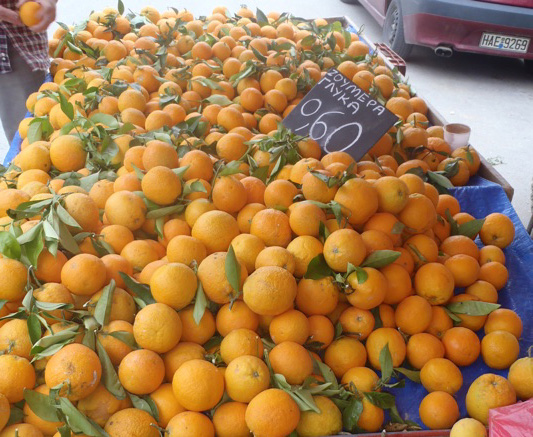
Do you see the oranges and lemons on the other end of the stall? These are two of the most abundant fruits in Greece. Citrus groves are almost everywhere especially in Peloponnese, the Southwest part of Greece. The annual citrus production is close to 1 million tons, the majority of which is oranges, mandarins and lemons. One third of it is exported to Western Europe and the Balkan countries.

Oranges

If you ever visit Greece in Spring, when citrus trees boom, as soon as you get out of the airport you will smell the characteristic intoxicating citrus scent that fills the air this time of the year. Oranges sell for 60 cents a kilo (euro), the equivalent of 34 cents/pound (USD). I put 15 kilos (36 pounds) in my bag. I eat 2-3 a oranges a day.

Lemons

The label says: “Fresh and Juicy,” and heck are they!

“I’m telling you, no taste!”

You see this vendor talking to my brother? When I took this photo, the vendor was  telling my brother his story. Back in the 70s, he visited Los Angeles, CA. He was going to get married with a very rich Californian woman. The woman was so wealthy that  she bought him an expensive Corvette as soon as the he landed in LA. He finally did not marry the girl and decided to come back to Greece. But what still lives vividly in his memory is that some of the fruits he ate in California were not as tasty as the ones in Greece. You see his gesture? “I am telling you, they had no taste” says emphatically shaping a “zero” with his two fingers. I am sure Darya will refute that, as will my brother who has lived in LA. Kinda funny, isn’t it?

Down the lane a bit, a beautiful display of tomatoes! My favorite vegetable. Or should I say fruit?

Tomatoes

I filled my bag with 2 kilos (4.4 lbs). When I later ate a few at home, I could clearly see how much better they taste comparing to conventional tomatoes.

Zucchini

Brocolli stems, beets, green beans, and squash (zucchini) were abundant in many stalls. The zucchini fruit is very popular in Greek recipes where we usually boil them (some prefer to fry them) and eat them with olive oil and garlic. Delicious appetizer! I purchased some, boiled them next day, dressed them with virgin olive oil, lemon juice and pepper, and ate them with olives. They had a slightly sweet taste that went great with my turkey fillet.

Ready to make your own healthy Greek salad? This vendor sells horta. On his stall you can find lettuce, chicory leaves, spinach, rocket, garlic and onion stems, dill, parsley, and green Amaranth which is known as vlita in Greece. I used to grow vlita in my backyard.

Horta

Swinging around to the other side of the market, I stopped to sample these gorgeous looking olives. Could olives not be present in a Greek farmers market? Of course not! Anywhere you look in Greece you see olive trees. Olives are a real treat and one of the local favorites in Patras. There are at least 6 local olive varieties that differ in size, taste, and color.

Olive Bar

The olive “bar” at the farmers market is the right place to figure out exactly what your favorite type of olive is and purchase it.

Olives in Jars

The woman at the olives stand also sold smashed olives in little glass jars. Smashed olives spread on small barley rusks makes a delicious appetizer. I purchased two jars and they were delicious. The jar also contained red pepper, oregano and other herbs, which all added to the healthy taste and flavor to the smashed olives.

Smashed Olives

As I was taking a few pictures of the olives in the jars, the lady behind the stall asked me why I was taking pictures of her produce. I explained to her that I was going to write an article about the local organic Farmers Market and post it online. When she asked me what site I would publish it in, I took a piece of paper and wrote “SummerTomato.com”.

Link Sharing

She marveled at the fact that people in San Francisco would see her beautiful display of various types of organic olives.

SummerTomato.com

Strawberries are at the market each week. Their aroma is out of this world and they taste sooo sweet! Unfortunately, they sell out within 10 minutes of the market’s opening. Who can resist the aroma of 360 different esters, alcohols, terpenes, and aldhehydes that comprise the strawberry flavor! I was not there soon enough to take pictures. Next time.

Grape leaves are necessary for making dolmades, a Greek delicacy made of rolled vine leaves stuffed with rice, meat and seasonings. Look how tender, green, bright and clean they are, and totally organic. My brother bought 30 leaves. His wife used them to make the best “dolmades” I have ever eaten. The label says: ΑΜΠΕΛΟΦΥΛΛΑ, which translates to “grape leaves”.

Grape Leaves

Honey, royal jelly, and propolis—powerful natural antibiotics, medicinal marvels with many health benefits. The label says: “Royal Jelly, the battery with the longest life”. On the back shelf sits natural soap made of honey and propolis.

Honey, Royal Jelly, Propolis Soap

I talked with the vendor, Mr Nikos Smyrnis, a member of the Smyrni organic farmers family, who explained to me how they prepare their organic products in the family’s 37 acres in Arcadia, situated in the mountainous south Greece. They cultivate olive trees, vines, herbs, aromatic plants, and cereals.

Beeswax Candles and Honey

The little vial that the man is handing over to me contains an antiseptic solution of propolis. Ancient Egyptians, Greeks, and Romans used propolis as a pharmaceutical agent for its anti-inflammatory, anti-microbial, and pain-killing properties.

Antiseptic Propolis Solution

Antiseptic Propolis Solution

I ended my little tour in Patras’ Organic Farmers Market by visiting the wine stall. Sant’or is the name of the company that makes this absolutely fantastic organic wine.

Wine Sant’or

They have their own vineyards in Santameri, a beautiful village in west Greece, which I have visited a few times. They cultivate a local grape variety called Santameriana. I bought a 5-liter white Santameriana wine. It is served cold with multigrain bread, seafood, and white cheese. Yum!

Sant’or Wine

Here is another vendor selling their own organic wine. The label says: Wine made of organic grapes, 2 euros (USD2.6) per bottle.

Wine

The Organic Farmers Market in Patras runs every Tuesday from 2:00 pm to 6:00pm in the winter season (up to April 30th) and 4pm-8pm during the summer season (up to October 1st). Greek organic producers love their agriculture. If you ask them about their products they have a story to tell you for each one of them.

Smell the freshness!

Tags: , , , , ,

How To Make Eggs Taste As Good As Bacon

by | May 30, 2012
Fried Eggs

Fried Eggs

Something magical happened a few weeks ago. While trying to figure out what to do with the first fresh eggs I’d found at the farmers market this season, I discovered the greatest egg ingredient in the history of mankind.

Okay, maybe I’m exaggerating a little (truffles are pretty darn good on eggs), but not much.

Generally I am a big fan of adding some kind of ground red pepper (usually chipotle or ancho) to fried or scrambled eggs. But this day I tried something a bit different.

Digging through my pantry I remembered that I had a ton of smoked paprika left over from the hummus I made. I decided to do an experiment and sprinkle the smoked paprika onto my eggs.

I can’t believe I went all my life without knowing about this.

But before I explain why exactly the smoked paprika made my eggs so amazing, I want to address what I’m sure many of you are wondering:

How healthy are fried eggs?

Answer: Eggs are perfectly healthy, and frying doesn’t make them any less so.

Personally I cook my eggs in olive oil (it’s just easier), but even if you use butter it isn’t a problem since the amount you need to cook is so small.

What scares people about frying eggs is an irrational fear of dietary fat. But theoretically the amount of oil you use to fry an egg should be about the same as you need to scramble eggs, so it isn’t clear why fried eggs would pose any more of a problem. I use olive oil to scramble eggs as well.

The other issue people have with eggs is the yolk. It amazes me how often people proudly inform me that they eat eggs but “only the whites,” as if this were some unique virtue.

I understand that the public health message we’ve heard about eggs for the past few decades has been extremely negative, but eggs have since been completely exonerated from heart disease accusations. There was a time when it was assumed that dietary cholesterol (which is definitely higher than normal in eggs compared to other foods) would raise blood cholesterol, but it doesn’t for most people. In fact, the healthy fats in egg yolks are likely to positively impact your good HDL cholesterol.

Moreover, dietary fats in general have been shown to be excellent at satiating hunger, and are thus a terrific replacement for calories from refined carbohydrates. That makes egg yolks your ally in fighting heart disease and burning fat, not your enemy.

Then there’s the fact that egg yolks are incredibly rich in vitamins and minerals, since they are meant to be nourishment for a developing life.

And finally there’s the most important part, that farm fresh egg yolks are out-of-this-world delicious.

Which brings me back to how to make the best eggs in the universe.

First you must start with high-quality eggs. Two factors have the biggest impact on egg flavor. The first is the diet of the hen who laid the egg, and the second is the egg’s freshness. Thus for best results you want to find the freshest pastured eggs you can get your hands on. Pastured means the hens that lay the eggs are allowed to peck around on grass eating bugs and whatever else they find.

Your best shot at finding pastured fresh eggs is at a farmers market or direct from a farm, since if they are already on a grocery shelf they probably aren’t very fresh. Try to find eggs less than 1 week old. Their day of boxing should be clearly marked on the carton. It requires a little math, but I’m not the one who made up these rules.

Chances are good that if your eggs are very fresh then they are from pastured hens, but this is not guaranteed. Ask the farmer and try to hold out for hens that are allowed to roam free in grass during the day. If you cannot get fresh pastured eggs, “cage-free” is your next best bet for flavor (though these may still be fed a limited diet).

Without asking the farmer it is hard to tell the difference between real pastured eggs and industrial eggs labeled “cage-free” that are still fed standard or organic chicken feed. One good indication will be the price, since pastured eggs tend to run $6-10/dozen here in SF. Trust me, it’s worth it.

I do not endorse the taste or healthfulness of industrially produced eggs (even the fancy kinds), and if you do eat them you should be careful to cook them completely.

(Aside: I never worry about the safety of eggs from farms I trust, so I always eat them runny. If you think runny eggs are gross, I don’t blame you. Runny industrial eggs are gross, and before I had fresh eggs I would have completely agreed with you. But fresh egg yolk is incredible, and it is something you have to taste to really appreciate. I definitely recommend stepping out of your comfort zone on this one.)

Once you have great eggs, fry them one at a time in 1 tbsp olive oil or butter on medium low heat and sprinkle with sea salt, course ground black pepper and a pinch of smoked paprika. The paprika adds a depth and complexity above what even chipotle peppers can offer, and the smokiness is reminiscent of—I kid you not—bacon. Needless to say, it is the perfect compliment to eggs.

Fry your eggs for just two minutes or so on each side, being careful to keep the yolk intact while turning. You really don’t want to overcook eggs, which will turn them rubbery and ruin the effect.

I haven’t actually tried these eggs with bacon yet, though I certainly plan to. But bacon is no longer a requirement for making a show stopping breakfast of champions. Here I served them with some ruby chard sautéed with pistachios and garlic.

Did you guys know about smoked paprika on eggs and if so, why was I not informed?

Originally published March 3, 2010.StumbleUpon.com

Tags: , , , , , , , , , , , , , ,