Archive for November, 2009

Nov 30 2009

How To Get Started Eating Healthy

Filed under Basics,Offers

eat-healthy

“The distance is nothing; it is only the first step that is difficult.”

-Madame Marie du Deffand

For some people the idea of getting healthy is one of the scariest thoughts in the world. When something in front of us seems very far away, the distance appears insurmountable. Unfortunately, this illusion inspires intense fear. Not only are we terrified of the amount of work we face, we also fear the possibility of failure.

But for most journeys, the perceived length and difficulty is much greater than the true distance.

Getting healthy is no different.

Remember when you learned to ride a bike as a child. It probably seemed like a big, scary thing to do before someone took you out and showed you how. But after a few simple lessons you see how easy it is and quickly become proficient.

The truth is most problems are easier to deal with than we think they are. The hard part is just getting started.

To demystify healthy living, I put together a 25-page free guide to help you get started eating healthy. The guide is a simple blueprint explaining the basic first steps needed to upgrade your healthstyle.

How To Get Started Eating Healthy: The 7 Essential Steps To Getting Healthy and Losing Weight is based on a series I published several months ago, but I have updated the content and added a substantial amount of new material.

In it you will learn:

benefits2

To get your copy simply write your name and email address in the form below and you will receive an email with a link to download the PDF. You are free to share this report with anyone you feel might benefit from it.

If you are already subscribed to the Summer Tomato Newsletter (different from blog), you should have received an email with the link sometime this morning. Let me know if you have any problems.

Enjoy!

Note: If you use Ad-blocker on Firefox or other browser you may need to disable it to see the form. Alternatively, you can use the newsletter subscription form here.

8 responses so far

Nov 29 2009

Farmers Market Update: Holiday Weekend

Leeks and Beets

Leeks and Beets

Probably my single favorite thing about Thanksgiving is that no matter what, it is always on a Thursday.

This simple temporal restriction gives us three full days to recover from too many mashed potatoes and that extra slice of pie we really didn’t mean to have. It also gives us time to stock up on healthy foods for the following week.

The San Francisco Ferry Plaza Farmers Market tends to be relatively empty after a holiday, which is nice for regular shoppers. I used this opportunity to sleep in a little and stroll slowly through the market once before going back and making the bulk of my purchases.

As expected, peppers, tomatoes and all other remnants of summer are now virtually non-existent, while signs of winter are undeniable.

Mandarins

Mandarins

Mandarins, lemons and oranges are widely available, and today I found the first pomelo of the season.

Pomelo are like huge grapefruit with thick skin, except they are not sour. I first learned to appreciate these fruits in Thailand, where vendors will cut and clean them for you right on the street. These big green pomelo with pink flesh are probably my favorite variety (but don’t hate me if I change my mind 2-3 times this season as new ones come out).

Early Pink Pomelo

Early Pink Pomelo

Meyer Lemons In Basket

Meyer Lemons In Basket

As much as I love citrus though, it is still tough for me to get too excited about it when pears, apples and persimmons are so unbelievably perfect.

Fuyu Persimmon

Fuyu Persimmon

In the vegetable world, the rockstars this week are roots, stalks and hearty leaves. I’ve been loving Tuscan kale (the dark, bumpy variety), chard, broccoli, cauliflower, cabbage, fennel and Brussels sprouts.

Celery, leeks, beets, onions and sweet potatoes are also worth playing around with this time of year.

Organic Celery

Organic Celery

Taylor Gold Pears

Taylor Gold Pears

And of course, I’m still obsessed with winter squash. With nothing but olive oil and sea salt, roasted red kuri squash tastes like pumpkin pie only better.

Lastly, it seems that the weekend after Thanksgiving is also the best time to go to the farmers market if you happen to be Super Mario.

If you live in SF, it is worth a trip to the Ferry Building just to see these GIGANTIC porcini mushrooms. I wouldn’t even know where to start with one of these bad boys, but I can’t help but marvel at them with a twinge of envy.

Giant Porcini

Giant Porcini

Seriously, what could you do with a mushroom like this besides grow super big or get a 1UP? If I had a few of these I could definitely save the princess.

Chantarelles, trumpet mushrooms and several other normal-sized fungi varieties are also in season.

Did any of you make it to the farmers market this week?

Today’s Purchases:


3 responses so far

Nov 25 2009

Intact Grains vs. Whole Grains

Photo by Venex_jpb

Photo by Venex_jpb

If there is a single subject that befuddles the health-conscious eater, it is undoubtedly carbohydrates.

Most of us have seen the impressive results of at least temporarily restricting carbs, but studies examining the long-term effects of carbohydrate restriction are often ambiguous. Also, while some experts argue fervently for a low-carb lifestyle, some nutritionists still warn about the dangers of eating too much fat or protein.

So how do we know what to believe?

A full examination of the science behind carbohydrate metabolism is beyond the scope of a single blog post, and is in fact not entirely understood by the scientific community (for a thorough review of this topic read Gary Taubes’ book Good Calories, Bad Calories, which I will be reviewing soon).

However, there are a few things we do know about carbohydrates that are worth pointing out.

Lesson 1: Refined grains contribute to nearly every chronic disease in modern civilization.

It is universally agreed in the nutrition community that refined, processed carbohydrates are the worst things to eat on the entire planet.

And it is impossible to overstate how remarkable this is.

The nutrition community is one of the most disagreeable bunches in all of science. But across the board–from vegans like Colin Campbell to carnivores like Robert Atkins–not a single one of them considers processed carbs to be nutritionally neutral. They all consider them dangerous.

Without question, refined carbohydrates contribute to poor health.

Lesson 2: Vegetables protect against nearly every chronic disease in modern civilization.

Where things start to get more complicated is with unrefined carbohydrates, and the various iterations of this definition. There is ample evidence that the carbohydrates contained in vegetables are not harmful, and possibly beneficial.

To call these vegetable carbohydrates “fiber” is to oversimplify the science, but suffice to say that vegetables are good for you and contribute to your good health.

This is also generally agreed upon.

Lesson 3: Whole grains are different from intact grains.

Few people will argue against my first two points. But bring up whole grains and you will unleash a fury of controversy. Some people believe whole grains to be the cornerstone of any healthy diet, while others consider them superfluous and possibly detrimental to good health. You can find dozens of PhDs and MDs to back up your claims no matter what camp you align with.

So why is there so much disagreement? What does the science say?

The problem is that nutrition science conducted in free-living humans is virtually impossible to interpret. This is largely because the studies are so difficult to control and people’s behavior and self-reporting are so unreliable. Another problem is that the definition of “whole grains” has been watered down to a point where it is virtually meaningless.

One reason whole grains are hard to identify is because the US Food and Drug Administration (FDA) has created a definition that is friendly to food companies, but not to consumers.

The FDA requirements for a manufacturer to use the term “whole grain” on its label (along with the respective health claims) are as follows:

“Cereal grains that consist of the intact, ground, cracked or flaked caryopsis, whose principal anatomical components – the starchy endosperm, germ and bran – are present in the same relative proportions as they exist in the intact caryopsis - should be considered a whole grain food.” (emphasis added by me)

Get it? To be considered “whole,” grains do not actually have to be intact.

Thus food manufacturers create products using this loose definition to their advantage, demolishing grains as normal, then adding back the required ratios of grain parts (germ and bran) to meet the standard.

This is how products like Froot Loops get spiffy health labels claiming they lower heart disease when any unbiased nutrition scientist would agree that, with 41% sugar by weight, Froot Loops almost certainly contribute to heart disease.

On the other hand, there is compelling data that intact whole grains contribute to better health.

Lesson 4: Eating grains is a personal choice, not a nutritional imperative.

The good news is that it is really easy to tell the difference between fake “whole” grains and intact whole grains. If a food actually looks like a grain (i.e., it retains its original form and bran covering), then it is an intact grain. If it looks like a Cheerio, chip, loaf of bread or pasta with a “whole grain” label, then it is a fake whole grain.

People following a primal or paleo diet will argue that this difference is irrelevant and that all grains (and legumes?!) are unnecessary for good health. Personally I disagree, but remain fairly neutral on the personal choice of removing grains from the diet entirely.

Grains do not appear to be necessary for survival (Inuit tribes survive without them), but optimal nutrition may require slightly more effort than would be necessary following a traditional balanced diet.

This is generally how I feel about all healthy, restrictive regimens such as vegetarian, vegan and raw diets. You can make it work for yourself if you are willing to make sacrifices and put in the effort.

However you should be aware that for many people, myself included, cutting whole grains out of your diet completely is extremely difficult and, if you ask me, unnecessarily painful.

Conclusion

When making food choices about grains, the critical question is not whether or not a food is “whole” grain but whether the grain is intact. For this reason, it matters very little if you substitute “whole grain” products for regular refined products such as pasta.

Examples of intact grains are oats, barley, brown rice, whole wheat, quinoa (sort of) and faro. White rice is not a whole grain, and is closer to a refined grain than a whole grain.

For optimal health, processed and refined grains should be eaten very sparingly. Small amounts such as those eaten in traditional cultures can be part of any healthstyle, but including them is a personal choice that will depend on your own goals and preferences.

The irony is that if you are able to remove processed foods from your diet, the way you eat could probably be described as low-carb. But this label really undermines a healthstyle based on real food.

Though I eat relatively few grains compared to most Americans, I cringe when I see the shining example of low-carb living, The Atkins Diet website, with images of fake pancakes and pasta plastered all over it. If that is what low-carb is, I want nothing to do with it.

Processed food is still processed food, whether the carbohydrates have been synthetically removed or not. Stick to eating real food and you’ll never have to worry about carbs.

Do you count your carbohydrates?

29 responses so far

Nov 23 2009

Thanksgiving Healthy Eating Tip: Slow Down

Photo by Photo Monkey

Photo by Photo Monkey

Worrying about carbs, calories and diets is one of the most unproductive things you can do on a holiday that celebrates thankfulness. Instead of giving you a list of healthy side dishes or tips on how to cut out calories, this Thanksgiving I offer just a single piece of advice: slow down.

The actual content of your Thanksgiving dinner matters very little in the grand scheme of things. A few hundred calories here or there can make a difference when projected over weeks and years, but for one meal the impact is negligible. Your body will adjust naturally and you’ll burn off those extra calories the next day, so don’t worry about it.

But for people trying to get healthy or lose weight, not worrying about food can feel very strange. There is always the fear that if you aren’t vigilant and conscious of what and how much you eat you may gorge yourself stupid and all your hopes of fitting into your favorite jeans by the end of the year will be ruined.

Overeating is certainly a possibility when food anxiety is a constant force in your life, but Thanksgiving is a perfect opportunity to start getting over it. Really. It may seem counterintuitive that such a food-forward holiday can be stress free, but let’s not forget that the real point of Thanksgiving isn’t turkey or pie, but being thankful.

Since most of us won’t be harvesting our own meals this year (hats off to anyone who is), it is silly to pretend this particular dinner requires more thankfulness than any other meal we eat. Turkey, stuffing and cranberry sauce are tradition, but do not necessarily reflect our 21st century needs and values.

With the emergence of modern media, there are other essential pieces of our lives that we can no longer afford to take for granted. Free time is one. Exercise is another. But most important of all these is our real, human, non-Twitter relationships, particularly those with family and friends. It is far too easy to neglect these basic elements of our existence when we have so many other obligations and distractions, but failure to nurture them can severely affect our overall quality of life.

If you care about your health and want to keep your eating under control on Thursday, why not focus your attention on strengthening relationships and spending time with the people you care about? Instead of worrying about yourself and what you want to accomplish, ask people about themselves and discuss mutual interests.

Let food be part of the celebration, but not the purpose of your day.

Once food is no longer the center of attention the only thing you need to keep in mind is to eat slowly–it is pretty tough to overeat if you are biting and chewing at a snail’s pace.

Slow eating helps you eat less food and appreciate it more. It also helps you make wiser food choices, since decisions about what to put on your plate are made less impulsively.

But slow eating does require some conscious effort. If you are in the habit of shoveling food in your mouth without taking time to put down your fork and chew (or breathe), it is easy to slip back into this pattern. Also, if people around you are all guzzling their food in a fury, you might feel a natural compulsion to keep pace and match their eating speed.

I’ve written before about how to become a slow eater, but at large family dinners some of these tactics can be particularly useful. Start by actively trying to keep conversations engaged while you eat. Chewing and talking are (hopefully) mutually exclusive, so the more you converse the longer it will take you to get through your meal.

Making an effort to put your fork down between bites is another effective way to slow your pace at the dining table. To give your hands something to do between bites, reach for your glass and take regular sips of your water (it is best not to rely exclusively on wine for this tactic) or wipe your lips with your napkin.

And don’t forget to chew.

Trying to eat slowly is much easier than trying to summon the will power to skip the mashed potatoes and biscuits. And slowly savoring the foods you love is far more enjoyable than inventing a clever recipe to replace the sugar or fat in your pumpkin pie.

Spend time with people, enjoy your meal and have a wonderful Thanksgiving.

How do you approach health and food on Turkey Day?

5 responses so far

Nov 22 2009

Farmers Market Update: Paris In Autumn

Paris Farmers Market Update

Paris Farmers Market Update

Yes, you read that right! Today’s Farmers Market Update is straight from the streets of Paris by the lovely Joanna Milo Ragland (@GirlAboutParis). Joanna is a California resident but has been living in Paris for the past several months, getting to know the local markets and vendors.

I love these guest posts from shoppers in other cities and am thinking about making this a monthly event. What do you think?

Farmers Market Update: Paris In Autumn

by Joanna Milo Ragland

The many Paris markets range from tiny and touristy to huge and mostly local. Each neighborhood has its own market, some of the once or twice weekly roving variey, others in stable locations open Tuesday through Sunday.

The largest of the roving local markets is the Marché de Bastille. Spanning several long blocks of boulevard Richard Lenoi along the Canal St. Martin, the Bastille market offers rows upon rows of the freshest, most colorful produce. The generally jovial vendors are all too happy to offer samples of their wares.

Clementines

Clementines

Market Vendor

Market Vendor

Near the 1pm market closing time, wheeling and dealing becomes de rigeur and a friendly smile might just fetch you a couple extra clementines in your shopping bag.

As in San Francisco, the late summer produce is on its way out, but peppers, eggplant, and figs are still widely available. Prickly Italian figs (also known as figues de barbarie and more reminiscent of cactus than figs), persimmons (here called kaki), and grapes in abundance can be found at just about every fruit stand.

The prickley Italian figues de barbarie has a green skin that becomes orange as it ripens and a bright orange flesh. Delicious as this strange little fruit is, I found it nearly impossible to eat, as it’s full of small, hard seeds that permeate the entirety of the soft flesh. Am I missing something?

Paris Produce

Paris Produce

Figuier de Barbarie

Figuier de Barbarie

(Note from Darya: Figuier de barbarie (English translation) are actually cactus fruit, or prickly pear. You’ll have to ask a Frenchman why they call them figs….)

I also spotted some huge persimmons with a lovely, deep red-orange color. (I’m a little afraid of persimmons, though they are delicious.)

Parsnips, Broccoli, Artichoke and Endive

Parsnips, Broccoli, Artichoke and Endive

Persimmons, Chestnuts and Berries

Persimmons, Chestnuts and Berries

Adding to the orange-colored fruit party, the clementines here are already awesome; easy to peel, not too many seeds, sweet and just tart enough to be thirst-quenching…the perfect snack to take along on a day of Paris sightseeing.

The lemons are also great and I’ve been stocking up and using them in my morning tea.

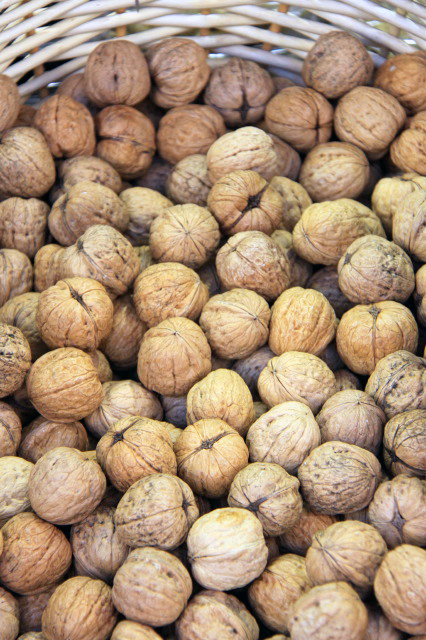
Walnuts

Walnuts

Vendor With Chestnuts

Vendor With Chestnuts

A chatty, Tunisian vendor offered me a sample of some yellow-green Italian grapes. Though they did have some seeds, they were plump, juicy and bursting with grap-ey deliciousness. He also explained to me that Italian fruit is far superior to Spanish fruit and that pesticides are not as widely used in Italy, rendering the grapes safe to eat unwashed–not the case with grapes from Spain, I was sternly told. (LOL)

Pink pomagranates have also appeared in the last week or two and are bursting with sweet-tart antioxidant goodness, although I still find red poms to be juicier and more flavorful.

What's wrong with this picture?

What's wrong with this picture?

Pomegranates

Pomegranates

Also noteworthy are the many varieties of apples. I had the opportunity to sample the honey crunch apple, one I hadn’t previously heard of, and it was true to it’s name. Firm, sweet, delicious, with that great apple bite! The honey crunch would be a perfect apple to use for a tarte tatin!

Fresh Tuna

Fresh Tuna

Leeks

Leeks

At the veggie stands, huge leeks, radishes, and many onion varieties are beautiful, aromatic, and begging to be used in your soups, stirfrys and tagines. Kale and swiss chard are also starting to show up, though just at a few of the stands.

Oh, and mushrooms!! Can’t have a Paris market update without discussing the mushrooms. It’s porcini (cêpes) season and they are as beautiful as they are earthily fragrant. Prices can range dramatically based on the location of the market and the quality of the mushrooms, so do be sure to shop around. During the late summer and early fall, it was all about yellow (and sometimes black) oyster mushrooms, but now, porcinis  rule. Their meaty texture and hearty, earthy flavor make them amazing in soups, stews, pasta dishes, risotto, or grilled and served up on bruschetta. The porcini possibilities are endless, but the season is short so I’m enjoying them as much as possible while I can.

Paris Fish Monger

Paris Fish Monger

French Wine

French Wine

Of course, the Paris markets have much more to offer than just fruits and veggies. Amazing seafood, cheeses, breads, sweets…it’s difficult to pass by all the beautifully displayed, wonderful smelling artisinal foods without going a bit crazy and putting a dent in your budget, not to mention your calorie-count. Not that you should count calories, especially when in Paris. Head to the markets, take in the sights, smells and flavors, and most importantly, enjoy!!

Fresh Scallops and Sea Urchin

Fresh Scallops and Sea Urchin

Oysters

Oysters

A bientôt et bisous de Paris!

8 responses so far

Older Posts »