Sign up

You deserve to feel great, look great & LOVE your body

Enter your email for your FREE starter kit to get healthy & lose weight without dieting:

  • This field is for validation purposes and should be left unchanged.

Eating Like An Avatar

by | Dec 28, 2009

Avatar

Sometimes it takes a new set of eyes to see things clearly. Sometimes a new perspective can be enough to change your world.

In the blockbuster film Avatar, advanced neuro-technology is used to plug human consciousness into alien bodies (avatars) and operate them remotely. Scientists use these avatars to explore the planet Pandora and learn the ways of its native people, the Na’vi.

The Na’vi share an intimate bond with their natural habitat, making their behavior seem primitive and incomprehensible to the humans studying them. But when Jake Sully immerses himself in Na’vi culture as an assignment, his experience changes him in ways no one could have imagined.

Behaviors we don’t understand are often the easiest to ridicule and reject. But putting aside your preconceptions and coming to a new world with open eyes can be the best way to improve your circumstances and enrich your life.

Do you have prejudices that are keeping you from eating healthy?

I have certainly had many.

Believe it or not, there was a time I thought all organic food was an elaborate, expensive hoax designed to trick rich people into paying more for food the rest of us could get for a fraction of the price. I just didn’t get it. I hadn’t yet tasted the difference, so I didn’t believe it existed.

There was also a time when home cooking seemed to me like a laughable, time-consuming and pointless affair, better suited to married life or, well, anyone who wasn’t me. Why would I cook when someone else could do it for me?

Weekly shopping at the farmers market was another tough idea to swallow (who wants to get up that early on a Saturday?), as was ignoring free food at social events–one of the most fundamental and revered components of graduate school (it’s free!!).

My problem was that I didn’t yet see the value in these activities, so they didn’t seem important.

But of course, I was wrong.

It is absolutely worth the extra effort and money for higher quality organic vegetables that I am actually excited to eat.

Cooking for myself is by far the most efficient, tasty and healthy way to feed myself.

And shopping at the farmers market and maintaining a high-quality diet is the single most important thing I do to stay healthy; it is also really fun.

But I don’t expect you to believe me. This is not the kind of information you can read on a blog and automatically integrate into your life.

To understand my enthusiasm for farm fresh food and home-cooked meals, you really have to dive in head first and try it yourself.

There’s nothing to lose and everything to gain.

So what’s stopping you?

Tags: , , , , , , ,

What’s Worse: Pests or Pesticides? [Poll]

by | Dec 2, 2009
Photo by star5112

Photo by star5112

It’s never fun to find an unwelcome critter in your food, but if you spend much time shopping at farmers markets or buying organic produce it is something you need to get used to. Without pesticides, sometimes there are pests.

But… usually not.

Before you get too grossed out and dash to your kitchen to throw away your organic apples, I want to make it clear that the vast majority of the food I buy (~90% purchased direct from farms) is perfectly clean and insect free. But unlike sprayed and irradiated conventional produce, occasionally there will be a bug. And sometimes there will be many bugs.

But as scary as this can be the first time it happens, bugs really aren’t so bad. Most critters can be easily rinsed off under the sink. Some of the smaller, more persistent little buggers can be coaxed out with a short bath in water spiked with a splash of vinegar.

Herbivorous insects pose no real threat to humans beyond mild annoyance. Yes, they can add an unpleasant crunch to your food if you don’t find them in time, but generally they contribute no flavor and–as many of my Twitter followers pointed out–they may add a little protein to your diet.

Twitterbugs6

Twitterbugs1Twitterbugs2

I somehow doubt that insects really provide a significant protein source, though I’ve heard they can contribute substantial vitamin B12 for vegetarians who ingest them accidentally in rural societies (couldn’t find a credible reference). But the point is that whatever insects do add to your diet probably doesn’t impact your health in a negative way.

That is, if you even notice them. Chances are you have never actually tasted an unwanted creature in your food (I know I haven’t), but they are probably there sometimes and you’ve probably eaten them.

Let’s be honest, the problem with finding bugs in your food isn’t how they taste. The real obstacle is our perception of bugs. In our society bugs are considered gross, so we don’t want to eat anything they have touched.

Twitterbugs4

But not all cultures consider bug eating repulsive (see photo). And after you’ve dealt with a few insects yourself, eaten your food anyway and come out unscathed, you realize there isn’t really anything to worry about.

Twitterbugs5

Only once have I encountered a situation where a vegetable was infested beyond salvation. These were some baby cabbage I had left for too long in the fridge. Over the course of a week the insects multiplied and completely took over. It wasn’t pretty.

But instances like these are rare and, in my case, it was self-inflicted.

True insectophobes, however, will not be comforted by this argument. I am entirely sympathetic to this viewpoint–at one time in my life I used to joke that I was afraid of butterflies (OK, live ones still creep me out when they get too close).

But what scares me even more than eating bugs is the alternative.

Twitterbugs7Twitterbugs8

We don’t yet know the extent of the damage done to our health by pesticides, but the history (dioxins, malathion, etc.) hasn’t been encouraging. The environment we live in is also significantly impacted by pesticide use.

Even if cancer and polluted lakes are a bit too abstract for you, there is still the bland, one-dimensional flavor of food produced on factory farms to consider. Taste is what really won me over when I first changed my eating habits.

I don’t mean to imply that it is never okay to eat conventional produce, just that there are serious issues to consider regarding where your food comes from.

Pests and pesticides can both be a little scary (I forgot to mention the live wasp that once crawled out of my spinach), but at this point it seems we do have to choose one or the other.

Which scares you the most? Vote now!

[poll id=”6″]

Tags: , , , , , , , , ,

Orthorexia, Bacon Worship And The Power of Food Culture

by | Nov 2, 2009
By lepiaf.geo

By lepiaf.geo

Is it possible for healthy eating to become an unhealthy obsession?

Absolutely.

Orthorexia is a word turning up frequently in the media to describe an excessive focus on healthy eating and dietary restriction. Though the term is not yet an official psychological diagnosis according to the DSM-IV, it is being used by some clinicians to describe patients with eating disorders that resemble obsessive compulsive.

Paradoxically, orthorexics obsessed with health are not healthy and often shun food to the point of emaciation and starvation. But unlike patients with anorexia nervosa, the goal of orthorexics is not to be thin but to be “pure, healthy and natural,” according to Dr. Steven Bratman who first described the disorder in 1997. Suffers are frequently associated with a particular eating regimen such as veganism or rawfoodism.

That orthorexia has only recently been identified and characterized may be the best argument yet for Michael Pollan’s assertion in The Omnivore’s Dilemma that over the past several decades America has undergone “a national eating disorder.” Americans spend tens of billions of dollars per year on weight loss and fitness products, with only growing obesity and chronic diseases to show for it. We’ve shunned fats, sugars, starches and everything in between, and embraced each new diet trend with open arms and wallets. And perhaps not surprisingly, it appears some people are now taking it too far.

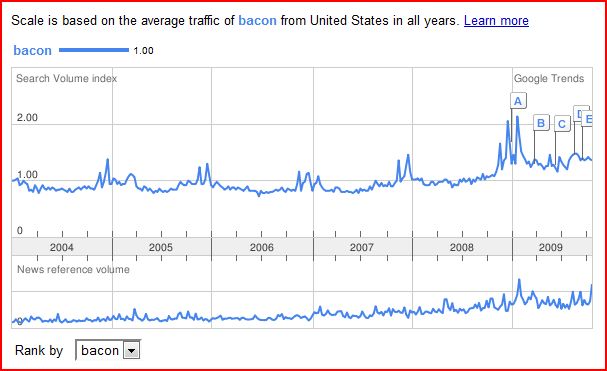
The irony is that as a condition like orthorexia has emerged as clinically relevant, we’ve also seen a notable health food backlash. Google searches for the word “bacon” have increased significantly in the past year, and books are being written from websites like This Is Why You’re Fat.

Google Bacon 2004-2009

Google Bacon 2004-2009

In other words, we have serious issues with food.

But why?

It is easy to be sympathetic toward all of these behaviors, even if their extreme forms make us a bit uneasy. For those interested in living healthy and being thin (the chronic dieters), the only guidance is offered by thousands of diet books and companies like Weight Watchers. Each of these systems has its own strict guidelines for success, while unfortunately few (if any) of them encourage us to behave in a way that we would naturally. Thus the dirty little secret of the diet industry is that the vast majority of them are ineffective for long-term weight loss.

This is why we now have a congregation of bacon worshipers. A growing segment of the population is tired of bland food and unsatisfying, ineffective diets. Bacon tastes good, and since we are all clearly dying of heart attacks anyway we may as well live it up. Right?

Even if this attitude is a bit fatalistic, at its core it reflects a desire to enjoy life. And anyone who counts themselves among the human race should acknowledge this as a sentiment that deserves respect.

But striking the perfect balance between health and gluttony is extremely difficult in a food culture where we are allowed to eat in our cars and in front of our televisions. The food industry has made sure that as far as food is concerned, there are no rules. So a bit of obsession seems like a necessity for someone that still holds the desire to eat whole, unprocessed foods from the bottom of the food chain. The healthiest foods, after all, cannot be found at your neighborhood supermarket. For taste, health and the environment, the best stuff is at your local farmers market.

But avoiding the supermarket, isn’t that orthorexic?

Not necessarily. Every day we take a little extra time to do things that are necessary and important, things like sleeping, doing laundry and brushing our teeth. We go out of our way to do these things because the alternative is simply unacceptable. Eating quality food isn’t an obsession so much as a life maintenance task that–like being clean–is not up for negotiation. Until we have farmers markets on every corner, a little extra effort will be necessary.

But delicious, high-quality food is not only about health. It is also about taste, enjoyment, community and life. Food is something that is worth building your days around, because when approached from this angle food improves your quality of life in every way. Eating like this is not a disorder, it is a culture. And it is something that we desperately need to rediscover.

When proposing the term orthorexia, Bratman suggested framing a diagnosis around two direct questions:

  1. Do you care more about the virtue of what you eat than the pleasure you receive from eating it?
  2. Does your diet socially isolate you?

In other words, seeking healthy food only becomes unhealthy when it is devoid of enjoyment and social relationships.

Several weeks ago I had the privilege of attending a lecture at UC Berkeley given by Michael Pollan. Near the end of his talk Pollan proposed reestablishing food culture in America as “The Omnivore’s Solution,” the way to break our habits of both health food obsession and unbridled gluttony. He described health as “a set of relationships,” and encouraged his audience to think of food not as a product but as something we do.

Throughout history and around the globe food cultures are what have dictated when, where and how much we should eat, and countries that have worked to preserve their cultures have fared better against obesity and other diseases of civilization. For Americans though, food culture has been replaced by nutritionism and all-you-can-eat buffets.

This kind of thinking is often branded as elitist, but it shouldn’t be. Food culture does not cost money, it is a basic tenet of life that extends across class boundaries. It costs time, but this is a priority shift that is worth investing in. According to the latest Nielsen statistics, Americans are watching an average of 5 hours of television per day. Calculate in the cost of high-definition screens and monthly cable bills and your daily food investment will start to be put into perspective.

It is undeniable that food grown locally with care costs more than the subsidized, mass-produced products that fill your favorite supermarket. But despite our reputation, Americans have never been opposed to going out of our way for and spending a little extra money on food that tastes amazing and makes us happy. (If you don’t believe me I’ll redirect you once again to This Is Why You’re Fat.)

Is it such a stretch to say that we should be able to eat healthy and still enjoy our food?

I’d love to know your thoughts.

Additional Reading from Amazon:

Downloads from Audible:

Tags: , , , , , , , , ,

Hungry to Know: What cuisine could you eat for the rest of your life? (poll)

by | Aug 26, 2009
Making Sushi

Making Sushi

After a fantastic food-filled weekend, I woke up Monday morning with mountains of amazing leftovers.

I therefore did what any self-respecting grad student would do: I ate leftover Romano (Italian) food for breakfast, tupperware Moroccan soup for lunch and a hodge-podge of Greek spreads for dinner.

Each dish was distinct, yet all were Mediterranean. And they were delicious, even days later. That got me thinking:

If I had to choose only one cuisine to eat for the rest of my life would it be Mediterranean?

Definitely, I concluded. (Though I was admittedly cheating by lumping together Italian, Greek and North African).

Problem is, just 2 weeks ago I had decided 100% for sure that Southeast Asian foods–specifically Thai and Vietnamese–would be the best choice for a lifetime of dining. There was also a time in college when Japanese cuisine was the unequivocal champion. And strange as it sounds, when I lived in Italy all I could dream of was Mexican food.

Keep in mind, I am not talking about my favorite food. Favorite is a term I associate with a single meal or dish. And it almost exclusively considers flavors and taste, with a slant toward indulgence.

Instead, choosing a single regional cuisine for the rest of your life requires careful balance of taste, variety and health.

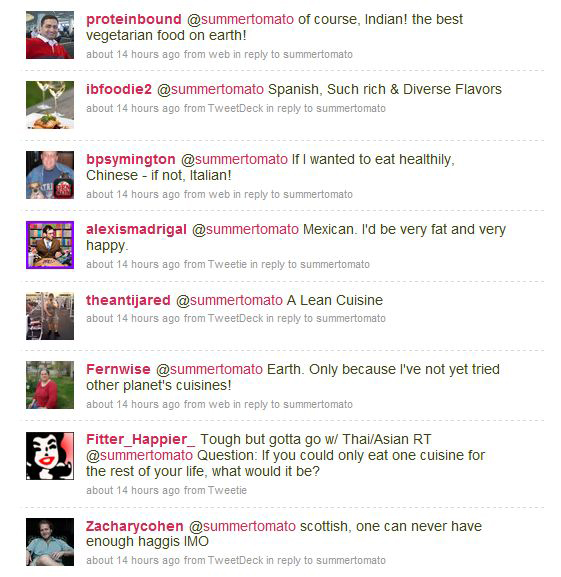
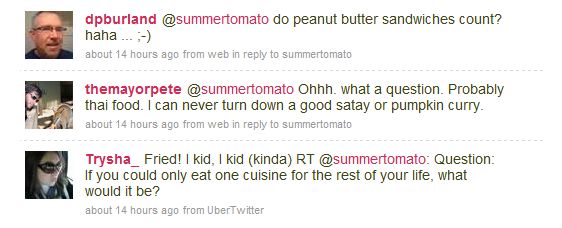
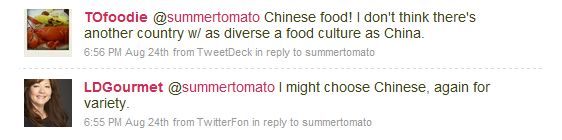
I did this as a thought experiment, and my conclusions (which seem to change quarterly) reflect my own personal tastes. To get a better idea of how others might deal with this question I asked my Twitter followers.

cuisine10

I got a flood of responses ranging from brilliant to hilarious. Here are some of my favorites:

cuisine2

Interestingly, some people clearly chose health over all else:

cuisine7

cuisine3

Some picked taste:

cuisine8

cuisine5

Others found conflict between health and taste:

cuisine9

cuisine6

Variety was also a big factor for many people, while others seemed to be influenced by the cuisine they grew up on:

cuisine11cuisine12

cuisine132

Some people asked if “American” counted and I think it certainly does, though only when American originality is clear as in the unique dishes created in the South.

For me a harder question is whether or not “California cuisine” counts. I decided it does not, but would love your opinion. The way I see it food in California is defined by fresh, seasonal ingredients and brilliant cutting-edge chefs–things that cannot be exported easily. I might give California credit for the burrito, but that hardly represents an entire cuisine.

Now tell me what you think.

What cuisine would you choose if you had to eat it for the rest of your life? Please tell us your answer in the poll then expand on your reasoning in the comments.

Would health be a factor? Variety? Taste? Tradition? How does your choice fit your healthstyle and what other ethnic cuisines would you consider?

To make it a little easier, I’m going to unfairly lump vast regions under single blanket terms such as Latin or Southeast Asian. This is not meant to stereotype but to help make a single choice more diverse and appealing. Trust me, I feel awful about the amazing cuisines getting lumped into “Other.” If yours is there please elaborate on your choice in the comments.

On a final note, the most common complaint I got when running this experiment was the difficulty of making a choice.

Needless to say, I completely agree.

cuisine14

[poll id=”5″]

Tags: , ,

The Loveliness of Raspberries

by | Aug 10, 2009

Raspberries

Raspberries

Today’s post is very special and a bit of a departure from the regular healthy eating tips of Summer Tomato.

Last week we had a discussion about truly special occasions and how they are defined. I mentioned that though special food moments can be characterized by remarkable food and talented chefs, they can also be deeply personal, reflecting moments and emotions from your past.

I’ve explained before and novels have been written about how moments like this can change your life.

Today my friend Austen Caldwell describes such a moment and reminds us just how special food can be.

Austen loves things.  Sometimes they are drawings, sometimes they are poems, and sometimes they are plates of perfectly manicured food.  At the end of the day, they all equal a well-satisfied sigh.  He hopes that everyone sighs today.

The Loveliness of Raspberries

A longtime fan of Anthony Bourdain’s No Reservations, I’ve become accustomed to his theory that there are two sensory phenomena that evoke memories of childhood and are made the better for it:  music and food.  Perhaps he referred to the song that was playing when he had his first kiss; I know I remember mine.  Or perhaps it was the smell of his mother’s kitchen, the homemade stew no one could recreate, something welcoming and warm, that inspired this epiphany. The music I understood, but the moment of reconnection with the youthful memories of food?  For this moment, I was waiting.

Her name was Loretta.  She was a lovely woman, kind and always happy.  She was short, barely five feet from the ground, but lively and spectacular.  She was my grandmother’s sister: my Great Aunt.

I have a great love of raspberries.  For that matter, I love berries of every variety: lingonberries, strawberries, cranberries, boysenberries.  All are exquisitely delicious, but raspberries, raspberries have always been particularly partial to my palette.  I have had a jar of raspberry preserves in my home for every day that I can remember, but I’ve only recently realized why.

Summers with my grandmother in Brunswick, Ohio, we would take the twenty-six mile trip up to Cleveland to visit her sisters.  She had four.  The eldest, Loretta, lived in a beautiful brick home, the kind you don’t get in the West.  She had a modest yard and a modest garden, and curled up next to the side façade of that gorgeous house was a pair of unassuming, modest raspberry bushes.  Garden fence and everything.

As a child, I spent every summer visiting relatives, and one of my greatest joys was those trips to see Lala (which was my nickname for Aunt Loretta).  She had her own nickname for me.  It was Little Bit.  When my sister was born, I became Big Bit, but I remained a bit: a bit of my father, a bit of his mother, a bit of her sister.  And each summer, I was privileged to visit this lovely woman, a woman who lived to see her 100th birthday, and pick raspberries with her.

Nothing ever tasted so good to a young boy.  And, I suspect, nothing ever will, even if I live to see my 100th birthday.

I was seven years old, the first time I remember picking raspberries with Loretta.  She was strong for her age, but still fragile, making me feel as if I were doing something she couldn’t as I reached a berry, buried deep, close to the wall of her house.  Something elusive.  Something special.

Sweet, ripe, juicy.  These are the words we use to describe fresh fruit.  Of course they were these things.  But they were also the start of something new, something unexpected.  They were the start of a love affair.  Years after the fact, they resonate.  The raspberries of these bright, amazing days remain the reason that particular fruit has always struck a chord with me, no matter what other flavors I may encounter.  The reason that these, these texturally magnificent, teasingly tart, and subtlety sweet fruits mean so much is not merely their excellence, but that reminder of something else beautiful.  To me, raspberries are not solely the flavor and texture, but they are also Loretta’s well-worn, infinitely kind voice, the way she stutter-stepped before she reached up to wrap her arms around me, the blink she always made when she smiled.

I can track that sensation to the first bite of fresh-picked berries with my Aunt Loretta, but it continues.  It continues through raspberry preserves and peanut butter in middle school.  It continues with raspberries as an afternoon snack in high school, when I was ‘concerned about my weight’.  It continues through convincing my friend to make for me custom raspberry smoothies at her juice stand which I frequented my freshman year at university.  It continues, and I am just finding out why.

I hope I understand now what Bourdain meant: that those transcendent moments of our youth stay with us, if not through memory, but something else.  Our memories of the people and places important to us remain in a different form.  They become a different kind of memory, and those memories, of something sensory, something sweet, something savory, will always remain

something special.

…………………………………………………………………………………………………………………………………

Do you have a food that changed or deeply affected your life? What do these foods mean to you and how have they influenced your relationship with food in general?

Thanks again to Austen for this beautiful story.

Tags: , , ,

Calorie Restriction and Quality of Life

by | Jul 20, 2009
Jeff Miller/University of Wisconsin Madison

Jeff Miller/University of Wisconsin Madison

Last week The New York Times published a story on the life prolonging effects of a low calorie diet in primates. The study in question found that like other organisms (from yeast to worms to mice), rhesus monkeys that eat 30% fewer calories age more slowly and develop fewer diseases than animals on a traditional diet. Those of us who follow the scientific literature on nutrition and aging are not surprised by this at all.

A few days after the story was published The Times published an op-ed questioning the value of the research. Roger Cohen argues that Canto, the healthier monkey, has suffered tremendously as a result of his restricted diet. He contends that it is far better to be fat and happy (and dead?) than thin and miserable.

To me it seems questionable why Cohen believes Canto is unhappy. If he is making his judgment solely on the image above, I must respectfully disagree with his assessment. To me both monkeys appear relatively miserable.

However, Cohen brings up a crucial question about diet and health. How far are we willing to go–how much are we willing to change our diets–in order to extend our lives?

Quality of life is a very important question.

To me one of the most interesting things about calorie restriction is that life extension is only one of many health benefits. Calorie restriction literally slows down the aging process. As a result the animals subject to a limited diet are able to maintain a high level of physical activity into old age. They are also relatively free of age-related diseases including cancer, heart disease, diabetes and neurodegenerative diseases.

Extended life would arguably not be as desirable if these diseases maintained the same progression as they do in those with normal diets. But freedom from these diseases and preserved physical and mental capacities may indeed be worth some dietary alteration.

The next question is how must the diet be changed?

In the monkey experiment, the calorie-restricted group received 30% fewer calories than the control monkeys, who were allowed to eat what they wanted. It is still unknown if a 30% reduction in calories will extend human life in a similar manner, but short-term experiments have indicated that at least some benefits are immediately apparent when calories are limited, such as lower triglycerides, body fat and blood pressure.

Interestingly, however, there may be alternatives to a strict low calorie diet. Cynthia Kenyon, a scientist at UCSF, was the first to show that the key to the life extending properties of calorie restriction is the insulin signaling pathway. A decrease in insulin signaling slows the aging process and extends life.

In the laboratory, organisms like worms, mice and monkeys always receive a uniform diet that has a consistent effect on insulin signaling. But humans do not eat lab food (at least not usually).

Extensive research over the past several decades has made it clear that different foods impact insulin signaling differently in humans. For example, refined carbohydrates have a large, rapid impact on blood sugar, insulin secretion and insulin signaling. By contrast, fat, protein and fiber have next to zero impact on blood sugar and subsequent insulin signaling.

The implication of the diverse human diet is that we are able to alter insulin levels and signaling in our bodies without undergoing severe calorie restriction. Whether or not a diet that promotes less insulin signaling can slow aging in humans is still unknown, but there are many other benefits associated with a diet that lacks refined carbohydrates.

Insulin signaling is not only tied to the aging process, it is also the primary cause of metabolic syndrome–high triglycerides, insulin resistance, hyperinsulinemia, abdominal obesity, low HDL cholesterol and high blood pressure–as well as type 2 diabetes and heart disease.

A diet that improves these symptoms may or may not slow the aging process directly, but it can certainly promotes a higher quality of life by lowering the risk of many debilitating and life threatening diseases.

Going to farmers markets and eating delicious meals isn’t so bad either.

What are your thoughts on health, diet and quality of life?

Tags: , , , , , , , ,

How To Eat Healthy In Restaurants: Healthy Tips For Real Life (series)

by | Jul 8, 2009
Quarter Pounder

Quarter Pounder

In my vow to stay home and eat healthy for the rest of the week, I’ve had a lot of time to think about all the places I’m not eating.

I’m not going out to meet a friend for one of San Francisco’s best burgers, for example. Nor am I going to another friend’s place to drink beer and play Rock Band.

Not today anyway.

I have many guiding principles for health here at Summer Tomato, but for me personally (and based on the emails I get, for many of you as well) the hardest part about upgrading your healthstyle is integrating it with your social life.

How many times have your best intentions to go home and cook a healthy dinner been derailed by an invitation to go out with work buddies or go to the movies? How often are your weekend’s best intentions ruined by birthday dinners and bar hopping?

That’s life. And it can make being healthy really difficult.

I always stress that the best way to combat these special occasions is to automate your health whenever possible. From my perspective, setting up your life so that healthy choices are your default–the path of least resistance–is your only chance at weathering the birthday cakes and holiday BBQs.

But it seems that for many of us these “special” occasions occur a little too frequently. A week rarely goes by that doesn’t offer an excuse to break our routine and indulge in something a little extra. And though this behavior is psychologically healthy and generally a good idea, too many exceptions can start to become the rule.

Not only do we sacrifice our health in these moments of celebration, we also begin chipping away at our good habits and before we know it they are gone.

Too many fun weekends and we give up on buying groceries and going to farmers markets for two, three or four weekends in a row. Then we go out more because we have no food at home (“Gotta eat somethin’!”), skip more workouts and the pounds start climbing back on.

Pretty soon your life is consumed with bad habits again, your jeans stop fitting right and you don’t even know what hit you.

So how do we deal with these events?

For me one important step in breaking this cycle has been to develop a clear understanding of how to navigate restaurants. Not all restaurants serve the same function. Some are simply cheap and convenient, while others are divine dining experiences to be remembered for a lifetime. And there are dozens of choices in between.

Over the next few weeks I will be describing each of the major restaurant categories and how to approach them to balance health and enjoyment. If you have any specific topic or issue you would like me to address in this series please send me an email and let me know.

(To continue following the How To Eat In Restaurants series, be sure to subscribe to Summer Tomato through email or your favorite news reader (RSS)–subscribing is always free of cost and spam.)

Today I will begin by describing the kind of restaurant you should never eat in: fast food chains.

Fast food restaurants are so unhealthy, evil and downright nasty tasting that there is really no good reason to eat in one for the rest of your life.

“Convenience!” They will shout.

But I don’t buy that argument. Wanna know what is inconvenient? Diabetes.

There is always a better option than fast food. If I find myself starving, behind schedule and in an unfamiliar neighborhood I do not consider pulling into a Wendy’s drive-thru and ordering a value meal. Instead I find a grocery store or local café. These places are just as ubiquitous, but instead of poison burgers I can get fresh food at reasonable prices. You’ve already given up on taste for this meal, there is no reason to give up on health too.

If you find yourself regularly eating in restaurants for “convenience” you still have some work to do toward upgrading your healthstyle. I am not in these situations very often because I plan ahead and make sure I always have something to eat.

The Summer Tomato guide can help you get started eating healthy.

The most important thing to remember about eating in restaurants is that you should save your indulgences for moments that are truly special. If you are desperate and just need some calories, eat the healthiest thing you can find. A bag of nuts, a piece of fruit, jerky or even a protein bar is a better option than a Quarter Pounder.

That burger in the photo looked exactly the same after sitting on my counter overnight as it did when I first bought it. Ick.

How often do you use “convenience” as an excuse to eat unhealthy?

Read more How To Eat In Restaurants:

  1. Healthy Tips for Real Life
  2. Neighborhood Convenience
  3. Sit-Down Chains
  4. Healthy Advice From SF Food Critic Michael Bauer
  5. The Truly Special Occasions

Tags: , , , , , , , , , ,

Farmers Market Update: What’s the point?

by | Jun 28, 2009
Green Tomatoes

Green Tomatoes

Healthy eating starts with fresh, seasonal produce, preferably from your local farmers market.

Years ago when I started my column at Synapse and began advocating seasonal vegetables as the best path to health, one of the most common questions I got was, “How do I know what’s in season?”

In response to this I wrote my first Farmers Market Update, and this has become one of the cornerstones of Summer Tomato.

There are many reasons I write these updates every week, but occasionally it is important to step back and make sure my objectives are met with each post.

Here are the main goals I aim to achieve with my Farmers Market Updates:

Education

As mentioned above, I hope that by reading these Farmers Market Updates you will get a feel for what is in season. Even if you are shopping at your local supermarket, seasonal produce is your best bet.

Follow along to get a general idea of what you should be eating this time of year.

Inspiration

For me just seeing the beautiful vegetables, fruit and other goodies at the farmers market makes me want to spend the rest of the weekend in the kitchen–and I’m not exactly the domestic type. With Farmers Market Updates I hope to inspire you to find your own local markets and look for the best seasonal produce you can find.

Going to the farmers market is by far the best part of my week and I wish you could all experience it with me. I realize not everyone has the Ferry Plaza Farmers Market to wake up to on Saturday mornings, but your own farmers market is still better than anything you will find at a big chain store.

There is nothing like spending a little time with the local farmers that grow the food you eat. Every meal you prepare with these ingredients is special, even if it isn’t exotic.

Demonstration

I’m the first to admit that cooking can be scary and the thought of it overwhelming. Most of us were never taught how to use a stove, let alone poach an egg. But we are extremely proficient at using Google to help us figure things out, right?

Cooking is no exception.

I make a point of finding things at my farmers market that I do not know how to cook. Why? Because exploring new foods is one of the most important things in making healthy eating fun and enjoyable. You can even rediscover foods you think you don’t like by buying them at the height of season and learning to cook them properly.

I promise, liking things is more fun than not liking things 😀

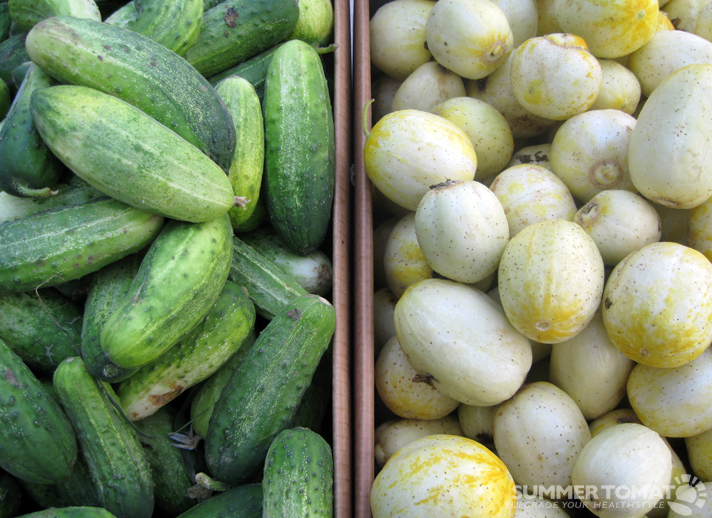
I try to convey this sense of adventure in my Farmers Market Updates. This week, for example, I bought all the flavors I associate with Thai food even though I do not have a specific recipe in mind. I also purchased some lemon cucumbers simply because they looked cool.

You do not need to know how to cook something before you buy it. Vegetables are cheap, just get what looks good and figure the rest out later. Email me if you need suggestions!

———-

Farmers Market Update

Cucumbers

Cucumbers

Brown Turkey Figs

Brown Turkey Figs

Summer officially started this week in San Francisco (according to me). With melons and figs popping up all over the place, there is no way I can keep sitting here and telling you it is springtime.

Woohoo!

Thai Basil

Thai Basil

Purple & White Peppers

Purple & White Peppers

Summer tomatoes are already fabulous, summer squash are as sweet as can be (especially the yellow Zephyrs!) and who knew there were so many kinds of cucumber? Green garlic has morphed into the bulbous “fresh garlic.” Green beans are starting to appear and there are 2 kinds of basil. Not one, but two!

Darya is happy.

Cucumbers

Cucumbers

Fresh Garlic

Fresh Garlic

Check out my first Farmers Market Update video from my new apartment. It is just under 3 minutes.

Today’s Purchases:

What did you find at the market this week?

Tags: , , , , , , , , , , , , , , ,

Food, Inc. Shows How Your Food Choices Can Change the World

by | Jun 15, 2009

foodincIt is fair to say I’m a bit obsessed with food.

To me this is perfectly natural, because few things are as important or bring as much pleasure to my life. I eat at least three times a day, and each meal is an opportunity to revel in the bounty of nature and ensure my health for (5? 6? 7?) decades. What confuses me is why more people aren’t so obsessed with food.

I admit that my personal history with food is long and intimate, but at this stage in my life what makes me passionate about eating well is what I know about the impact of my daily meal choices on myself and the world.

Food is the cause of almost every modern disease, and is in the midst of creating some new ones.

Food is destroying the planet faster than anything in human history.

Food threatens our national security and the health of the global economy.

But food is not all doom and gloom, nor should it be. Real food is a celebration of life and brings people together. Real food is an art. Real food is health.

My personal favorite reason to eat the way I do is that real food tastes amazing, nothing like the processed junk most of us grew up eating.

When it comes down to it, real food makes my life better.

If you are like most people I talk to, this all sounds wonderful but is a little too abstract to move you to action. Sure we would all love to make it to the farmers market this weekend, but when Saturday rolls around there are 1,001 excuses not to go. Right?

In my world though, the earth has to be collapsing for me to miss my market trip and even then I’ll probably find another one. I don’t see it as a choice. For me my weekly trip to the farmers market determines how well I will eat for the entire week. I know it is possible to eat healthy without going but it won’t taste nearly as good, is less exciting and more expensive. These things make it harder to eat healthy at all, and that is not okay.

My resolve comes from the knowledge that there is no more important decision I can make each week than where I buy my food.

If you aren’t convinced yet, you should definitely see the new film Food, Inc.

Food, Inc. will help you see food as a priority, a solution to and not the cause of our problems. It is a journey through our modern food system, how it works and the tremendous impact it has on our lives.

One of my favorite quotes comes early in the film as Michael Pollan, one of the film’s narrators and hero of the “real food” movement, describes the disappearance of seasonal produce at the grocery store. His quintessential example is the perfectly red, perfectly round tomatoes that can be found year-round in American supermarkets.

“Although it looks like a tomato, it is a notional tomato. It’s the idea of a tomato.”

This is because, as you all know by now, real tomatoes only exist in the summer.

Food, Inc. gives you an intimate look at where these artificial foods come from and the how they affect our lives. It also explores the government policies that have encouraged and protected these practices at the expense of good food and health.

If you have read (and you should) Michael Pollan’s landmark book, The Omnivore’s Dilemma, you will find many similarities in this film. However, Food, Inc. preferentially emphasizes the results of our food system and the toll it takes on our health and economy.

Central to Food, Inc. are the stories of people who were the honest victims of our toxic system. These stories are heartbreaking and will make you think twice the next time you are tempted to order a Quarter Pounder.

Importantly, Food, Inc. offers more than just criticism, it also gives us a solution: vote with your fork.

The message of the movie is almost entirely aligned with the philosophy of this blog: shop at farmers markets, cook your own meals, pass on the processed foods.

These simple acts are enough to change the way the system works, because ultimately consumers decide what is produced. If you stop buying it, they will stop selling it and find another way to satisfy your needs. We are the ones with the real power.

It is completely possible to opt out of our current food system by reducing and even eliminating processed, industrial foods from your diet. Amazingly, once you start on this journey you learn that you don’t actually give anything up in the process, but in fact regain a world of lost flavors and the joys of eating real food.

If you like Food, Inc. and want to know more there are numerous resources:

Have you seen Food, Inc. yet? What did you think?

Tags: , , , , , , , ,

Automatic Health: Lessons From Personal Finance

by | Apr 3, 2009
Healthy Breakfast

Healthy Breakfast

Probably the biggest misconception about health and weight loss is that it takes a tremendous amount of willpower to succeed. Another myth is that it requires a substantial time investment.  In fact, neither excessive willpower nor time are necessary to be healthy and thin. So isn’t it useless to trying to force them on yourself? I think so.

After reading a captivating article by Ramit Sethi on Tim Ferriss’ (The Four Hour Work Week) blog, I learned most people have the same delusions about personal financeas they do about health—-they think paying off debt and saving money require willpower and time. So we should not be surprised that the solutions for personal finance offered by Ramit are the same fundamental strategies necessary for investing in your personal health. Make no mistake about it, your health is an investment. And a pretty important one at that.

Today I am going to show you how the advice and reasoning Ramit uses in his article can apply to health and weight loss, and how automating these steps can help you achieve your goals. In future articles I will describe in detail how to implement each step. Be sure you are subscribed with either RSS or email so you can follow the series.

Choice Paralysis

Ramit starts by pointing out that we have dozens of choices to make every day when it comes to money. The same is true for health. Should I eat breakfast? Should I pack a lunch? Am I going to the gym?

“Faced with an overwhelming number of choices, most people respond in the same way: They do nothing.”

Clearly “nothing” is not a winning strategy. In both finance and health you must set your default activities so that you will automatically contribute to your long-term goals. Automation is the essence of healthstyle.

Establish a Foundation

Ramit says the first step to automating your personal finance system is to make sure you are getting the best deals you can from your financial institutions, meaning that you have the lowest possible interest rates and are not paying annual fees. Not doing this is equivalent to throwing money away.

In health the first step in establishing your foundation is having the tools you need to succeed. Since how you eat is the biggest factor in determining your long-term health and body weight, you must have the ability to eat properly. In our modern lives, this ultimately means you need to know how to cook for yourself. You will never get healthy eating at restaurants every day. This is the same as throwing your health away.

Therefore it is essential that your kitchen is supplied with the tools you need to cook, eat and store your food. This may seem obvious to some of you, but for many people the kitchen is a foreign and scary place. To assist both newbies and veterans in upgrading your kitchenstyles, I have put together a section of the Summer Tomato Shop called Kitchen Gear (go to the Shop then use the navigation in the sidebar on the right).

Kitchen Gear is grouped into categories that are meant to help you find exactly what you need. The Basics has all the essential items for a functional kitchen. Additionally, below each item I give a brief description of why it is on the list.

If you regularly follow my blog, however, you will soon find that I sometimes use items that are not in The Basics. Usually you can find these in Accessories. In general, Accessories are items that are not absolutely necessary for cooking, but they can make your life a whole lot easier if you have them. For example, you can peel vegetables with a knife, but a vegetable peeler makes it quick and easy.

Storage & Transport has products that help you mobilize your healthstyle, which is especially important if you work away from home during the day. There are also reusable grocery and farmers market bags available.

The Finer Things offers the top-of-the-line products that I wish I had (okay, I have a few of them). I have spent an embarrassing amount of time reading reviews of kitchen products and appliances, and these are the products I envision in my future dream kitchen. For those of you who can afford them, this is your list.

I feel confident in the quality of the items I recommend–I own or have used most of them. I also consider price in my recommendations and try to make this clear in my explanations. If, however, you feel you want an item that is different from what is on my list, you can still navigate to and purchase it through the Amazon links on this website to support this blog. My store is run through Amazon.com and almost always represents the best prices on the internet.

Automate the Basics

The next step in Ramit’s personal finance plan is to automate your bank accounts so that regular payments and savings deposits occur as soon as you get your paycheck (also automatic). This takes care of all your goals and gives you the freedom to make personal decisions with the rest of your money without worry, guilt or willpower.

If you are like most people the structure of your day stays pretty much the same all year long (particularly Monday through Friday). We wake up, go to work (or equivalent), come home, eat, spend time on personal things then go to bed. This structure provides us an excellent opportunity to optimize for health.

Breakfast. One of the simplest things you can do to improve your health is eat breakfast, particularly whole grains and fruit. To easily begin improving your metabolism and blood sugar control, find a couple whole grain cereals you like and start eating breakfast every day. If you think you do not like to eat first thing in the morning, you are most likely dehydrated. Wake up, drink water, then eat breakfast.

Lunch. For many people lunch is the most difficult meal to make healthy because they do not prepare for it, get stuck at work with no food and end up going out and eating something unhealthy. But since you know you always eat one meal at work each day, this is something you can easily automate in your favor.

Each weekend you need to plan in advance what you will be eating for lunch all week. Make sure you cover at least 4 days, but five is better. There are several ways to approach this: you can bring ingredients and prepare your own lunch at the office, make a large batch of food on weekends especially for lunch during the week, or make enough food each night at dinner that you have leftovers for the next day. All these strategies are effective because they help you avoid buying your lunch.

Shopping. In order to accomplish the two above points, you need to set aside a little bit of time each weekend to go grocery shopping and plan (or at least consider) your meals. This time must be non-negotiable; ultimately it saves you time later in the week. For my personal healthstyle the weekend always includes a trip to the farmers market, but there are many other options if this is not realistic for you.

Effective shopping has several components. You must always have the basic stocks of items in your pantry, freezer and refrigerator. You need to shop regularly for staples (milk, for example) and fresh items must be purchased weekly. Details on how to shop for all these components will be given in future posts.

Dinner. People expect the most out of dinner. It generally needs to be quick (I’m starving!), simple (I’m busy!) and delicious (I’m picky!). Luckily, the changing seasons offer great opportunity to keep variety in our dinner menus without needing too many different cooking techniques. If you can get at least a few of the basic skills under your belt, you can make an infinite number of healthy, interesting and delicious meals. Basic cooking techniques will also be summarized in future posts.

Work exercise into your daily routine. Physical activity is essential for staying fit and trim, but it doesn’t particularly matter where you get it. The important thing is that you make it happen consistently by incorporating it into your average day. Personally I walk to work, take the stairs, and make it to the gym for cardio and weights whenever I can.

Whatever method you choose as your source of physical activity must be your default, and skipping your exercise must be the exception. If you prefer using a gym, make sure you have a membership, a gym bag and the necessary apparel to workout at all times. Don’t like the gym? Find an activity that you enjoy and recruit friends to join you. Even if you prefer not to engage in formal workouts at all, you can make an effort to increase your non-exercise daily activity. Some scientists think non-exercise energy expenditure may be especially effective for people who are trying to lose weight but dislike structured workouts.

Tweaking Your Style

Ramit’s final recommendation for automating your personal finance is to customize your plan for your personal circumstances.

We are all individuals and have different needs and preferences, especially when it comes to food and exercise. I do not recommend trying to incorporate every ounce of my advice into your life at the same time. Try the things that are easiest for you and see how they work. Once a few new habits are formed, you can try to tackle some harder ones. As you grow and evolve into your own healthstyle, you may find things that never worked for you before are suddenly feasible. Or you may come up with your own hacks to optimize your health and fitness.

This blog is meant to be a source for suggestions and guidelines, not dogma or a regimented plan. Discovering and improving your own strategies for success are essential for building a lasting healthstyle that reflects both who you are and who you want to be.

How will you upgrade your healthstyle?

Read more on How To Get Started Eating Healthy:
http://forms.aweber.com/form/95/split_2017558195.htm

Tags: , , , , , , , , , , , , , , , , , , , , , , , , ,