Sign up

You deserve to feel great, look great & LOVE your body

Enter your email for your FREE starter kit to get healthy & lose weight without dieting:

  • This field is for validation purposes and should be left unchanged.

Winter Salad Tip: Making Tough Greens Soft

by | Jan 11, 2010
Winter Salads

Winter Salads

Today Nathalie Lussier is sharing her secret tips for making tough winter greens soft enough to eat in salads. Winter salads are a perfect use for all the lovely radishes, kohlrabi, carrots, beets and other sweet vegetables available this season at the farmers market.

Top off your salad with hazelnuts, grapefruit and some shaved cheese for a satisfying winter meal or side dish.

Nathalie Lussier helps people overcome unhealthy food cravings so they can eat more fruits and vegetables, and experience the magick of raw foods. She’s known as The Raw Foods Witch.

How To Use Winter Greens In A Salad

by Nathalie Lussier

Winter might not strike you as salad season, but there are plenty of delicious hearty greens to be had this time of year. One trick is to marinate the leaves so they soften and are easier to chew.

Here’s how to prepare some of these tougher greens and enjoy rich, satisfying salads year round.

Choosing Hearty Greens

The foundation of any good salad is the green component. Usually we think of lettuce, but there is a world of other greens to explore.

So what options do we have when it comes to hearty greens?

1. Kale: Kale is a tough vegetable that can handle the cold. It has a strong taste, but with a little bit of massaging it can make a really satisfying salad green. There are a few varieties, from the most common curly green to the spotty dinosaur (aka Tuscan) and beautiful purple kales. They are each slightly different and you should experiment with them all.

2. Cabbage: Cabbage is a tried and true winter veggie, but we can go beyond the usual coleslaw, saurkraut and cooked cabbage. Different colored cabbage adds beauty and variety to your salads, as well as sweetness and a crispy texture.

3. Swiss Chard: A relative of spinach, Swiss chard has a thick midrib that comes in a rainbow of colors like green, white, red, pink, and yellow. Swiss chard is great in salads and can be easier to chew than some of the others.

Washing & Cutting The Greens

kale-destem

De-stemming Tuscan Kale

Wash the greens thoroughly, you never know when a caterpillar will decide to make her home in a leaf of kale.

The way you cut the greens is important because you want them to absorb the marinade and soften.

Cutting Kale and Swiss Chard

For both kale and Swiss chard, you need to remove the stems by using a knife and slicing them out vertically. You can then chop up the stems and add them back to the salad like you would celery or other hard vegetables.

After you’ve removed the stems, slice the kale and chard horizontally into 1 inch strips. Put the sliced greens in a large bowl.

Don’t worry if you think you sliced up too much, it will shrink down in size as it marinates.

Cutting Cabbage

If you’re using cabbage, cut the cabbage in half and then use a knife to cut thin strips. These should look like coleslaw slices. You may have to cut them lengthwise if they are too long.

I recommend you cut the whole cabbage and make a big batch, unless you have something else planned for the other half. Making large batches at once makes future healthy meals that much easier.

Massaging & Marinating The Greens

This is the magic part that will take regular tough greens and turn them into the perfect salad.

Ingredients

  • Your chosen greens or a combination of them (1 bunch)
  • 2 tbsp Extra Virgin Olive Oil or more as needed
  • Juice of 1/2 a lemon
  • Pinch of Celtic sea salt

Now it’s time to get your hands dirty! Add the ingredients into your mixing bowl and massage them into the greens with your hands.

You really want to squeeze the oils and juices into the greens, because that’s what will make them truly mouthwatering.

The Final Touches

After you’ve thoroughly massaged your winter green salad, add any other chopped vegetables you like, or any of these salad toppings.

Dress the greens and veggies for a hearty, satisfying winter salad!

Don’t let tough winter greens turn you off salads. Once you know how to make those winter greens more palatable, you’ll be eating delicious raw salads all year round!

Do you have any winter salad tips?
Tags: , , , , , , , , , ,

Farmers Market Update: Brassica!

by | Dec 6, 2009

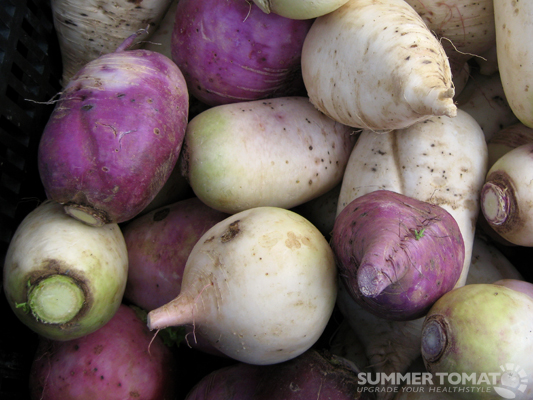
Turnips

Turnips

This weekend was the Brassica Festival at the San Francisco Ferry Plaza Farmers Market.

Brassica

Brassica

Brassica Bash!

Brassica Bash!

Brassica is a genus of vegetables in the mustard or cabbage family that includes cabbages, broccoli, cauliflower, kale, turnips, bok choy, kohlrabi and Brussels sprouts. They are also known as cruciferous vegetables, and I adore them.

Curly Kale

Curly Kale

Broccoli Crowns

Broccoli Crowns

In honor of the festival I stocked up on two kinds of kale, collard greens, broccoli and kohlrabi. I resisted Brussels sprouts since I got them last week. The great thing about brassica vegetables is they are very affordable, usually less than $2/bunch.

Kohlrabi

Kohlrabi

Generally I am spending a lot less money at the farmers market now that summer is over. I attribute this largely to the lack of berries and stone fruit. Oh, and my $10/week tomato habit has now dried up. But I can’t complain at all.

Daikon, Kohlrabi and Sunchokes

Daikon, Kohlrabi and Sunchokes

Baby Bok Choy

Baby Bok Choy

Citrus, especially the mandarins, are marvelous this season and getting better every week. Pomegranate seeds are by far my favorite thing on my breakfast. Pears from Frog Hollow Farm are freaky good.

Persimmons. Almonds. Walnuts.

I think I’m falling in love with autumn in San Francisco.

Kiwi

Kiwi

Mandarins

Mandarins

Hachiya Persimmons

Hachiya Persimmons

Almonds

Almonds

I finally got some kiwi this week. If you’re a kiwifruit fan, you absolutely must go try the ones from Four Sisters Farm, they have an unbelievable flavor that is almost floral. I had no idea kiwi could be so complex. These are really special.

Many of the farms are offering gift wrapped items for the holidays. Most of these things are pretty cute, probably delicious and something to consider if you’re shopping for any foodies.

Holiday Foodie Gifts

Holiday Foodie Gifts

Or for that person who has everything, you could always just get one of these giant parsnips. They are about the size of your head. Who doesn’t need jumbo parsnips?

Giant Parsnips

Giant Parsnips

Exactly.

Today’s Purchases:

Tags: , , , , , , , , , , , , , , ,

Farmers Market Update

by | Mar 14, 2009
spring vegetables

spring vegetables

Spring is continuing to sprout up all around us here in San Francisco. Today at the Ferry Plaza Farmers Market fluffy spring greens mingle with waning citrus crops, in breathless anticipation of the coming stone fruits and berries.
assorted kale
Chard and kale are particularly beautiful these days. Kale comes in so many colorful varieties, just look at this assorted kale braising mix I got at Marin Roots today.

Green garlic is another unique spring time treat, as green onions are to regular onions, green garlic is more mild than your typical bulb and is perfect for spreads and dips. It is also wonderful in eggs or on salad.

I highly recommend the artichokes from Iacopi Farms, green garlicparticularly the baby ones that can be marinated and sauteed. Fennel is another great vegetable to try this time of year.

I haven’t been overly impressed with the fruit lately, though. I am getting tired of citrus, and the apples I tried today were far too sweet for me. Kiwi are fantastic, but I can only eat so many kiwi in a week.

One day soon though, the market will transform into a cherry explosion. I can’t wait!

Today’s Purchases:dried lavender

  • Assorted kale (Marin Roots Farms)
  • Free range eggs (Marin Roots Farms)
  • Baby artichokes (Iacopi Farms)
  • Baby leeks (Dirty Girl Produce)
  • Treviso (Dirty Girl Produce)
  • Broccoli shoots (Dirty Girl Produce)
  • Red Russian kale (Eatwell Farms)
  • Rosemary (Eatwell Farms)
  • Russian fingerling potatoes (Capay Organics)
  • Carrots (Capay Organics)
  • Asparagus (Capay Organics)orange blossoms
  • Gold chard (Capay Organics)
  • Tangelo (Hamada Farms)
  • Clementines (Hamada Farms)
  • Meyer lemons (Hamada Farms)
  • Kiwi (Four Sisters Farm)

Is it spring time in your town yet?

Tags: , , , , , , , ,

Green Up Your Pasta Puttanesca With Kale

by | Jan 11, 2009

I was never sure if I liked pasta puttanesca. In fact I am not even sure how many times I had eaten it before last week. That’s why I was so surprised when I found myself suddenly craving this distinctly Mediterranean medley of flavors.

Who knew?

I admit that anchovies, capers and olives scare me a little (okay, a lot) with their pungency. For that reason–once I decided I had to make it–I was careful to get high-quality ingredients (the antidote to every scary food you think you don’t like). The last thing I wanted was overly fishy pasta for dinner.

I got my anchovies from Whole Foods, and the kalamata olives and capers from Trader Joe’s. I got my canned tomatoes from TJ’s as well.

The only other ingredients required were olive oil, garlic, chili flakes and parsley.

The recipe I used was a super easy one from Cook’s Illustrated (you have to pay for a subscription to see their recipes) that claimed you could make the entire sauce while your pasta is boiling. I have the utmost faith in Cook’s to guide me through a flawless meal, so I made very few changes to their original recipe.

My main concern was that as a single, busy person in the city I wanted a more balanced meal than just pasta and sauce, and I would rather not go to the trouble of making a side dish. I solved this problem by adding some steamed dinosaur kale to the puttanesca, which turned out to be a perfect, crispy complement to the robust sauce and chewy pasta. The dish ended up truly fabulous.

You can use whatever kind of pasta you like, but this time I went with rigatoni.

———-

Pasta Puttanesca With Kale

(modified from Cook’s Illustrated)

Ingredients:

  • 28 oz can of diced tomatoes
  • 8 anchovy fillets, minced
  • 0.5 cup pitted kalamata olives, coarsely chopped
  • 3 tbsp capers, rinsed
  • 0.5 bunch dinosaur kale, cut into 1 inch squares
  • 0.25 cup parsley, finely chopped
  • 4 cloves garlic, pressed
  • 2 tbsp olive oil
  • 1 tsp red chili flakes
  • rigatoni or pasta of choice

Place a steam basket into pot of shallow water and boil. Add kale and cover. Steam 10 minutes.

Bring several quarts of water to a rolling boil (prepare sauce in the meantime). When water is boiling add 1 tsp salt and pasta. I prefer to make only enough pasta for one meal (~0.5 cup dry), since it does not keep particularly well once cooked. The sauce makes 4 servings and stores up to 3 days in the refrigerator.

Press or finely mince garlic and soak it in 1 tbsp of water in a small cup or bowl. Open your can of tomatoes and drain them, reserving 0.5 cup of liquid. Prepare all other ingredients before adding pasta to the water.

Immediately after starting your pasta boiling, heat a pan on medium heat and add 2 tbsp olive oil. When the olive oil swirls easily in the pan add anchovies, garlic mixture and chili flakes. Stir continuously until garlic just begins to brown, about 2 minutes, then add tomatoes and simmer.

When pasta is done, drain it and return it to the pot. Moisten pasta with some reserved tomato liquid and toss.

After sauce has simmered about 8 minutes toss in capers, olives, kale and parsley. Mix to combine. I tossed in some excellent Stonehouse olive oil at this point to brighten it up. (Don’t bother with this if you only have cheap olive oil.)

Add an appropriate volume of sauce to your pasta, toss and serve immediately.

If you enjoy this recipe, please come back and tell us what you think!

Tags: , , , , , , , , , , ,

Turkish Quinoa Pilaf With Chickpeas, Kale and Pomegranate

by | Nov 16, 2008

A couple weeks ago the New York Times health section featured several recipes using quinoa (keen-wah), a small, round ancient seed from Peru that can be used much like a cereal grain.

Because I had all the ingredients on hand, I decided to make this recipe for Quinoa Pilaf With Chickpeas, Pomegranate and Spices. I must admit, while it sounded good I did not expect to like it as much as I did.
I did not have an onion, but I had leeks so I used them instead. This made the recipe faster since leeks only require 1-2 minutes of cooking before additional ingredients are added.
Also, I do not have a spice grinder so I added slightly smaller amounts of already ground spices instead of toasting and grinding them myself. I just eye-balled the amounts using a teaspoon measure.
The recipe says that canned chickpeas (aka garbanzo beans) are fine, but I prefer to make my own. In my opinion, homemade beans are much better than canned. However, I have the luxury of having a pressure cooker in the house, which reduces cooking time for beans to about 25 minutes (including depressurization). Otherwise beans require at least an hour to cook. They also require several hours of soaking. Since beans are one of my most reliable and affordable protein sources, this process is worth it for me. If you would rather just crack open a can, that is your call.
Finally, I wanted a little more green in my meal so I steamed half a bunch of dinosaur kale. To prepare, I cut it up into bite sized pieces and steamed it for 8-10 minutes. I salted it then added it to the quinoa after I added the chickpeas. I strongly recommend adding kale if you plan to use this recipe as a main course. It was delicious!
Adaptation of New York Times Quinoa with Chickpeas, Pomegranate and Spices (with kale):
  • 1 teaspoon(ish) cumin
  • 3/4 teaspoon(ish) coriander
  • 2 tablespoons extra virgin olive oil
  • 1 medium leek, chopped
  • 1/2 teaspoon salt
  • 2 garlic cloves, minced
  • 4 cups cooked quinoa, (1 c. dry)
  • 1 cup cooked chick peas (canned are fine), rinsed
  • 1/4 cup pomegranate seeds

Rinse and chop kale and place in steam basket over shallow water. Cover and steam 8-10 minutes. This step is particularly important for dinosaur kale, which can be very tough. If you are using traditional kale, reduce cooking time accordingly. Cook until tender then sprinkle with sea salt.

Adjust a frying pan to medium heat and add 1 tablespoon of the olive oil. Add the leek and cook, stirring often, until tender, about 2 minutes. Add the garlic and salt, stir together for about half a minute, and stir in the cumin and coriander. Add the remaining olive oil and stir in the quinoa, chick peas, kale and 3 tablespoons of the pomegranate seeds. Stir over medium heat to heat through, several minutes. Taste and adjust salt.
Transfer to a platter or wide bowl and decorate with the remaining pomegranate seeds. You can also mold the pilaf into 1/2-cup ramekins or timbales and unmold onto the plate, then decorate with pomegranate seeds.
Leftover pilaf can be stored in the refrigerator for several days. Picture above was after 3 days, and it was still beautiful. Only the pomegranate seeds started losing color after awhile, but they were still tasty. Reheat 1-2 minutes in the microwave.
Tags: , , , , , , , , , , ,

Cruciferous Vegetables: Did You Know?

by | Oct 28, 2008

Brussels sprouts are a member of the cruciferous or brassica vegetable family. The term cruciferous means “cross-bearing” since the four petals of their leaves resemble a cross. Popular cruciferous vegetables include broccoli, cabbage and kale, but also root vegetables such as turnips and rutabaga.

Cruciferous vegetables are usually what we are talking about when we say “green leafy vegetables,” and they are thought to have anti-cancer properties.

Some people consider cruciferous vegetables to be “functional foods” or “super foods,” because they have benefits beyond basic nutrition. For instance, these vegetables are rich in compounds that have been shown to fight cancer and other diseases.

It is in your best interest to learn to love cruciferous vegetables. I eat them several times a week (preferably daily).

Other members of this vegetable family include:

  • broccoli
  • kale
  • cabbage
  • collard greens
  • bok choy
  • cauliflower
  • turnip
  • mustard greens
  • radish
  • watercress
  • arugula
Tags: , , , , , ,