Sign up

You deserve to feel great, look great & LOVE your body

Enter your email for your FREE starter kit to get healthy & lose weight without dieting:

  • This field is for validation purposes and should be left unchanged.

How To Eat Healthy When You Have No Time

by | Dec 7, 2009
Photo by liquene

Photo by liquene

I’m always pretty busy, but these past couple weeks I have been especially slammed with work. I have a big thesis committee meeting coming up in lab that I want to be very well-prepared for. I also launched a 25-page free healthy eating guide last week, all amidst my 30th birthday and Thanksgiving in different cities.

I’ve had a lot of people ask me how I do it all (I stay focused and work hard), but some of you have asked an even more interesting question:

How do I have time to eat healthy?

The most truthful answer is that I always have time to eat healthy, because it is not something I consider optional. Healthy eating doesn’t really take any more time than unhealthy eating, it just requires a little more foresight. Luckily I have automated my healthstyle so that healthy eating is actually easier for me than eating junk.

However, when time is especially strained I do make a few adjustments to save on prep time and clean up.

Here are a few tricks I’ve been using to have healthy meals in under 15 minutes.

8 Quick Healthy Eating Tips

  1. Focus on single vegetable meals. If I were asked to make the quickest meal I could think of, I would grab a bunch of kale, a clove of garlic, some sea salt and maybe some pistachio nuts, put them in a pan and cook them for about 7 minutes. You can do this with chard, spinach, fennel, broccolini or any other green vegetable. For protein and carbohydrate I throw in some beans or lentils at the end. These aren’t the most creative meals in the world, but they are healthy, filling, quick and delicious enough to make friends jealous. I could live on these dinners for weeks at a time, and they only leave one pan to clean.
  2. Count on legumes. As mentioned above, it is important to have something other than vegetables in your meals or you will get really hungry. Nuts are a great addition to anything, but the most bang for your buck is beans and lentils. I make huge batches of these once or twice a week and throw them in virtually everything I cook. A pressure cooker makes legume preparation a piece of cake. If I’m really in a hurry I will just dress some legumes with vinaigrette, maybe throw in some herbs or fruit and call it lunch.
  3. Eat salads. I also add beans and lentils to salads to make them more substantial. It takes less than 5 minutes to slice up some Napa cabbage, toss in some beans, cut up a pear and sprinkle on walnuts with olive oil and balsamic vinegar for a quick lunch. Salads don’t require cooking and I just eat it out of the bowl I make it in.
  4. Scramble eggs. By far the fastest cooking protein you can get is eggs. Scrambling 2-3 eggs takes about 2 minutes. Saute some spinach with a little garlic (you can use the same pan if you cook the greens first) and you have a healthy homemade meal in under 10 minutes. This works for breakfast, lunch or dinner.
  5. Eat breakfast for dinner. Eggs aren’t the only food that can break the typical American meal pattern. If cooking at night really isn’t an option, sometimes I will just double up on my normal breakfast of muesli, fruit and plain yogurt and have it for dinner. Sure I’d rather eat leafy greens, but intact grains are sure better (and faster) than the burrito place down the street.
  6. Cook in large batches. In addition to legumes I also make intact whole grains in big batches and freeze them in single servings. These can be thawed in the  microwave in 1-2 minutes and added to any meal (stirfry, salads, soups, etc.) to make them more satisfying. During the autumn and winter I also rely on roasted winter squash like kabocha for additional vegetables/carbohydrates. My favorite is to cut a kabocha squash in half, remove seeds, rub the inside with olive and sea salt and roast, face down for 30-45 minutes at 400F. Three or 4 slices of winter squash make a plate of greens a lot more interesting. Store your cooked squash in a tupper and add it to various meals throughout the week. I like kabocha, red kuri and delicata squashes because, unlike butternut, you can eat the skin (no peeling).
  7. Have a reliable takeout option. The only trouble I sometimes run into is not having enough ingredients in the house to make a solid meal before heading out. For times like this I rely on a local artisan market, Bi-Rite, that has awesome healthy prepared foods. I’ll pick up a pint of lentil, chickpea or quinoa salad from their deli fridge and a piece of fruit, then I’m good to go. It is worth it to hunt down a place like this near your home or work that you know you can count on to pick something up in a pinch. Whole Foods has great prepared food options if you can find one near you.
  8. Carry fruit and nuts. The worst case scenario is that you get stuck outside the house with nothing but vending machines within walking distance. If you always have trail mix or nuts in your bag you can usually put off a meal until you can find something healthy. Don’t leave home without it.

What tricks do you use to eat healthy when you have no time?

Tags: , , , , , , , , , , , , , , ,

Farmers Market Update: Brassica!

by | Dec 6, 2009

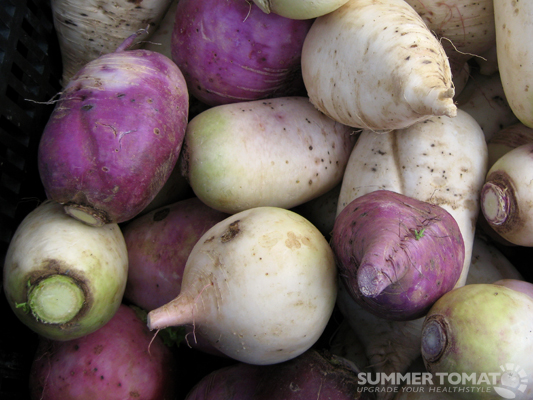
Turnips

Turnips

This weekend was the Brassica Festival at the San Francisco Ferry Plaza Farmers Market.

Brassica

Brassica

Brassica Bash!

Brassica Bash!

Brassica is a genus of vegetables in the mustard or cabbage family that includes cabbages, broccoli, cauliflower, kale, turnips, bok choy, kohlrabi and Brussels sprouts. They are also known as cruciferous vegetables, and I adore them.

Curly Kale

Curly Kale

Broccoli Crowns

Broccoli Crowns

In honor of the festival I stocked up on two kinds of kale, collard greens, broccoli and kohlrabi. I resisted Brussels sprouts since I got them last week. The great thing about brassica vegetables is they are very affordable, usually less than $2/bunch.

Kohlrabi

Kohlrabi

Generally I am spending a lot less money at the farmers market now that summer is over. I attribute this largely to the lack of berries and stone fruit. Oh, and my $10/week tomato habit has now dried up. But I can’t complain at all.

Daikon, Kohlrabi and Sunchokes

Daikon, Kohlrabi and Sunchokes

Baby Bok Choy

Baby Bok Choy

Citrus, especially the mandarins, are marvelous this season and getting better every week. Pomegranate seeds are by far my favorite thing on my breakfast. Pears from Frog Hollow Farm are freaky good.

Persimmons. Almonds. Walnuts.

I think I’m falling in love with autumn in San Francisco.

Kiwi

Kiwi

Mandarins

Mandarins

Hachiya Persimmons

Hachiya Persimmons

Almonds

Almonds

I finally got some kiwi this week. If you’re a kiwifruit fan, you absolutely must go try the ones from Four Sisters Farm, they have an unbelievable flavor that is almost floral. I had no idea kiwi could be so complex. These are really special.

Many of the farms are offering gift wrapped items for the holidays. Most of these things are pretty cute, probably delicious and something to consider if you’re shopping for any foodies.

Holiday Foodie Gifts

Holiday Foodie Gifts

Or for that person who has everything, you could always just get one of these giant parsnips. They are about the size of your head. Who doesn’t need jumbo parsnips?

Giant Parsnips

Giant Parsnips

Exactly.

Today’s Purchases:

Tags: , , , , , , , , , , , , , , ,

For The Love of Food

by | Dec 4, 2009
For The Love of Food

For The Love of Food

I had to take a little break from reading articles this week since I have a big project I’m working on in lab right now. Instead of the usual awesome links, today I want to share with you a video lecture by UCSF professor, Robert Lustig.

It is long, but absolutely worth watching.

And it is particularly important if someone you know is suffering from type 2 diabetes or other chronic disease.

Dr. Lustig argues that sugars, and specifically fructose, are a direct cause of the current obesity epidemic and more similar to alcohol (poison) than to food. His discussion of the effects of fructose on children is heartbreaking and makes his arguments particularly poignant.

It also helps answer the question I often get about why cultures that depend largely on pasta and white rice (Italian and Asian societies) aren’t as unhealthy as Americans even though we all eat “processed carbs.” The answer is that it is both the processing and the additives that cause the problem, and Dr. Lustig explains in detail the science behind it all.

I should warn you that about half way through he starts going into some serious biochemistry, but don’t let it scare you. That section is short and you don’t need to understand the details to get the take home message. Those of you with some undergrad chemistry under your belt will enjoy it, but that is by no means required. Scrub ahead if you must.

My favorite quote:

“Fructose is ethanol without the buzz.”

In other words fructose is much, much worse.

Watch this and share it with your loved ones.

P.S. Thanks to those of you who downloaded How To Get Started Eating Healthy. If you thought you should have received a copy but didn’t, you are probably signed up for the blog post emails but not the newsletter. The difference is explained here. Fill out the newsletter form to get a link to the free guide.

Tags: , , , , , , ,

What’s Worse: Pests or Pesticides? [Poll]

by | Dec 2, 2009
Photo by star5112

Photo by star5112

It’s never fun to find an unwelcome critter in your food, but if you spend much time shopping at farmers markets or buying organic produce it is something you need to get used to. Without pesticides, sometimes there are pests.

But… usually not.

Before you get too grossed out and dash to your kitchen to throw away your organic apples, I want to make it clear that the vast majority of the food I buy (~90% purchased direct from farms) is perfectly clean and insect free. But unlike sprayed and irradiated conventional produce, occasionally there will be a bug. And sometimes there will be many bugs.

But as scary as this can be the first time it happens, bugs really aren’t so bad. Most critters can be easily rinsed off under the sink. Some of the smaller, more persistent little buggers can be coaxed out with a short bath in water spiked with a splash of vinegar.

Herbivorous insects pose no real threat to humans beyond mild annoyance. Yes, they can add an unpleasant crunch to your food if you don’t find them in time, but generally they contribute no flavor and–as many of my Twitter followers pointed out–they may add a little protein to your diet.

Twitterbugs6

Twitterbugs1Twitterbugs2

I somehow doubt that insects really provide a significant protein source, though I’ve heard they can contribute substantial vitamin B12 for vegetarians who ingest them accidentally in rural societies (couldn’t find a credible reference). But the point is that whatever insects do add to your diet probably doesn’t impact your health in a negative way.

That is, if you even notice them. Chances are you have never actually tasted an unwanted creature in your food (I know I haven’t), but they are probably there sometimes and you’ve probably eaten them.

Let’s be honest, the problem with finding bugs in your food isn’t how they taste. The real obstacle is our perception of bugs. In our society bugs are considered gross, so we don’t want to eat anything they have touched.

Twitterbugs4

But not all cultures consider bug eating repulsive (see photo). And after you’ve dealt with a few insects yourself, eaten your food anyway and come out unscathed, you realize there isn’t really anything to worry about.

Twitterbugs5

Only once have I encountered a situation where a vegetable was infested beyond salvation. These were some baby cabbage I had left for too long in the fridge. Over the course of a week the insects multiplied and completely took over. It wasn’t pretty.

But instances like these are rare and, in my case, it was self-inflicted.

True insectophobes, however, will not be comforted by this argument. I am entirely sympathetic to this viewpoint–at one time in my life I used to joke that I was afraid of butterflies (OK, live ones still creep me out when they get too close).

But what scares me even more than eating bugs is the alternative.

Twitterbugs7Twitterbugs8

We don’t yet know the extent of the damage done to our health by pesticides, but the history (dioxins, malathion, etc.) hasn’t been encouraging. The environment we live in is also significantly impacted by pesticide use.

Even if cancer and polluted lakes are a bit too abstract for you, there is still the bland, one-dimensional flavor of food produced on factory farms to consider. Taste is what really won me over when I first changed my eating habits.

I don’t mean to imply that it is never okay to eat conventional produce, just that there are serious issues to consider regarding where your food comes from.

Pests and pesticides can both be a little scary (I forgot to mention the live wasp that once crawled out of my spinach), but at this point it seems we do have to choose one or the other.

Which scares you the most? Vote now!

[poll id=”6″]

Tags: , , , , , , , , ,