For The Love of Food

by | Apr 30, 2010

For The Love of Food

Welcome to Friday’s For The Love of Food, Summer Tomato’s weekly link roundup.

Exceptional reading this week. Whatever you do, don’t miss Michael Ruhlman’s calling BS on the food industry deceiving us into believing we’re too busy to cook. There’s also new data suggesting your genes may determine what diet suits you best (healthstyle anyone?) and important news for diabetics taking vitamin B supplements.

I read many more wonderful articles than I post here each week. If you’d like to see more or just don’t want to wait until Friday, be sure to follow me on Twitter (@summertomato) or the Summer Tomato Facebook fan page. For complete reading lists join me on the social bookmarking sites StumbleUpon and Delicious. I’m very active on all these sites and would love to connect with you there. (Note: If you want a follow back on Twitter introduce yourself with an @ message).

Links of the week

What inspired you to eat well this week?

Tags: , , , , , , , , ,

6 Reasons To Eat More Sardines

by | Apr 28, 2010
sardines

Photo by rockyeda

I’m happy to introduce my friend and fellow sardine lover, Benjy Weinberger. Neither of us were particularly happy about the recent news of the last US sardine cannery closing, so I invited Benjy here to defend the honor of one of my favorite sea creatures.

Benjy Weinberger has been eating food for over 30 years, and has held strong opinions for almost as long.

Read his personal blog: http://jamknife.blogspot.com/
Follow him on Twitter: @benjyw

Yes, We Can! Why We Should Be Eating More Sardines

The whole street rumbles and groans and screams and rattles while the silver rivers of fish pour in out of the boats and the boats rise higher and higher until they are empty. The canneries rumble and rattle and squeak until the last fish is cleaned and cut and cooked and canned.
- John Steinbeck, Cannery Row

A few days ago we were told the last sardine cannery in the US closed its doors for good. A symbol, so the story goes, of how far sardines–once a staple of working-class pantries across the nation–have fallen out of favor with the American palate.

But if you get past the bad “last sardine factory canned” puns, this narrative starts to seem, ahem, fishy. Because, in fact, the sardine is like Bad Company, alive, well and making a comeback.

Fresh sardines are showing up on menus in restaurants from San Francisco to New York. Your local supermarket still offers plenty of canned sardine choices, albeit imported. In Monterey, California, where Steinbeck romanticized the sardine industry in Cannery Row, a group of self-styled “Sardinistas” is working to return the sardine to its rightful place in the American diet. Meanwhile, nearby, small-scale gourmet canning operations have resumed. So it seems the supposed death of the sardine industry has been exaggerated.

So what are sardines, exactly? The term means slightly different things in different countries, but in the US it denotes any of several species of small, oily, silvery fish related to herring.

What all types of sardine have in common is that we should be eating a lot more of them.

6 Reasons To Eat More Sardines

1. They’re good for you.

Sardines pack an awesome nutritional punch. A single serving has around 23 grams of protein and is loaded with omega-3 fatty acids, calcium, iron and potassium, and only 200 calories. And even with canned sardines, all this goodness comes with only around 400 mg of sodium, which is relatively little for a canned product. Plus, they’re often packed in olive oil, itself an important component of a healthy diet.

2. They aren’t bad for you.

Sardines are low on the oceanic food chain, and therefore contain low amounts of mercury, PCBs and the other toxins that accumulate in longer-living marine predators such as salmon and tuna. This makes them a particularly good choice for children and pregnant women.

3. They’re sustainably fished.

Monterey Bay Aquarium’s SeafoodWATCH rates sardines as a “Best Choice”. Sardine stocks are, once again, abundant, healthy and are now well-managed.

4. They’re affordable.

Prices per oz. of canned sardines are on a par with canned tuna, poultry, ground beef and other supermarket protein sources. Prices of fresh sardines vary with availability, but they are usually among the less expensive fresh fish on display.

5. They taste like fish.

In a supermarket landscape dominated by bland, artificially dyed salmon fillets, pale tuna steaks, frozen fish sticks, artificial crab meat and other attempts to sell seafood as generic chicken-like protein slabs to people who aren’t sure if they actually like it, sardines stand out. You simply can’t ignore the fact that they are, well, fish. They look like fish, being too small to fillet or grind up. They smell like fish. They are oily. They have heads and tails, scales and bones. And they taste fishy.

This is, as most people who genuinely enjoy food know, a good thing.

6. They’re delicious.

This is ultimately the most important point in favor of consuming more sardines: they are a pleasure to eat. Simple, easy to prepare and downright delicious.

If you get your hands on some fresh sardines, they feature in fabulous recipes originating from all over the Mediterranean basin. But sardines are so simple and basic, you really don’t need a recipe to get the best out of them. Just scale and gut them, brush them lightly with olive oil and coarse sea salt, or whatever marinade you make up, grill them for around 5 minutes per side, until the skin is crispy, and serve them up with a drizzle of lemon juice and your favorite fresh herbs.

And if you can’t be fussed to cook, there are few pleasures greater than mashing canned sardines, bones and all, onto buttered toast, or perhaps over a slice of camembert.

The sardine is dead. Long live the sardine!

What are your favorite sardine recipes?

Tags: , , , , , , , , , ,

A Springtime Quiche, Gluten Free

by | Apr 26, 2010
Springtime Quiche Recipe

Springtime Quiche

Today I’m excited to have one of my favorite scientists and healthy eating bloggers, Jenn Cuisine, sharing her story. Jenn is an amazing cook who has learned gluten free cooking because of her husband’s gluten intolerance.

I find Jenn particularly inspiring because despite her culinary restrictions, deliciousness is always her top priority. She cooks amazing, healthy food and takes beautiful photos. In fact, it was months before I even realized her recipes were gluten free.

Jenn Cuisine is perfect for anyone interested in delicious, healthy recipes. Follow her on Twitter @jenncuisine

A Springtime Quiche, Gluten Free

by Jenn

Hello! And thanks so much to Darya for inviting me to talk with you all. I have always been a big fan of Summer Tomato, the vast wealth of information that Darya provides about health and tasty food is just simply amazing!

The month of May, Celiac Disease Awareness month, is quickly approaching, and so I thought it would be the perfect time to talk about my family’s gluten free experience and how we get on in the kitchen.

My husband is not technically celiac, but is very intolerant to gluten and has many similar symptoms as celiac disease. Never having had any problems with gluten myself, I panicked a little bit when I found out. I learned about his condition soon after we started dating, and was completely overwhelmed at the thought of making gluten free food.

“No bread? No pasta?  No flour? OMG what in the world am I going to make for him??” This put a serious wrench in my plans to win over his heart with some fabulous home-baked goods, like my dad’s famous peach pie.

I was utterly clueless about how to prepare gluten free food, and my husband didn’t have a good handle on how to eat GF back then either. He was constantly miserable and reacting to everything, and just didn’t have the kitchen know-how to consistently create tasteful gluten free meals. Gluten free became a learning experience for the both of us. And together, by learning how to cook all over again, we fell in love.

At first, I felt that making gluten free food shouldn’t be a big deal. I wanted our lives to continue as if being gluten free were a mere afterthought–but I quickly realized this is not how this works. GF is a permanent and ever present part of his life, which needed to be acknowledged. Some foods are challenging and others are simple, but no matter what we will be gluten free. This is not some fad diet for us, this is a part of who my husband is, and therefore, who I am.

We started out simple and slow, at first relying on a number of packaged foods. However, these products really weren’t fulfilling taste-wise and were quite pricey for our grad-student budgets. Thus began my venture off into the world of gluten free cooking from scratch, learning about various alternative flours, binders and ratios.  I even managed to successfully make my dad’s peach pie.

As time went on, cooking transformed from something I used to stress over into part of our daily lives that we both can now proudly embrace. Gluten free cooking is not a handicap. If anything, GF has been liberating, because I have grown to appreciate so much about food, flavor, creativity and love.

One of the biggest lessons I’ve learned is that GF cooking doesn’t have to be difficult. In fact, most of what we cook on a daily basis needs no alterations, no substitutions. I find it’s best this way. After all, food shouldn’t be a fuss–that takes the fun out of it. Cooking should be relaxing, a time for sharing, and a time to enjoy the simple pleasures in life. We learn from each other this way, and bond over soups bubbling on the stove, chicken roasting in the oven, or pastries being rolled out.

These are the little joys that food and cooking can bring us, little ephemeral moments of bliss, which are not limited to only glutenicious dishes. Through learning how to create food gluten free, I’ve learned to enjoy cooking all over again.

There are so many tips and tricks I have learned along the way–to remove the stress and panic that can so easily overwhelm the newly GF. If you are just starting out in the realm of gluten free food, here are some helpful little bits of advice:

1. Explore!

Be adventurous and try those grains you’ve never seen before. Quinoa, amaranth, millet. Each has a new, different flavor and often contains more nutrients than plain old white rice flour.

2. Find a recipe for a GF mix that you love?

Mix a bunch of the dry ingredients together ahead of time and store the entire mix in one container. This way you aren’t always grabbing a thousand ingredients at once, making baking just as easy as if you had plain old wheat flour in your pantry.

3. Embrace the flourless

Roasts, salads, soups, stir fries, risottos, curries. All of these things are very easy to cook without any substitutions. Many dishes are decadent without ever needing flour, from a simple tapioca pudding to a sophisticated chocolate soufflé.

4. Look to Indian and Southeast Asian cuisines

Several foods from these cultures are naturally gluten free, involve lots of great fresh legumes and produce, and pop with flavor–you may find some great gluten free ingredients at ethnic food markets as well.

5. Practice

Don’t be afraid to mess up! You may not find the perfect whole grain gluten free bread recipe on the first try, but don’t give up. With all things, practice and patience will yield great results.

Today I am sharing with you one of my favorite gluten free dishes to make, a quiche. Pie crusts and the like are great for adapting to be gluten free. They need none of the elasticity or network of air pockets that gluten develops in a bread dough. You can make a decent pie crust with just about any gluten free flours, as long as you keep around 1/3 of the flour a starch, like the tapioca I’ve used here.

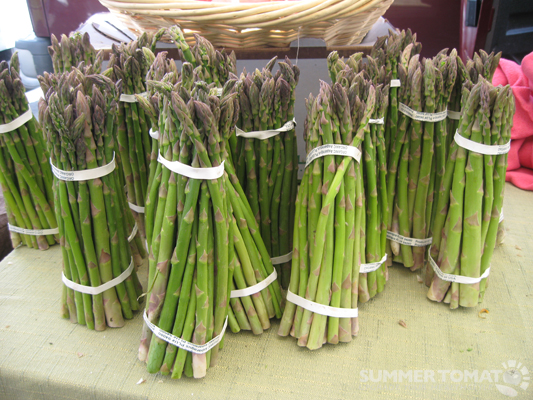
In this recipe I like adding the cream cheese because it makes for a great texture–cream cheese is common in several glutenicious quiche crusts as well. Fillings are also extremely versatile, and baking is generally forgiving. I chose to highlight some of my favorite springtime vegetables–spinach and asparagus–but you can add in whatever you want!

Asparagus, Spinach and Bacon Quiche, Gluten Free

Gluten free quiche

Gluten free quiche

Ingredients:

For the crust:

1/3 cup chickpea flour
1/3 cup brown rice flour
1/3 cup tapioca flour
4 oz. cream cheese
1 stick (4 oz.) butter
salt, pepper, herbs

For the filling:

5 eggs
2 shallots, peeled
2 cups fresh spinach
1 bunch asparagus, chopped
4 slices bacon, cooked and crumbled
4 oz. gruyere, grated
¾ cup milk

Directions:

1. Add all of the ingredients for the crust into a food processor and pulse until it comes together into a ball of dough. Wrap dough in plastic wrap and let rest in the fridge for at least 30 minutes. Preheat oven to 350F.

2. Heat up a frying pan with a little olive oil and sauté minced shallots until softened. Add in fresh spinach and continue to cook, stirring occasionally until wilted.

3. Remove dough from fridge, roll out in between 2 sheets of plastic wrap (gluten free dough tends to be a bit sticky) until ¼” thick. Peel off top sheet of plastic wrap, flip and transfer to a 9” spring form pan. Press into the bottom and sides of the pan, and then peel off the remaining layer of plastic wrap.

4. In a large bowl, beat eggs and then add vegetables, bacon and cheese, and then add in about ½ to ¾ cup milk. Pour into quiche, cover edges of the crust with foil, and bake about 45 minutes (this will be longer if you make a taller thicker quiche as I did here), or until it has set and crust has nicely browned.

5. Let cool about 10 minutes, unclamp spring form pan, slice, and top with some fresh greens to garnish.  Serve and enjoy!

What are your favorite gluten free recipes?

Tags: , , , , , , ,

Farmers Market Update: Earth Day!

by | Apr 25, 2010
Dirty Girl Strawberries

Dirty Girl Strawberries

What better way to spend Earth Day than with a trip to the farmers market?

On April 22 I took a little break from my normal weekday schedule of neuroscience and recipes to visit the Thursday farmers market at the San Francisco Ferry Building. I visit this farmers market every Saturday, but rarely break away to see what goes on during the week.

Pizza Politana

Pizza Politana

Roli Roti

Roli Roti

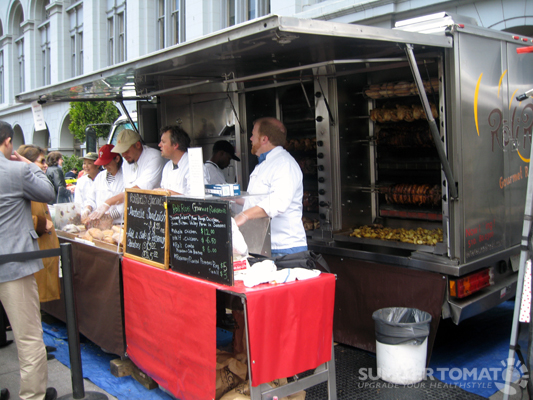
The market is very different on Thursday, and is really more of a street food fest than a farmers market. Legendary San Francisco edibles like 4505 Meats, Namu and Roli Roti serve up mouthwatering lunch snacks to savvy SF street food devotees.

Arlequin

Arlequin

Namu

Namu

It was a tough choice, but I couldn’t resist grabbing some tacos at Tacolicious. I’m a sucker for a good taco, and this week they were also hosting guest chef Laurence Jossel from my absolute favorite Mexican restaurant, Nopalito. I tried one taco from each restaurant, the beef cheeks from Nopalito and the carnitas from Tacolicious. Both were divine, but I must admit the carnitas transported me instantly down to LA, which is the highest compliment a taco can receive from this SoCal native.

4505 Meats

4505 Meats

Tacolicious

Tacolicious

If you’re ever at the San Francisco Embarcadero on a Thursday afternoon, definitely have your lunch at the farmers market. You won’t regret it.

There weren’t many farm stands around on Thursday, but I did manage a HUGE score while there. It seems Dirty Girl Produce comes to the Thursday market and they had strawberries! (behold top photo)

If you’ve been following my farmers market updates you know I haven’t had much luck getting my hands on these since they sell out so early Saturday mornings. When my brain finally processed what I was looking at (lousy slow synapses), I almost dropped my camera in a reflexive rush to buy them.

And yes, they were gone before I got them home.

Happy Earth Day!

Tags: , , , , ,

For The Love of Food

by | Apr 23, 2010

For The Love of Food

Welcome to Friday’s For The Love of Food, Summer Tomato’s weekly link roundup.

Be sure to check out my guest post today over at Ecosalon! Top 10 Mistakes Made By Farmers Market Noobz

No good news this week for those of you who still love processed foods. Turns out sugar (not fat) causes heart disease, processed soy products causes cancer and the health insurance industries puts their extra money into fast food stocks. Luckily there is still hope for those of us interested in eating real food with actual taste.

I read many more wonderful articles than I post here each week. If you’d like to see more or just don’t want to wait until Friday, be sure to follow me on Twitter (@summertomato) or the Summer Tomato Facebook fan page. For complete reading lists join me on the social bookmarking sites StumbleUpon and Delicious. I’m very active on all these sites and would love to connect with you there. (Note: If you want a follow back on Twitter introduce yourself with an @ message).

Links of the week

What did you find worth reading this week?

Tags: , , , , , , , , , ,