Sign up

You deserve to feel great, look great & LOVE your body

Enter your email for your FREE starter kit to get healthy & lose weight without dieting:

  • This field is for validation purposes and should be left unchanged.

5 Classic Super Bowl Foods That Are Surprisingly Healthy

by | Jan 28, 2013

Photo by Надя Антонова / Nadja Antonova

Healthy eating is important, but sometimes on special occasions you just don’t want to compromise. Luckily, sometimes you don’t have to.

Some of the most classic Super Bowl foods actually aren’t as bad for you as most people think. Just make sure that real, good-quality ingredients are used in all your recipes and enjoy.

5 Classic Super Bowl Foods That Are Surprisingly Healthy

1. Chili

Beans, tomatoes, onions, spices and grass-fed beef are the things healthy meals are made of—just don’t forget to eat some leafy greens at some point during the day.

Really good chili doesn’t require cheese, but if you can’t live without it just make sure you get real cheddar and not the processed fake stuff. Check the ingredients.

2. Chicken wings

Chicken wings are tasty, and depending on what you put on them they can be healthy as well. What’s important is that you avoid breading and sweet sauces. Traditional Buffalo wings are probably not the best option (they’re breaded and fried), but Chef John’s famous Super Bowl pastrami wings would be perfect.

3. Guacamole

I’d be lying if I said you didn’t have to watch your portions with guacamole—it’s easy to eat a lot and it is very high in calories. But fortunately it is very filling and all the calories are of the healthy variety. The monounsaturated fats in avocados are very effective at raising healthy HDL cholesterol, without negatively impacting other blood measures.

4. Salsa

Of course there can be no talking about Guacamole without mentioning his fiery little sister Salsa. On the health front, you can’t beat the combo of tomatoes, onions, chili, cilantro and lime, and it tastes good on pretty much anything. So go nuts, you can enjoy this one guilt free.

5. Bean dip

Black bean dip is a classic at Super Bowl parties. If you start with dried beans and soak them overnight before cooking and pureeing them for the dip, you can even avoid the digestive issues most people associate with legume consumption. If you’re tired of Mexican flavors (the ingredients are similar to those in salsa and guacamole) try using chickpeas in a Mediterranean-style hummus instead.

What are your favorite Super Bowl recipes?

Tags: , , , , , , ,

Mind-Blowing Japanese Carnitas Tacos

by | Jan 23, 2013
Japanese Carnitas

Japanese Carnitas

A few weeks ago I tweeted about this dish and got an overwhelming positive response, begging me to share the recipe. I have finally acquiesced.

While it was in fact mind-blowingly delicious, I’ve been resistant to publish it because bad lighting and my trusty iPhone camera really didn’t do the dish justice in the photos. To be honest, my dislike of food photography (the taking, not the viewing) is what prevents me from posting more recipes in general.

Lame, I know.

I used to spend a ton of time styling food, perfecting the lighting, then spend hours editing in Photoshop to get that one perfect photo. It’s a tedious process, and I can’t stand it. I like to cook and eat good food, but I don’t like to fret over it. And photography is fretful. Maybe one day I’ll have enough free time to spend my days mastering shutter speeds and lighting, but in the meantime you’ll just have to believe me that this is one worth making.

I’ve been messing around with my slow cooker lately, and have made several renditions of this Japanese version of carnitas. It’s so unbelievably good. It’s basically a pork shoulder (I got mine from Prather Ranch) braised in Japanese flavors like dashi, soy sauce, and ginger. I throw some Tokyo salad turnips or daikon in with the meat as well. I serve it in little cabbage cup “tortillas” with rice, cilantro and Sriracha hot sauce.

You’ll have a better time if you find a cabbage with leaves that are easy to separate, such as Napa cabbage. Smaller cabbages make this easier as well. I used some concentrated liquid dashi broth I found at a market in Japantown, but you can make your own or use the dehydrated kind if you prefer.

This is a great, simple dish for a group, though vegetarians might want to sit this one out.

Mind-Blowing Japanese Carnitas Tacos

Serves 6


Carnitas

Braised Pork Shoulder

Marinade

4 c. water

1 c. concentrated dashi

1/2 c. brown rice vinegar

1/2 c. soy sauce

1/3 c. mirin cooking wine

1/4 c. rough chopped ginger

1 cippolini onion chopped

1 c. coursely chopped daikon or Tokyo turnips


Meat

3.5 lbs pork butt (shoulder), trimmed of excess fat, cut into 4 large hunks


Garnishes

1 medium cabbage

2 c. cooked haiga rice (cook 1 hour before serving)

Fresh cilantro sprigs

Sriracha sauce


Preparation

In a large Dutch oven or cast iron pan, brown the meat on each side (about 20 minutes total). A splatter guard will come in handy during this step. While meat is browning, prepare marinade by adding all ingredients to crock pot.

Add cooked pork to marinade, liquid should cover 3/4 of meat. Cover and cook on high for 6-8 hours, turning half way through, or until pork pulls apart easily with a fork.

Before serving wash and dry cabbage and cut in half. Separate leaves and place on serving platter. Leaves should be approximately the size of corn tortillas, 5-6” across. Rinse cilantro sprigs, trim the ends and add to serving plate.

To serve, separate meat with fork into smaller, but still hefty chunks. Scoop some rice onto each plate, along with a portion of pork and a few daikon pieces. Place the vegetable serving platter in the center of the table, with a bottle of Sriracha. Fill some small bowls or ramekins with a small serving of cooking liquid for dipping.

To eat, scoop a small amount of rice onto a cabbage leave and top with pork. Add a few cilantro sprigs and a squirt of Sriracha to taste. Dip in sauce as desired.

Enjoy!


Tags: , , , , , , ,

Healthy Snacking 101

by | Jan 14, 2013

Photo by zlakfoto

Americans love to snack. We snack at work, at parties, at the movies, in the car… pretty much anywhere we can get a few fingers free to grab a bite of food. As a nation we’ve elevated snacking to an art form, and on the surface it seems like it has no boundaries.

Of course there’s nothing wrong with snacking. Having a small bite to eat between meals is a great way to give your metabolism a little kick and keep you from becoming ravenously hungry later, which can lead to overeating. Snacking is also fun, and can be a great way to socialize and connect with others.

But there is a difference between snacking and compulsive, emotional or hormonal eating. There is also a difference between snacking and bingeing.

The Purpose of Snacking

Snacking always has a purpose. If we were less emotional beings, it would almost always serve to prevent hunger. But since our motivations for eating tend to be complex, identifying all the reasons we snack is important in helping us decide how to approach it.

1. Regain attention

Being hungry is exceptionally uncomfortable. Knowing it will still be awhile before the next meal, a small snack is a great way to buy a few hours of focus and attention, allowing us to be more productive without disrupting our schedule.

2. Curb overeating

As mentioned above, snacking can also be important in preventing overeating. When you’re starving, your eyes can easily become larger than your stomach. And since it takes at least 20 minutes for your satisfied stomach to communicate to your brain via your bloodstream that you are no longer starving, that time can be the difference between a sensible meal and a binge. It’s best to avoid becoming deliriously hungry in the first place by having a small snack in the interim.

3. Socializing

Between meal eating can be initiated for less utilitarian purposes as well. For instance, snacking is a fabulous epicenter for a social event. As many awesome organizations have discovered, food is a great leveler and platform for fostering interaction and collaboration, a value far greater than the price of a cheese plate.

4. Tasty taste

Sometimes the best reason for a snack is that food just tastes good. Maybe you didn’t anticipate your officemate bringing in samples of her mom’s famous baklava, but some foods are just worth making a little extra room for. This kind of snacking may bring in some extra calories, but it isn’t the end of the world so long as you adjust for it later (a slightly smaller dinner or longer workout).

5. Cravings

Food cravings are the least awesome reason for snacking. They can be caused by nutrient deficiencies, hormone imbalances, mental disquietude, and can seem to come out of nowhere. Though giving into cravings sounds like a bad idea, attempting to ignore them can be distracting and often pointless. (How many of you can actually ignore your cravings if the food you want is available? Yeah, I didn’t think so.) So it is better to have a strategy for dealing with cravings rather than waste your time and energy putting off the inevitable.

Goals of Snacking

No matter what your reason for snacking, the goal should always be satiation. If you are hungry, you want to eat enough to regain your attention and avoid later overeating, and that’s it. If you’re snacking at a social event and aren’t hungry, a few bites should be enough to get you chatting. If a mid-day hors d’oeuvre tastes amazing, a bite or two should satisfy your curiosity. If you’re craving something, you want to stop the craving as quickly and effectively as possible.

Snacking should be a clearly defined occurrence, not something that drags out over the course of hours. It helps if your snacks come in defined quantities to prevent mindless eating. Choose foods that are dense and slowly digesting so you feel like you’ve eaten enough and aren’t tempted to return for round two.

Thinking about foods in terms of their macronutrients is rarely useful, but as a rule of thumb the most filling foods tend to have:

  • protein
  • fat
  • fiber
  • water

Or some combination of these. Foods that have a lot of sugar or refined carbohydrates tend to do the opposite, and encourage continuous eating.

When eating for hunger, it is also a good idea to find snacks that are on the healthier side–nutrient dense, whole and unprocessed foods.

Snacking should be enjoyable and mentally satisfying as well. You should love the food that you eat as much as the clothes you wear and books you read. Eating is one of life’s simple pleasures.

Cravings are a different beast, and can often be alleviated without the specific food you think you need. For cravings, healthy options should be your first resort. Low-calorie beverages such as sparkling water or herbal tea can also be effective.

Healthy Snack Ideas

Here are some snack ideas to get you started, but don’t feel limited by this list. Start with foods you enjoy and work from there.

Fruits

  • Apples
  • Pears
  • Melon
  • Grapefruit
  • Orange

Nuts

  • Pistachios
  • Almonds
  • Cashews
  • Trailmix
  • Nut butters

Preserved meats (highly processed meats aren’t healthy, but small quantities can be useful for curbing your appetite)

  • Smoked salmon
  • Jerky
  • Charcuterie
  • Sardines

Cheeses

  • String cheese
  • Fancy cheeses

Vegetables

  • Kale chips
  • Carrots
  • Avocado
  • Celery
  • Bell pepper
  • Zucchini

Beans/other protein

  • Hummus
  • Edamame
  • Lentils
  • Boiled eggs

Beverages

  • Sparkling water
  • Tea
  • Tisane (herbal tea)

Sweet tooth

  • Dark chocolate
  • Dried fruit
  • Mint/herbal tea
  • Juice spritzer (mixed with sparkling water)
  • Fruits
  • Fruit/nut bars (e.g. KIND)

What are your favorite healthy snacks?

Originally published December 1, 2010.

Tags: , , , , ,

Farmers Market Update: Marrakech, Morocco

by | Jan 13, 2013

Covered Food Market in Marrakech

Elyse Kopecky is an Oregonian living, working and playing outdoors in Geneva, Switzerland. She’s a passionate food and health blogger who enjoys inspiring friends to live fresh. Next month she’s leaving the corporate world to study health supportive culinary arts at the Natural Gourmet Institute in NYC. Follow her adventures in the kitchen and on the trail at www.freshabits.com and @freshabits.

The Market Mazes of Marrakech

by Elyse Kopecky

Marrakech Farmers Market

In Marrakech every day is market day. In fact, in this city of a million people, every minute of every hour of every day the streets are alive with the sights, sounds and smells of vendors hawking their wares. Even for a serious foodie the city’s food and spice markets are a force to be reckoned with. Pass through the red walls of the Medina and you will soon find yourself lost in a maze of markets.

Street Vendor

As a food and health blogger, I’ve developed a craving to seek out extraordinary markets. Discovering farmers markets in faraway places is an adventure in both food and culture.

Beets

I also have an affinity for spices. To me Moroccan food celebrates the range of sweet, bitter, fiery and aromatic spices better than any other cuisine. In fact, Morocco’s most famous seasoning, Ras el Hanout, is typically a blend of 35 spices. 35! Oh la la! Therefore, it was no surprise to my husband when I told him that for my birthday, I wanted to go on a culinary excursion to Marrakech.

Peppers and Cinnamon

The old fortified city of Marrakech is truly one giant market. In any direction you look someone is selling something. Anyone visiting for the first time should be prepared to get lost, and lost, and lost again as you search for the true foodie corners where local Berber farmers sell their homegrown specialties. Luckily, on our first day, my husband and I stumbled upon a small square packed with elderly men selling local produce.

Artichokes

We bought some oranges and pomegranates that looked bruised and battered, but tasted fabulous. I especially loved the giant weathered flour sacks stuffed with bundles of fresh mint. For Moroccans, mint tea is the cornerstone of every gathering. They mix fresh mint leaves with green or black tea for a midday energy boost (healthy alternative to coffee!).

Pomegranates

For our second day of exploring the markets we hired Eben Lenderking, owner of the fabulous cooking school at Sanssouci Collection and author of the cookbook Tanjia Marrakchia, to guide us through the maze of food stalls. Our culinary adventure continued with a tour of the spice markets, where we were guided to a wholesale shop in a small back alley of the old Jewish quarter.

Culinary Class Dada

There we bought spices for the tajine and couscous dishes that we would be cooking later in a class taught by Eben’s Dada (aka head chef). We also bought a few Moroccan specialties to bring back home, including beautiful threads of saffron, savory cumin, the shop’s own house Ras el Hanout blend, cinnamon bark and the famed nutritious Argan oil.

Fish

After stocking up on spices, we headed to the impressive Marche du Mellah, a covered food market where we picked up fresh vegetables. A traditional Moroccan vegetable couscous dish contains seven vegetables (so nutritious!). The version we cooked at Riad Kaiss included onion, cabbage, zucchini, tomato, carrot, turnip and pumpkin. We also scoped out the fresh fish for a monkfish tajine, which ended up being our favorite dish of the cooking course.

Tajine

Marrakech is not for everyone. It’s loud, dusty and chaotic. But Marrakech has a magic, energy and excitement that I have never experienced anywhere else. And it has the flavors to match its unique vibe. For a food lover, Marrakech is a true culinary adventure. An adventure in finding your way through the maze of markets and an adventure in endless spices, oils, grains and vegetables. I left Marrakech inspired to continue my drive to explore the amazing and wonderful food markets of our world.

Beets and Squash

You can continue to follow my culinary adventures and get inspired to live FRESH at www.freshabits.com.

Tags: , , , ,

How To Make Brussels Sprouts That Aren’t Gross

by | Dec 3, 2012
Pan Roasted Brussels Sprouts

Pan Roasted Brussels Sprouts

Hate brussels sprouts? So did I. But I also don’t like being a picky eater, so I was determined to learn to like these little devils.

This is the recipe that finally made me love brussels sprouts. Bacon makes anything taste good, but these days I appreciate the sprouts even without it.

Buy the freshest brussels sprouts you can get your hands on, preferably from your local farmers market. Like any vegetable the fresher it is, the tastier and more nutritious it will be. I usually buy a pound or so. The smaller they are, the better (sweeter and less bitter) they taste.

The secret is to halve and blanch the sprouts before cooking them with other ingredients. This helps them cook through and gets rid of the nasty, bitter taste that can be so characteristic of sprouts. The other trick is to balance the remaining bitter flavor with an acid like lemon or red wine vinegar. Oh, and did I mention bacon?

I prefer to purchase my bacon from a local butcher. Get two slices, but for a larger batch of sprouts increase it to three.

This recipe is delicious with either walnuts or hazel nuts. If you decide on hazel nuts, I prefer to toast them in the oven first (350 degrees) until the skins start to turn dark and crack, about 10-15 minutes. I then roll them in a paper towel or plastic wrap to separate the skins from the nuts. Don’t worry if all the skins don’t come off, they’ll still taste good.

Pan Roasted Brussels Sprouts With Bacon

Ingredients:

  • 1 lbs brussels sprouts, cleaned and halved
  • 2 slices of bacon
  • 1 cipollini onion (or 1 leek or 2 baby leeks)
  • 1/2 cup walnuts or hazel nuts, coarsely chopped
  • 1 tbsp fresh oregano leaves, finely chopped
  • 1 tbsp red wine vinegar
  • 1 tbsp butter
Blanching Brussels Sprouts

Blanching Brussels Sprouts

Start some water boiling and add a few pinches of salt. Rinse and halve your brus sprouts. When the water comes to a rolling boil, add sprouts and set a kitchen timer for 5 minutes. Do not rely on yourself to remember, overcooking at this stage will ruin your meal. Boil sprouts exactly 5 minutes, rinse with cold water, strain and set aside.

In the meantime, chop cipollini onions (or leeks) and the nuts. Slice bacon (pieces stacked) into half inch slices.

Heat a pan on medium heat and add bacon slices. Allow bacon to cook about 4-5 minutes, until fat starts to render in the pan. Add the nuts and stir. If you are using cipollini onions, add those too (wait if you are using leeks).

Cook nuts and bacon until the bacon is almost done, then add butter. You can add leeks at this point or skip this step and add Brussels sprouts directly. When leeks just begin to soften (about 1 minute), add Brussels sprouts, sea salt and pepper.

Stir sprouts and turn most of them so their cut faces are resting against the pan. I strongly recommend using tongs for this. After about 2 minutes, stir the sprouts and sprinkle on oregano. Continue to cook, stirring every 2 minutes or so until the faces of the sprouts are all browned and onions begin to caramelize, 8-10 minutes. In the last 3 to 4 minutes, add vinegar (or lemon). This step is essential to cut any last bit of bitterness remaining in the sprouts. Use the taste test to determine precise cooking time (depending on the size of the sprouts).

Brussels sprouts pair beautifully with almost any protein. Pork, chicken and fish work especially well. Here they are served with French green lentils.

How did you learn to love brussels sprouts?

Originally published October 27, 2008.

Tags: , , , , ,

Farmers Market Update: Pteleos, Greece

by | Dec 2, 2012

Pteleos is surrounded by half a million olive trees

Matthew Denos of  Lodlois.com is a biologist who lives in Greece. He enjoys the Mediterranean diet and lifestyle after spending 6 years in the US working as a research fellow in academia. He believes that health is our greatest resource and therefore it’s worth keeping it optimum. When he doesn’t review diets and gourmet food delivery programs at SeaRocketBistro he is outdoors biking, mountain climbing or windsurfing.

Farmers Market Update: Pteleos, Greece

by Matthew Denos

Pteleos Farmers Market

I am blessed to live in Greece. Yes, the economy sucks, unemployment is at an all time high, the cost of living is expensive, and basic salary is a joke. Yet, I wouldn’t trade the Greek islands, the beaches and the mountains for any of the strong economies up north or overseas. I wouldn’t trade the Greek food, either—the healthy  Mediterranean diet. The extra virgin olive oil, wine, feta cheese, seafood, olives, unique herbs and spices—the Mediterranean lifestyle in all its forms has a top place in my heart.

Fortunately, the Greek food chain is not as industrialized as it is in other Western countries. Of course, food is nowhere what it once was. But Greece is a relatively small market in Southeast Europe (the gate to the East), and, thankfully, has not yet totally assimilated the Western diet. Our traditional diet still holds strong, and healthy soils abound, especially in Greek islands and villages.

Last summer I spent a few weeks in my grandfather’s village in Pteleos, where I had the opportunity to visit the local farmers market. Pteleos is a picturesque village nestled among curvy hills on the west side of Pagasitikos Gulf, in Thessaly, Greece, not far away from gorgeous beaches facing Aegean Sea. Thessaly is the birthplace of Greek hero Achilles (think Brad Pitt in the movie Troy).

Melons

Olives and olive oil are the farmers’ main produce in Pteleos, and this shouldn’t come as a surprise given that there are over half a million olive trees planted within a radius of 3 miles from the village center. The village is basically embedded in a huge plantation of olive trees. The local farmers, which are mostly olive oil producers, own the plantations. Yet, it’s impossible for them to harvest all these fields by themselves, which is why each year in November, when the olive tree harvest begins, they hire workers from Bulgaria, the neighboring country, to help them out.

As I headed to the market that Wednesday morning, I was excited to meet the farmers. It was my first visit ever. Some of the farmers live and work in Pteleos while others come from nearby villages (Sourpi, Valestino, Almyros). Most of them have their own plantations and are proud and passionate about the quality of their products. Others are simply re-sellers of produce they bring from distant parts of the country. Farming is for them a family business. One can sense the care and passion that goes into cultivating the land, sowing the seeds, growing, protecting, and harvesting the plants, and finally selling the product. It’s a long and strenuous process which the family is proud of.

Beautiful Assortment of Peppers

The market takes place outdoors in a car park every Wednesday. It starts at 8am and goes until noon. It’s worth getting to the market early, so at 9am I was there, with my Olympus Stylus Tough 8010 in hand, greeting the first stall owner with a smile.

He thought I was a tourist and greeted me in English. Pteleos, and the broader area, is a popular summer vacation destination. When I told him I am just taking pictures for an article I am going to publish at a California-based health site, he gladly pointed me to his colorful and fresh produce. I loved his beautiful array of groceries of the nightshade family. Peppers of different shapes and colors drew my attention, as well as the shiny, ovoid, dark purple eggplants. I bought two pounds of peppers. Pepper is part of my daily high-protein, veggie-rich omelet.

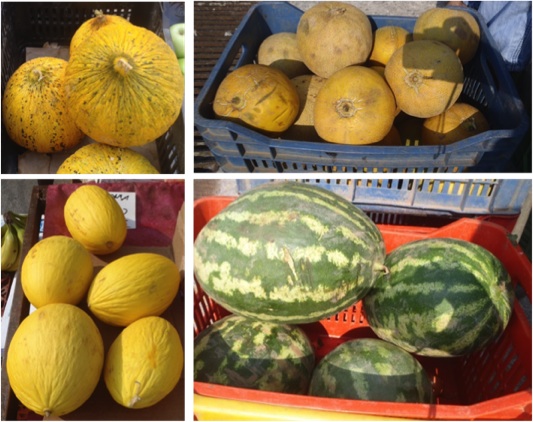
A little further down there was a stall full of melons. The football shaped ones are called “Thrakiotika” (Thracian), because they grow in Thrace, the northeastern section of Greece, bordering Bulgaria to the north and Turkey to the east. I bought one and it was really sweet. In the summer, production of watermelons is in full swing. The stall owner was thirsty this sunny day and was feasting on a half watermelon.

Feasting on Watermelon

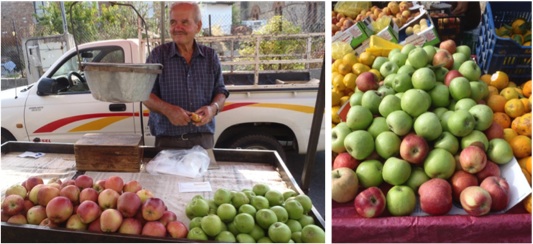
Across the way was a stall displaying a beautiful assortment of apples. Did you know that green apples have fewer calories than red? 30% less to be exact. This is because they contain less sugar. The same holds true when you compare the green and non-green version of almost any fruit or vegetable. Green olives have 38% fewer calories than black olives. Green peppers are 29% less calorie dense than red peppers.

Apples

As I had approached the apple stand, thinking about the calorie content of green and red apples, the farmer behind it greeted me. I introduced myself as a reporter for local Greek farmers markets. “Can you take a picture of me, too?” he asked. “Certainly,” I replied, “people in San Francisco and around the world will be glad to see your produce.” Another lady from a nearby stall heard the conversation and came along for the shot.

SummerTomato.com

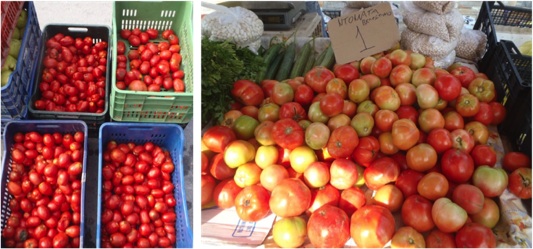
As I wandered around the stalls, picking my weekly groceries, I stopped to buy some tomatoes. I love tomatoes, especially if they are produced organically. This was not an organic farmers market (like the one I visited in Patras), still the farmers try to use as little pesticide as possible to grow their produce. Some grow the produce in their backyards without using chemicals at all, mainly for their own household’s needs. They then sell what they don’t consume themselves. Tomatoes sell for 1 euro a kilo (USD 59 cents a pound).

Tomatoes

In general, organically produced tomatoes are less attractive than conventional ones. Take a look at these two photos below and compare the looks and the taste. Well, you cannot actually taste them, but I did. The difference is like day and night.

Compare Tomatoes

The ones on the top tasted much better and were full of flavor.  If you look at them you will notice that they are not as pleasant to the eye as the ones beneath. They are not evenly colored. They have patches of green. They have scars, too. Obviously, in the absence of pesticides and other chemicals, appearance is compromised in favor of taste.

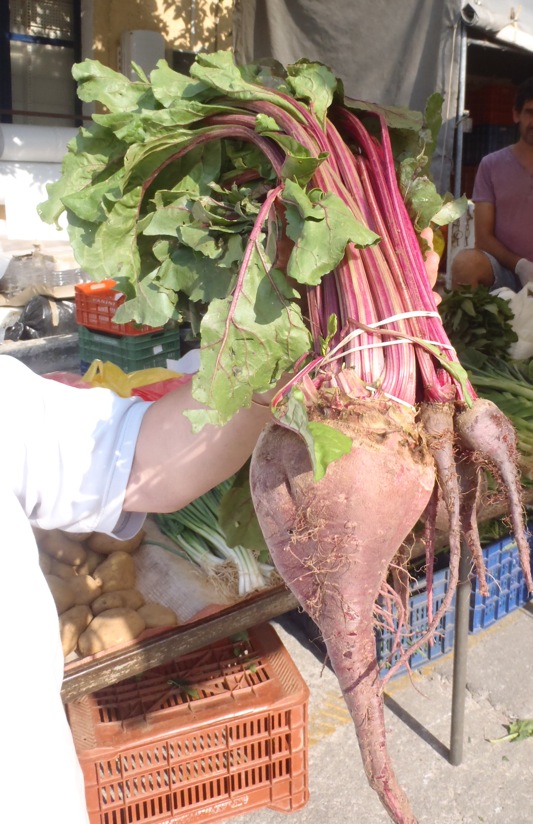
At this point, I heard somebody coming from behind me and I turned around. “Take a look at these gigantic beets! You should feature them in your report,” a vendor said as she held these huge beets proudly in front of my camera. Her request was hard to beet.

Big Beets

Peaches, nectarines, and vanilla plums make it to the list of my favorite summer fruits. Their distinctive aroma and color drew my attention. The ones I purchased had really juicy flesh. They were highly flavored and had a sweet and sour taste.

Vanilla Plums and Peaches

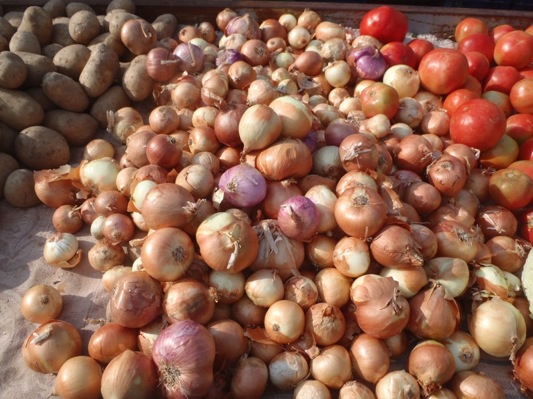
Potatoes and onions are always displayed together in any Greek farmers market I have visited. I like onions because they add to the tastiness of many foods. I eat one a day as they are one of the healthiest vegetables. Being aware of the enormous health benefits onions, famous American chef Julia Child once commented “I cannot imagine a world without onions.” I got a few from the stand below.

Onions

As my Pteleos farmers market trip drew to an end, I looked around for grapes. Grape is regarded by many in Greece as the king of fruits. Here grapes support a vibrant wine industry which is rich in native varieties. Grapes are a seasonal fruit that is available in the market only from August to November. The variety I bought is called “σταφίδα” (stafida – raisins) because it is the variety used for the production of raisins.

Grapes

I was about to leave when I noticed two of my favorite medicinal herbs. Mountain tea (sideritis) and oregano. Both are native plants. They grow in Greek mountains. The vendor opened a bag where he kept the oregano, and the aromatic oils, which are strong enough to numb the tongue, filled the air.

Oregano and Mountain Tea

The farmers market in Pteleos is a lovely place to go shopping if you ever happen to visit Thessaly, the homeland of hero Achilles.

Tags: , , , , ,

How To Cook Perfect Rice Without A Rice Cooker (and store it for months)

by | Nov 26, 2012

Rice Balls

I have been getting a lot of questions about rice lately, and I am not surprised. Though some people swear by rice cookers I have found them to be inconsistent and generally unreliable, especially when it comes to brown rice.

My solution? Stove top.

A few years ago I read about this method of cooking rice that supposedly worked “every time” for every kind of rice. I had trouble believing it because I’ve found that different styles of rice have hugely different requirements in both the amount of water and time needed. However, I have had great success with the method and am extremely happy with it (sorry, I do not remember where I found it).

The reason this trick works so consistently is that it does not rely on a specific amount of time or water. Rather you need to test the grains occasionally for tenderness and decide for yourself when it is done. I have found for brown rice the entire process takes about 30 minutes, which is 10 minutes shorter than it took in my rice cooker.

Because rice does take so long to prepare, I like to make large batches and freeze individual servings so that I do not have to wait half an hour for dinner every single night.

For short grain brown rice, I use about 2 cups of dry grain and a large 2 quart sauce pan. Put the rice in the pot and add cold water until it is almost full. Use your hand to swirl the rice around and loosen any dirt and dust. When the rice settles back to the bottom, dump the water off the top and repeat. Continue to rinse rice until the water is almost perfectly clear, about 4-5 times.

After the last rinse add cold water to your rice until you have at least 3 times the volume of water to rice. Do not worry too much about the amount, and err on the side of excess. This is especially important with brown rice which absorbs much more water than white rice. Place the rice and water on the stove and turn the heat on high.

When the rice begins to boil, reduce heat to medium and continue to simmer, uncovered. This is a good time to start the rest of your dinner.

Check on the rice grains occasionally by grabbing a few out with a fork and testing them for tenderness (squish between your fingernails or taste it). Rice becomes opaque when it cooks, so there is no point in checking it while it is still somewhat translucent. Once the rice does start to turn opaque, check tenderness every 2-5 minutes. If too much water evaporates and the rice starts to look soupy, you need to add more water. You should add enough water at the beginning to avoid this.

Boil rice until it is almost tender enough to eat. In other words, imagine you are an impatient person who wants the rice to be finished as quickly as possible so you decide the rice is done and serve it, but later regret that decision because the rice is ever so slightly al dente. It is at this point you want to stop the boiling and begin the steaming.

Next drain off the remaining water. A mesh strainer or splatter guard works nicely for this (hold it over the pot and simply dump the water into the sink), but you can also carefully pour the water off and use a fork to keep loose kernels from falling out (but seriously be careful!).

Place the pot with rice back on the burner and reduce the heat to as low as it will go. Cover the rice and set a kitchen timer for 5 minutes. After 5 minutes turn off the burner and set the timer for another 5 minutes. Do not lift the lid during this process unless you are concerned that you messed up the boiling time and want to check on the doneness. After the rice has sat for 5 minutes, remove the lid, fluff with a fork and serve. Put the lid back on if you are going to let the rice cool in the pot.

If for some reason you think you overcooked the rice when you were boiling it, you can skip the steaming step and just let the drained rice sit covered with the burner off for 5 minutes. If you undershoot, you can always extend the length of the steaming process, but it will take much longer.

I usually wait until the rice has cooled down substantially before wrapping it in plastic. It is the last thing I do in my after-dinner clean up. To store rice, break off squares of plastic wrap and scoop individual rice servings (1/4-1/2 cup) into the middle. Fold over the plastic, twist the ends and tie them in a half knot so that the rice is in a ball, as shown. Put rice balls in a freezer bag and into the freezer.

To thaw, remove a rice ball from the freezer and allow to sit on counter for a few minutes until you can untie the knot without leaving little pieces of plastic stuck in the folds of rice. If you forgot to do this (I always forget!) you can run the knotted plastic under warm (not hot, heat releases toxins in the plastic that can get into your food) until you can untie it. Place unwrapped frozen rice ball in a small bowl and microwave on high for 1-2 minutes. I like to use our microwave cover for this, but you have to figure out for yourself what works best in your own microwave.

Having individual rice servings is very, very handy. Brown rice is a fabulous option to make light vegetable dishes, soups and salads more substantial.

I just dug this recipe out of the archives because it is so darn useful. Use it wisely.

Originally published October 12, 2008.

Tags: , , , , , , , , , , ,

Book Review: The 4-Hour Chef

by | Nov 21, 2012

The 4-Hour Chef

In my humble opinion, there are few things on this earth that improve your life (not to mention your physique) more than learning to cook.

Like most urban kids in the late 20th century, I grew up thinking that “cooking” meant heating frozen lasagna or adding orange powder and butter to tubular noodles. Heating food is hardly the same as cooking, but even if you love Kraft’s neon version of Mac N’ Cheese, if this is where your culinary adventures end you’re selling yourself sadly short.

That said, by no stretch of the imagination do I consider myself a chef. The most common request I get from readers is for more recipes. But while I am touched by the overwhelming positive responses to my roasted cauliflower and delicata squash dishes (both ultra-simple kitchen homeruns), it has been difficult for me to provide more detailed cooking instructions on a regular basis.

The reason for this is that I almost never use recipes myself. I find them constraining, which means they generate a certain amount of stress for me—not dissimilar from the feelings I had running experiments in the lab (you can keep your frozen aliquots of DNAse, thanks). It’s slightly comforting knowing I could cook by the book if I had to. But the reality is I have more fun being creative with the ingredients I have at the moment, sort of winging it as I go.

The result of this method is that while I often eat delicious food, I rarely cook exactly the same thing twice, which does not make for reliable recipe development. If I do share a recipe here on the blog, it is usually because I’ve found a simple technique to make an ingredient taste lightyears better than it had ever turned out on accident with my random kitchen hacking methods. These are discoveries I think will change your life, and I am very confident you can reproduce.

Of course when I first started cooking I was not proficient enough to be so whimsical. It took years of kitchen experiments and more than a few screw-ups to get to a place where most of the things I cook at home are edible. This skill level (nothing particularly impressive, but head and shoulders above most open-heat-serve American dinners) is the minimum you should strive for if you’re serious about optimizing your healthstyle.

Enter: The 4-Hour Chef. Despite the cooking theme, this is not a cookbook. Think of it more as a cooking class, where each recipe is designed to teach a skill (e.g. braising, sautéing, knife skills, etc.) and every subsequent recipe builds upon those of the last. The idea is to teach the principles of cooking, so that after finishing the book you can tackle any recipe you come across and, more important, have the skills to improvise on your own.

If you’ve struggled with cooking in the past, this alone is enough of a reason to pick up the book. Not only will it ensure that you have the essentials under your belt, it’ll also give you a few crowd-pleasers to dazzle dates and parents alike. But the fun doesn’t stop there.

The 4-Hour Chef is divided into five main parts: Meta-Learning, The Domestic, The Wild, The Scientist, and The Professional. For those familiar with Tim Ferriss‘ previous work, these subdivisions make perfect sense. If not, here’s a quick rundown:

Tim* is a bit of a self-made savant, and has built his career on starting as a no-name, know-nothing then transforming himself into a world-class _(fill in the blank)    . The “blank” for Tim has included holding a world record in tango, being a champion Chinese kickboxer, #1 best-selling author, etc. The full list of Tim’s accomplishments is astounding. As such he’s developed a reputation for learning things incredibly quickly, unusually and effectively. In The 4-Hour Chef he unveils the secrets of this “meta-learning” using cooking (a skill he’d always struggled with) as an example.

At first glance I was most excited about the Meta-Learning, Domestic and Scientist sections (go figure), and I was not disappointed. In “Meta” he breaks down the basics of deconstructing problems (e.g. language learning, tango, swimming, tasting, launching companies, etc.) and solving them in the most effective way possible. (It also includes how to say “I must eat” in 9 different languages. Win.). Long-time Ferriss fans will love this section.

Despite having a decent idea of how to navigate a kitchen, I learned a lot from the “Dom” section as well, and found its instructions far more logical than most introduction cookbooks. He focuses on transferable skills, like learning to “eyeball” measurements (while clarifying when you need to be exact) and knowing when something is “done.” There are also dozens of little tips and tricks that’ll instantly skyrocket your kitchen confidence, which is half the battle of sticking with it. Though I didn’t cook my way through the lesson plan (I’ve only had the book for a few days), it seemed highly approachable and even a little fun. The first day you’ll learn to make osso “buko” without ever touching a knife.

The “Sci” section wasn’t at all what I expected (come to think of it, I have no idea what I expected—I just like science). It turned out to be a crash course in molecular gastronomy, which left me a bit crestfallen at first. While I love eating at fancy restaurants that serve elegant foams and spherical droplets of surprising flavors, I’ve never had any desire to recreate these things at home; some things are best left to the professionals. But the second I saw his “Crunchy Bloody Mary” recipe where chipotle infused vodka and bloody mary mix is transformed into a gel used to fill mini celery sticks, I had a change of heart. Reading the science behind all the culinary magic of restaurants like Alinea and El Bulli is fascinating, and I picked up a few parlor tricks to impress my friends. This section is a great way to feed your inner food geek.

I didn’t expect to be as impressed with the “Wild” section. Catching city pigeons in the park with my bare hands? Thanks, but no thanks. Yet sure enough, I was roped in after a few pages. The recent devastation of Hurricane Sandy really drove home the importance of this section. Though he dives deeper into shelter building and arrow carving than I probably need (Tim may beg to differ), this section is an excellent lesson on the value of life, the importance of life skills, and even a few things you’ll use on a more regular basis, like quartering a chicken. To my surprise, I found myself enthralled by the details of cooking a squirrel over a fire and removing pigeon (aka squab) breasts from a whole bird (feathers and all) with bare hands. Yum.

The “Pro” section was another surprise. As I’ve said, I’ve never aspired to cook like a pro at home. I just want simple, tasty food. And the quicker the better. But this section is essential for transferring the skills from the rest of the book into things you can use in the real world. It also covers some essential “classic” dishes, like roasted chicken, that weren’t covered in the “Dom” section. Most important, this section teaches you the basics of kitchen creativity, and how to branch out and improvise on your own using the techniques from the earlier sections.

The 4-Hour Chef is an incredibly ambitious book, but it is clear from the beginning that the goal is always to simplify and distill the essence of any task to its basic elements. It teaches the principles of cooking (and learning in general), not one-off recipes that you may or may not get around to making. I anticipate using it for years as a reference, whether it’s to find restaurant recommendations in NYC or as a reminder of the essential few ingredients that define a specific ethnic cuisine. I’ve flagged dozens of pages to revisit in the future.
On that note, I’d highly recommend getting the hardcover if you plan to buy it. I have both the print copy and the Kindle version, and while the latter will certainly suffice (and is much lighter, if that’s an issue for you) you really miss out on the beautiful design and experience of the printed book. That said, both the print ($21.00) and the Kindle versions ($4.99) are on sale right now, so you can get both for less than the price of one originally priced hard copy ($35).

Lastly, I also love that Tim revisits life philosophies in this book, which I loved in The 4-Hour Work Week, but missed in The 4-Hour Body. The 4-Hour Chef touches on several invaluable life lessons, including why it is important to not waste food (especially if it comes from an animal), and how cooking is a path that brings you closer to love and life. Feeding ourselves is one of our most basic human needs, and is at the root of our life, our culture and ultimately our happiness.

Bon appetit! 

*Full disclosure: As many of you know, Tim is a friend. He even included a jumbotron shot of me stuffing my face in the first few pages of the book. Hence my using his first name in this review and not his surname, which is more conventional in journalism. That said, he did not ask me to write this review, nor am I being compensated in any way for writing it (unless you count the $0.20 Amazon affiliate commission I’d get from reviewing any book in their inventory—blogging isn’t particularly profitable). The truth is I would have reviewed The 4-Hour Chef whether I knew Tim or not (I was a fan before we were friends, The 4-Hour Work Week changed my life), because I knew it had the potential to be particularly valuable to you (my readers). You may think you want more recipes, but what you really want is to feed yourself well in as many ways as possible. This book is the equivalent of teaching you to fish, rather than giving you fish. If you still have conflict of interest concerns, feel free to voice them in the comments. Just keep in mind that nothing trumps trust on the internet and I’ve spent years working to gain yours. As much as I like Tim, I’d be an idiot to jeopardize that.

Tags: , , , ,

How To Become A Great Cook Without Being A Chef

by | Nov 12, 2012
Photo by Sara Bjork

Photo by Sara Bjork

I have a confession to make: I don’t love to cook.

Sure I like the idea of cooking, and I’m glad that I can cook, but my idea of a perfect day rarely involves spending time in the kitchen.

What I really love is food.

I love to shop for ingredients and envision the delicious dishes I can make with them. I love the taste of fresh, ripe, seasonal produce from the farmers market. I love the way good food makes me feel. I love the knowledge that what I eat helps me thrive.

But cutting stuff up and putting it in a pan isn’t particularly fun for me, though I certainly enjoy the fruits of my labor.

For me cooking is a means to an end. I cook for my own health and happiness, and for whomever I happen to be sharing my time with at the moment.

This is enough for me.

I came to realize my lack of cooking passion over the past several weeks as I’ve watched my fellow food bloggers fret on Twitter over holiday meal plans, perfect cookies and fallen souffles. It became very obvious to me that I had no desire to entertain dozens of people or perfect the quintessential holiday recipe.

I’m proud of the food I make and it’s always important to me to do a good job (I love eating, remember), I just don’t have that extra drive that distinguishes a good cook from a true chef.

For some, cooking is a true passion–they adore being in the kitchen and everything it involves. These are my heroes. They are the brilliant chefs responsible for the exquisite food all over this wonderful city. They construct the fabulous recipes I count on when searching cookbooks and blogs for something new. They photograph the beautiful dishes that inspire me to try a little harder. Without passionate chefs we would not have spectacular food, and I am profoundly thankful for them.

But not all of us can be amazing cooks. Fortunately it isn’t necessary to be a Michelin-rated chef to make delicious food.

Simple, fresh cooking doesn’t require any special talent. It all starts with excellent ingredients and just a few basic techniques that anyone can master with practice.

The moral of the story is that you do not have to be a kitchen ninja (or even particularly enjoy cooking) to be able to feed yourself well on a daily basis. The most important step is getting in the habit of buying good-quality, seasonal food and learning the basic skills you need to whip up something you enjoy.

If you get in the habit of cooking for yourself, it will one day stop feeling like a big ordeal and become second nature. You’ll get faster at chopping, you won’t need to constantly check recipes and measure ingredients, and you’ll intuitively know when and in which order to add things to the pot. But all this takes practice, and if you don’t make a regular habit of cooking for yourself it will continue to be difficult.

The good news is once you are comfortable in the kitchen, more interesting and complex recipes start to sound appealing. This is not necessarily because you learned to love cooking, but simply because it is easier for you.

Once you’ve broken the proficiency barrier you open a world of different dishes and cuisines, unchaining yourself from repetitive stir fries and culinary boredom.

For the non-chef, this is the level of proficiency you want to achieve. You do not have to love cooking to enjoy making dinner. You just have to get beyond the point where you struggle with it. It really isn’t as hard as it sounds.

Why do you cook?

Originally published January 4, 2010.

Tags: , , , ,

Farmers Market Update: Sydney, Australia

by | Nov 11, 2012

Fresh Vegetables

Tora Cullip and Donna Richards are Weight Control Experts based in Sydney, Australia. They teach people how to get in control of their weight by mastering their mindset, motivation and metabolism. They believe that eating real, whole food is not only delicious, nutritious and satiating, but also allows you to easily control your weight without diets and deprivation. They prefer to eat local, seasonal and preferably organic and believe the only diet anyone should ever follow is the Upgrade Diet —always be upgrading to better quality food!

Follow them on Facebook, Pinterest and Twitter @donnaandtora.

Eveleigh Market, Sydney, Australia

by Tora Cullip and Donna Richards

Eveleigh Market

Although Sydney isn’t a huge city, we are typical Sydneysiders in that we don’t always venture too far out of our own stomping ground on weekends, so we didn’t come across Eveleigh Market until about a year ago. Since then, it’s become our firm favourite and the one that we visit every Saturday. In fact, during our first trip to Eveleigh Market we had a mixture of excitement and disbelief: how could we not have known about this fantastic market only 20 minutes away?

Over the past year, we’ve come to know a lot of the stall holders at Eveleigh Market and we are always amazed at their stories. One of the things we love the most about farmers markets is discovering how everyone came to be growing or making their own produce. Without fail, each of them is driven by a passion and belief in health for their families, community and the environment. We love that!

Overlooking Eveleigh Market

We know that people can find getting their groceries for the week a real chore and hassle, so we like to think of our farmers market trip as our ‘hunting and gathering’ time. That may sound a bit silly, but it makes our weekly trip to get all of our fresh produce seem fun and enjoyable rather than humdrum. Of course, it helps that we always pick up a piccolo latte before we get started.

We made this particular trip to Eveleigh Market in November, which for us down under is Spring. We’re not quite into stone fruit season, and our favourite organic farmer doesn’t come back until Summer, but apart from that this is the perfect time for us to enjoy all the wonderful local produce from the State of New South Wales.

Donna Richards

After a stop at the coffee bar, we picked up our vegan falafels at Naturally Falafel. Josline runs the stall and is also the founder and head chef of the business. She started making falafels because she loves cooking and wanted to do a small job while she was having her three children. With a Middle Eastern background, her passion is for this style of food and she found that people quickly took to her delicious falafels. Her business has grown from running one little stall at a farmers market selling falafels to, three years later, having 30 shops on board and a range of different flavours of falafels. Despite that growth, she still makes all of the falafels by hand and they are all gluten free, 100% vegan and contain all natural ingredients. If you’re in Australia, these are definitely the best tasting falafels in the country.

Salads Direct

There’s nothing better than a falafel and fresh green salad, so our next stop was Salads Direct. Jason runs the stall and the farm, and gets up at precisely the right time each day to get the maximum nutrition out of his range of lettuce and edible flowers. On market days, he’s still up just as early to ensure his customers get the freshest produce. And all that hard work pays off. His salad leaves are the best we have ever tasted; you can literally eat a bowl of his salad leaves with no dressing or any additions because they are so full of flavour. Delicious!

Salads Direct

Margin’s Mushrooms are a family run business, so each week it’s a surprise as to which dynamic duo you’ll see running the stall. On this trip, wife Christine was there with a member of their picking team. Although Donna has always been an avid mushroom eater, Tora’s only been a convert since discovering the non-watery, full flavoured variety. And that would be Margin Mushrooms. The family are also such happy and delightful people that we think they send these positive vibes into all of their mushrooms.

Margin's Mushrooms

We always like to start the morning with some lemon in hot water. We don’t like those waxy ones you get when you’re at the supermarket, so we always pick up a big pile of organic lemons from Champion’s Mountain Organics. That’s not the only thing they grow, of course. They also have a fantastic range of produce that is always changing because they only sell what’s in season. Cucumbers, zucchini, leeks and lots of greens were also on offer this trip.

Champions Mountain Organics

A few months ago, we were a bit disappointed that our favourite ‘Egg Man’, also known as Egganics, seemed to have disappeared from Eveleigh Market. These are the best tasting eggs and have the brightest, deepest hues of orange and yellow yolks—we couldn’t believe they had left. Thankfully, they are now back with their weekly stall so we can enjoy these true free-range and certified organic eggs again. If you check out their website you’ll see that the chickens (or chooks as they’re known in Australia) are free to roam in huge amounts of pasture space. They are also incredibly fresh, thanks to a family effort at getting the eggs delivered fresh to the market each week.

We did discover one interesting new fact this time: the color of the egg yolks change according to the seasons, so in summer they are lighter because the pastures are lighter. You learn something new every day.

Egganics

Macadamia Nuts are a popular nut in Australia, but most people only eat them when they’re chocolate coated or dipped in honey, not realising that they have so many health benefits. However, Hand ‘N’ Hoe organic macadamias come to the rescue with their spread of oils, natural and roasted butters as well as the ‘treat’ style macadamia. Owners David and Kerrie Flinter first started planting in 1997 and lived in a tent for three years before they got things off the ground, trialling various types of macadamia until they discovered what was most suitable to their soil and climate. They now proudly employ people in the surrounding area, which is a high unemployment area, to help with their hand harvesting and offer a fantastic product. We often chat to David about the benefits of macadamia oil. He couldn’t believe we weren’t using it on our skin. He’s also very generous with his free chocolate covered nuts.

Hand N Hoe Macadamia

As our Eveleigh Market trip drew to a close we had a lovely chat with Kemps Creek Farms, which is a co-op of six to nine farmers providing seasonal vegetables. Many of the farmers are retired or don’t speak much English—Italians, Cambodians, Chinese, Lebanese and Nepalese people all contribute their produce to Kemps Creeks Farms, and they have the most amazing mixture as they often grow produce that’s unique to their origins and not readily available in Australia. For example, this is the stall where we finally found purslane, which has the highest omega-3 content of any green vegetable. They all try to use as little pesticide as possible to grow their produce, so we know to always expect to find a little snail or worm hole when we return home with our produce.

Kemps Creek Farms

Although we enjoy our weekly trip to Eveleigh Market, we particularly loved this one as we got to spend more time chatting to the stall holders about their wares. If you live in Sydney, or ever make the trip to Australia, do be sure to pay Eveleigh Market a visit. We think it’s the best Farmers Market in Sydney.

Tags: , , , , ,