Sign up

You deserve to feel great, look great & LOVE your body

Enter your email for your FREE starter kit to get healthy & lose weight without dieting:

  • This field is for validation purposes and should be left unchanged.

5-Minute Lunch: The Tastiest, Easiest, Healthiest Bean Salad on the Planet

by | Feb 22, 2012
Heirloom Bean Salad

Heirloom Bean Salad

This is a recipe that I rely on often, particularly when I’m short on time but don’t want to eat something unhealthy. As I’ve mentioned like a zillion times during my show, I think beans are one of the absolute best go-to foods when you want something tasty and satisfying.

Don’t worry, this is not one of those nasty 3 bean salads your well-meaning aunt brings to barbecues. When you start with good quality, dry beans they bring an amazingly creamy texture to a dish and are absolutely delicious. And if you prepare them properly by soaking them for a few hours beforehand, you also won’t get any of the digestive issues most of us associate with canned beans.

On that note, the title isn’t quite accurate. It assumes that, like me, you’ve spent a bit of time early in the week making a big batch of beans to add to the meals you make through Friday. That said, preparing the beans only takes 2-3 extra minutes of prep time, but there are a couple hours of waiting between the essential steps. If you use a pressure cooker it is even faster.

In a pinch, feel free to substitute lentils, which can be used similarly but cook up in only 20-30 minutes, depending on the size.

Today I made this recipe using only ingredients I already had in my fridge. I did this intentionally to show you how easy and versatile it is. But feel free to substitute any of the vegetables with ones you have or like better. It doesn’t matter which beans you use either, a simple black bean is also very lovely if you can’t find fancy heirloom beans.

This dish turns out different every time I make it, depending on what I have in the house, my mood and, of course, the season. In the summer, for example, I tend to use cucumber, French radish and a handful of arugula. Also feel free to experiment with different oils, vinegars, citrus, herbs, salts and spices (smoked paprika is a great addition).

I use this dish most often for a light lunch or substantial snack. It can be served warm or cold, or can be made into a full meal by adding a fried egg on top (or other protein) with a side of greens. This recipe is for a single serving, but it scales easily.

Heirloom Bean Salad With Winter Vegetables

Serves 1

Ingredients:

  • 3/4 cup cooked Rancho Gordo Pinquito beans
  • 2 small carrots or 1 medium carrot, thinly sliced
  • 1/4 cup sliced lo bok or daikon
  • 1/2 green onion, finely chopped
  • 2 tbsp freshly diced parsley
  • 1 tbsp olive oil or nut oil
  • 2 tsp rice or red wine vinegar
  • salt
  • pepper

If your beans aren’t already cooked, soak them overnight or at least 6 hours. Discard the soaking liquid, rinse several times then cook in beef, mushroom or vegetable stock until tender.

Place appropriate amount of beans in a bowl and add sliced vegetables, green onion and parsley. I tend to go heavy handed on the herbs because they add such a wonderful freshness, but feel free to experiment with the amount you like.

You’re welcome to mix the vinaigrette beforehand, but if you’re lazy like me feel free to just add oil and vinegar directly to the bowl, along with some salt and pepper and any other spices you choose.

Gently stir with a spoon, taking care not to damage the beans. Adjust salt and pepper and enjoy.

Tags: , , , , , , , , , ,

Klamath River Spicy Pickled Green Beans

by | Aug 24, 2011
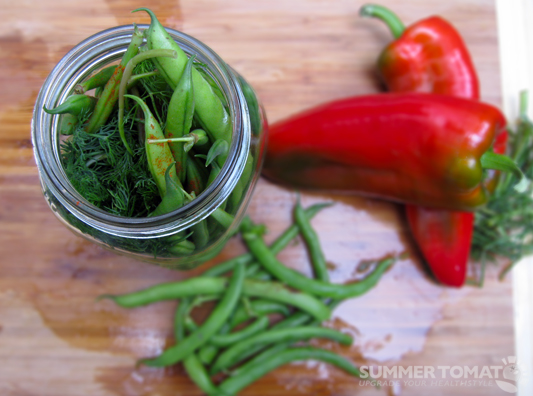
Pickling Green Beans

Pickling Green Beans

The first time I really appreciated the art of pickling was at Slow Food Nation here in SF back in 2008. I thought a pickle was a pickle, but when I tasted the variety, complexity and depth of pickled vegetables at the SFN Taste Pavilion, I realized how naive I had been.

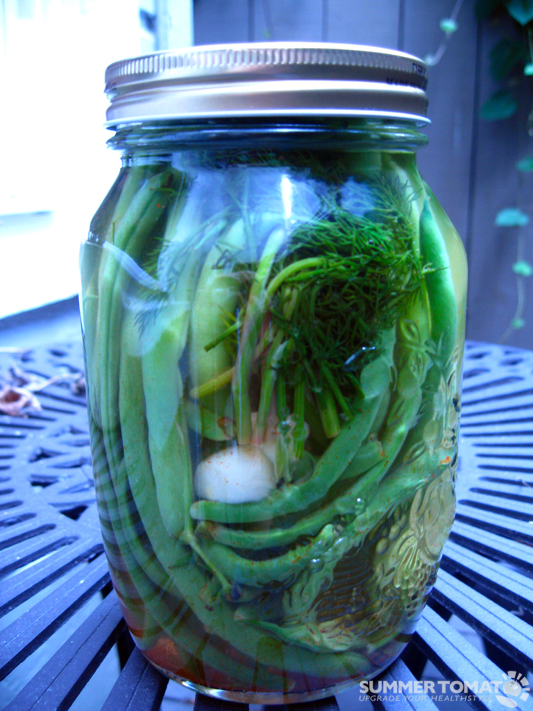
This weekend I tweeted out that we were pickling some green beans and several people asked for the recipe. Though this is my first pickling experiment we are using a well-tested family recipe, so it should be good. It sure looks good!

The pickling process takes 45 days, but green bean season will be over by then so I figured it would be best to post the recipe now for whomever wants to try it.

A few notes on successful pickling:

  • Though pickles have rather high acid levels, botulism is still a risk. Be careful to use sterile materials, and be sure to follow the protocol exactly.
  • You can get mason jars for canning at any cookware store or order them online.
  • The Exploratorium Science of Cooking page has more awesome pickling tips.

Klamath River Spicy Pickled Green Beans

Makes 4 pints

Pickled Beans

Pickled Beans

Ingredients:

  • 2 lbs green beans (blue lake is best)
  • 1 tsp cayenne pepper
  • 4 garlic cloves
  • 4 heads fresh dill (approx. 4 heads per tied bundle)
  • 1/4 c. salt
  • 2-1/2 c. white vinegar
  • 2-1/2 c. water

In each pint jar, put in the following:

  • 1 garlic clove
  • 1 head fresh dill
  • 1/4 tsp cayenne pepper

Vertically pack each pint jar with green beans until fairly packed (1/2 inch from the top).

In a pot bring to a boil the brine (salt, white vinegar, and water). Pour over the beans (1/4 inch from the top). Seal jars with lids and rings.

Place jars in a boiling bath of hot water for at least 10 minutes. Carefully remove jars and let sit until cool.

Store 45 days before eating.

Thanks to Kevin Rose for sharing his dad’s recipe. Originally published August 16, 2010.

Tags: , , ,

Perfect Summer Tomato Bruschetta Recipe

by | Aug 15, 2011
Bruschetta

Bruschetta

Bruschetta was the first sophisticated dish I could really make. That’s probably because it doesn’t require any cooking and is entirely dependent on the quality of your ingredients. Find some good ripe tomatoes, a decent baguette and you’re in business.

For this recipe I used the abundance of spectacular tomatoes I found this weekend at the San Francisco Ferry Plaza Farmers Market. I chose one big striped heirloom tomato, several dry-farmed early girls and half a basket of mixed cherry (red) and sungold (orange) baby tomatoes. It doesn’t matter much what varieties you choose, just make sure they are ripe and have good flavor.

Bruschetta Ingredients

Bruschetta Ingredients

The next essential ingredient is a good baguette. I bought sour and Italian baguettes from Acme Bread Co. To turn your bruschetta from good to amazing, be sure to brush your bread slices with olive oil and lightly toast them in the oven.

For this recipe I added a diced roasted pepper, but feel free to get creative with your ingredients. Chunks of fresh mozzarella are a great addition, especially if you are having a hard time choosing between bruschetta and caprese salad.

This recipe is the perfect summer snack and can be served as a starter, side dish or brought to a potluck (keep bread and topping separate until you arrive).

Summer Tomato Bruschetta

Ingredients:

  • 2 c. diced summer tomatoes
  • 1 clove garlic, worked through garlic press
  • 1/4 c. good quality extra-virgin olive oil

    Roasting Pepper

    Roasting Pepper

  • juice of half lemon
  • 8-10 basil leaves, sliced into ribbons
  • paprika, to taste (optional)
  • good sea salt, to taste
  • red bell pepper, fire roasted (optional)
  • splash of balsamic vinegar (optional)
  • sour baguette, sliced into 1/2 in. discs at an angle

If you are roasting a pepper, start by turning on a burner and placing the pepper on top. Blacken the skin evenly by using tongs to turn periodically. When the pepper is completely blackened, remove from flame and allow to cool. Scrape off blackened skin with a dull knife or fork, remove seeds, dice and set aside.

Bruschetta Mix

Bruschetta Mix

In the meantime preheat oven to 325 F and slice bread.

Combine first 9 ingredients in a mixing bowl. Some people add sugar, but I prefer to add a splash of balsamic vinegar if I want a little more sweetness. Paprika is also optional, but I find it adds a nice, subtle complexity. Don’t be shy with your sea salt in this recipe. Allow mixture to marinate briefly, stirring occasionally.

Olive Oil on Baguette

Olive Oil on Baguette

Next brush your baguette slices on one side with olive oil and place in warm oven. Toast for 6-10 minutes. Monitor carefully and do not allow to burn.

Place baguette slices on your serving plate and heap marinated tomatoes on top. Add extra small spoonfuls of juice on top of the mixture to add flavor and soften bread.

Serve immediately and crack the champagne.

What do you add to your bruschetta?

Tags: , , , , , , , ,

8 Reason Breakfast Makes Your Life Better

by | Jul 20, 2011

Yogurt, muesli and blueberries

I should admit right now that I’m a born again breakfast eater. In the past I always told myself that skipping breakfast meant one less meal adding calories to my day, and I was proud to have eliminated this annoyance from my life.

For the last several years, however, I have grown to love breakfast and am something of an evangelist. Breakfast may seem like an odd thing to try to covert people to, but once you see my reasons you may become a believer yourself.

8 Reasons Breakfast Makes Your Life Better

  • It’s easy. Breakfast doesn’t take much time or energy to prepare; I’m half asleep when I pour my cereal, rinse my fruit and boil my coffee every day. It also requires minimal planning. Just buy everything you need every week or two and you are good to go. What’s your excuse?
  • Health wins. We all must deal with the internal struggle between eating healthy and eating not-so-healthy. Throughout the day breakfast is by far the easiest battle in which health can triumph, since there is no outside social pressure and unhealthy options are harder to attain. I recommend taking winning odds whenever they are presented.
  • Hunger check. If you eat a satisfying breakfast before heading into work you are less likely to be tempted by the junk food that haunts most office environments. Likewise, you will have better self-control when it comes time to decide what to eat for lunch.
  • Whole grains. For my own healthstyle, intact whole grains are the most difficult to get in my diet. Unsweetened oats, plain brown rice and quinoa aren’t exactly staples on American restaurant menus. But without grains I feel constantly hungry and my workouts suffer. If I eat them at breakfast I am guaranteed at least that one serving during the day. (For tips to get more whole grains at dinner, check out my easy frozen brown rice balls).
  • Higher metabolism. Eating healthy food has a positive effect on your metabolism. Not only does what you eat for breakfast affect how your body reacts to different foods for the rest of the day, it also influences your metabolic rate in the long term. Be careful though, highly processed and easily digested foods have a negative effect.
  • Healthy habits. Healthy behavior begets more healthy behavior. According to some studies, this is especially true of breakfast eaters. Waking up and eating a healthy breakfast encourages you to pack a healthy lunch and plan your day around wholesome food. It feels really good to do healthy things, but we easily forget this when presented with free donuts on an empty stomach during a mid-morning meeting. Build your healthy habits when it is easy and help them stick around for the long haul.
  • Self-esteem. I think it is important to reiterate how good it feels to do healthy things for your body, and as a bonus it extends to how we feel about ourselves. Most of us feel proud and confident when we know we are doing the right thing. Why not start out each morning on the right foot?
  • Deliciousness. Of all the reasons I just listed, this one probably has the biggest sway with me personally. My breakfasts are absolutely delicious and I adore waking up and eating such yummy food. It is worth going out of your way to find healthy foods you enjoy eating, that way good food has as much pull on you as the less healthy junk. This will make your food decision making a whole lot easier.

Once you have convinced yourself that eating breakfast is important and worthwhile, it helps to know what constitutes a healthy one. I have written about breakfast before, focusing on the difference between fake “whole grains” as sold to us by processed food manufacturers and real intact whole grains.

Recently I have switched to a new favorite breakfast: plain yogurt, muesli and fruit.

I love this new combo for a few reasons

  1. I tried yogurt because I was having digestive issues for a few weeks and was hoping the probiotics in the yogurt (I eat even more probiotic foods now) might help. It totally did, and I’m sold on this method for improved digestion (despite my mild lactose intolerance).
  2. Coarse and chewy muesli is perfect on yogurt and I was able to completely cut out the fake whole grain flakes that bothered me about my old breakfast. Woohoo!
  3. The added protein and fat from the lowfat plain yogurt helps me feel satisfied longer in the day and adds a creamy luxury to my morning.

Be sure that when you are choosing your healthy breakfast you find foods with no added sugar. For example, fruit and vanilla yogurts are notorious for having obscene amounts of sugar (especially vanilla) putting it more on par with ice cream than health food. Likewise, most store bought granolas are loaded with sugar, molasses, honey, agave, concentrated fruit juice and other sweeteners. This is why I prefer muesli–completely unsweetened grains with bits of dried fruits, nuts and seeds.

When choosing plain yogurt I recommend lowfat instead of nonfat yogurt, because it is much more palatable and satisfying. Nonfat plain yogurt tends to be too tangy for me. Also, you need the fat to help with nutrient absorption and satiation.

My breakfast

  • 1 c. Plain lowfat yogurt
  • 1/4 c. Dorset muesli
  • 1/4 c. fresh fruit

What is your favorite healthy breakfast?

Originally published August 17, 2009

Tags: , , , , , , , , , , , , , , , ,

Red Lentil Soup With Indian Spices

by | May 18, 2011
Red Lentil Soup

Red Lentil Soup

Today’s guest recipe is by Boston Globe writer, Allison Boomer. A big lentil fan, she recommends using either Red Chief or Petite Crimson lentils from Zürun.

Her last recipe contribution to Summer Tomato was also a huge hit:

French Green Lentils Roasted With Carrots And Beets

Allison is an artisanal food expert, marketing professional, writer and nutritionist. She partners with people and businesses who share a passion for handcrafted food. She’d love to connect with you on Facebook.

Red Lentil Soup With Indian Spices

Serves 6-8

by Allison Boomer

Ingredients:

  • 6 tablespoons olive oil
  • 2 onions, finely chopped
  • 4 cloves garlic, finely chopped
  • 2 teaspoon ground cumin
  • 2 tablespoons tomato paste
  • Salt and pepper, to taste
  • 1/4 teaspoon chili powder, or more to taste
  • 2 quarts chicken stock
  • 3 cups water
  • 1 pound (2 cups) red lentils, rinsed with cool water and sorted to remove any small stones
  • 2 large carrots, cut into 1/4-inch dice
  • 1 can (about 14 ounces) diced tomatoes
  • Juice of 1 lemon

1. In soup pot over medium heat, heat the olive oil. When it is hot, add the onions and cook, stirring often, for 8 minutes. Add the garlic and cook for 1 minute more.

2. Stir in the cumin and cook, stirring, for 1 minute. Add the tomato paste, salt, pepper, and chili powder. Cook, stirring, for 1 minute more.

3. Add the stock, water, lentils, carrots, and tomatoes. Bring to a boil, partially cover the pan, and turn the heat to medium-low. Simmer the soup for 30 to 40 minutes or until the lentils are soft.

4. Add the lemon juice. Taste for seasoning and add more salt and chili powder, if you like.

Tags: , , ,

Dosa’s Rasam “Fire Broth” Recipe

by | Feb 21, 2011
Dosa's Rasam

Dosa's Rasam

I’m absolutely delighted to be sharing this top secret recipe from the kitchen of one of my favorite restaurants, Dosa. I recently highlighted this recipe in an article I wrote about lentils and their health benefits for Edible SF, where you can read more about the soup.

Dosa owner Anjan Mitra is very protective of his recipes and I am eternally grateful to him for sharing this one for rasam, a spicy lentil soup. If you have a minute please stop by and thank him on Twitter (@dosasf) and Facebook.

If you’ve never explored Indian cooking, it’s a fantastic way to familiarize yourself with new spices and feel like a culinary badass. These recipes never cease to impress, and as much as I adore (and rely on) simple recipes, it’s fun to try something a little more challenging every now and then.

The hardest part of this recipe will be tracking down some of the more elusive ingredients. While the majority of the spices can be found at a regular grocery store, a few ingredients may require a trip to an Indian grocery or specialty store. For more info on the ingredients, check out my last article on rasam ingredients.

A few notes before you begin:

  1. You’ll need a spice grinder. A coffee grinder will work, but you’ll need to clean it well before using it again for coffee.
  2. Curry leaves are not necessary if you can’t locate them, but do not attempt to substitute curry powder.
  3. The better quality tomatoes you use, the better the recipe will turn out.
  4. This is meant to be spicy, but you can adjust the spice level depending on your tolerance by switching up the type and number of chilies you use.
  5. The lentils and the tamarind each require a 1 hr soak before cooking, so plan accordingly.
  6. Since some of the ingredients are difficult to find, once you have them you can make a large batch and freeze the rest in quart-sized containers.

Dosa’s Rasam “Fire Broth” Recipe

© DOSA May not be copied or distributed without prior written permission

Approximately 8 portions.  Naturally vegan & gluten-free.

Ingredients:

  • 1/2 c. Toor dal (lentils) aka Pigeon Peas, available at most Indian grocery stores
  • 4 Organic red tomatoes cut and blended
  • 1 1/2 sq. inch Tamarind pulp (usually sold in blocks)
  • 1/2 Organic lemon
  • 1/4 c. Chopped cilantro
  • 6 Cloves of garlic
  • 5 Dried red chilies
  • 6-8 Fresh curry leaves (leave out if you can’t find them, do not use “curry powder”)
  • 4 tsp Cumin seeds
  • 3 tsp Whole black peppercorns
  • 4 tsp Coriander seeds
  • 1 tsp Mustard seeds
  • 1/4 tsp Turmeric
  • 1/8 tsp Asafetida (This stuff is very potent so don’t overdo it. Gluten-free versions with rice-flour are available.)
  • 10-11 c. Water
  • 1-2 tbsp Oil
  • 1 1/2 tsp Salt

Preparation:

Tamarind

  1. Soak the tamarind in 1/2 cup of water for 1 hour.

Toor dal

  1. Soak to the Toor Dal in 1 cup of water for 1 hour.
  2. Add 5 additional cups to the Toor dal and cook for about 15 to 20 minutes on a medium flame or until grains are very soft and blending with the water. (Note from Darya: this took closer to 30 minutes for me)
  3. Let it cool for 5 mins, then blend the Toor dal with the water. (Note from Darya: a hand blender works well)

Garlic

  1. Crush whole garlic and grind into a paste (Note from Darya: use mortar and pestle or back of wooden spoon)

Powdered Spice Mixture

  1. Grind cumin, peppercorn and coriander seeds. It can stay relatively coarse, but should be fine enough to drink in the soup.
  2. You can use a coffee grinder, however, be sure to clean it thoroughly after use.

Tomatoes

  1. Cut and blend the tomatoes into a pulp. (Note from Darya: use a food processor or blender)

Cooking:

**Have all your ingredients ready since some of these steps are relatively quick

  1. Add a minimal amount of oil to coat the bottom of a soup pot.  Turn to medium-high heat.
  2. When the oil is hot, add mustard seeds, dried red chiles and curry leaves.
  3. Keep stirring for about 2 minutes. You’ll get the aromatic flavors of these ingredients.
  4. Add asafetida and keep stirring for another 30 seconds.  This has a very strong aroma of onion and garlic so make sure you don’t add too much.
  5. Add turmeric and crushed garlic paste. Lower the flame slightly and keep stirring to ensure the garlic doesn’t burn. Stir for another 2 to 3 minutes or until the raw garlic flavor has dissipated.
  6. Add the fresh tomato pulp.
  7. Add tamarind pulp with the water in which it’s been soaking.
  8. Stir and cook for about 2 to 3 minutes on a medium flame.
  9. Add the powdered spice mixture.
  10. Cook for about 5 to 6 minutes on a medium flame.
  11. Stir intermittently. You’ll notice the aromatic flavors of the spices.
  12. Add the blended Toor dal (lentil) and stir.
  13. Add remaining water about 2 to 3 cups. You can add more or less water depending on how thin or thick you would like the soup. It’s flavorful enough to be served relatively thin.
  14. Add cilantro.
  15. Add salt.
  16. Squeeze 1/2 an organic lemon.
  17. Simmer for 10 minutes and stir intermittently. Do NOT boil or cook. When it starts to froth you’re done.
  18. Check salt and add to taste if needed. (Note from Darya: I added an extra 1/4 tsp to get the same taste as at the restaurant)

Serving:

  • This nutritious and flavorful soup has a grainy and coarse texture as a result of the coarsely blended spices.
  • Stir the pot before ladling the soup into a cup as the spices will settle to the bottom.
  • Serve hot and garnish with cilantro.
  • It can be drunk straight from a cup or even eaten with rice.
  • You won’t even notice it’s vegan and gluten-free!

HUGE thanks to Anjan and Dosa for sharing this amazing recipe.

Tags: , , , , , ,

French Green Lentils Roasted With Carrots And Beets

by | Oct 4, 2010
Roasted French Lentils

Roasted French Lentils

I’m really excited about this recipe for a few reasons. First, it looks super easy, healthy and delicious. Anything that hits in those 3 departments is a winner in my book. Second, while beets and carrots are awesome this time of year, they are pretty easy to find year round, making this a recipe you can go to anytime you need something easy, healthy and delicious. Win – Win.

French green lentils aren’t always easy to find, but you can order them online at Zursun, a great source for getting heirloom beans and lentils.

Huge thanks to Allison Boomer for the recipe. Allison is an artisanal food expert, marketing professional, writer and nutritionist. She partners with people and businesses who share a passion for handcrafted food. She’d love to connect with you on Facebook.

French Green Lentils Roasted With Carrots And Beets

by Allison Boomer

Robust, earthy flavor and beautiful deep fall green color make French green lentils – also known as Lentilles du Puy – one of the world’s finest legumes.

In this recipe lentils are oven roasted with caramelized carrots, beets, shallots and savory thyme. Finished with a splash of red wine vinegar and fresh parsley, the easy-to-prepare dish (no pot watching on the stove) is satisfying on its own or as a side dish.

  • 1½ cup French green lentils
  • 3 small beets, peeled and diced
  • 2 carrots, peeled and diced
  • 4 shallots, peeled and halved
  • 6 tbsp. olive oil
  • 2 sprigs fresh thyme
  • salt and pepper to taste
  • 3 tbsp. red wine vinegar
  • ¼ cup chopped parsley

Sort and rinse lentils in cool water. Preheat oven to 400 degrees. Place beets, carrots, shallots and 3 tbsp. olive oil in a medium-size roasting pan. Coat vegetables evenly with oil. Add thyme, salt and pepper and cook in oven until vegetables begin to brown, about 20 minutes. Add lentils, 3 cups of water, stir, then cover pan with foil. Cook until lentils are tender and all water is absorbed, about one hour. Remove pan from oven, remove thyme spring and dress lentils with vinegar and remaining oil. Cool slightly and stir in chopped parsley. Adjust salt and pepper and serve.

Have you tried roasting lentils?

You may also enjoy How (And Why) To Cook And Freeze Large Batches Of Lentils

Tags: , , , ,

Healthy Pasta Substitute: Chickpeas (with recipe)

by | Sep 29, 2010
Chickpea Puttanesca

Chickpea Puttanesca

I’m generally not a big noodle fan. Homemade fresh pasta is great, but I rarely go through the trouble to make it myself. Also, pasta isn’t particularly healthy and I’m happy to keep it as a special occasion food.

But sauce is a different story. I love a chunky summer tomato puttanesca sauce. In the past I have made a big batch, put the first serving on rigatoni, then used the rest on whatever I happened to have in the fridge over the next few days. I’ve tried it on brown rice and quinoa (neither is particularly good), but one day all I had was some chickpeas I made in the pressure cooker.

This changed everything.

Chickpeas, also known as garbanzo beans, are a perfect match to a thick Italian red sauce. At this point I actually prefer my puttanesca on chickpeas rather than pasta. And I feel way better after eating it. This is also a wonderful substitution if you are sensitive to gluten.

I doubt chickpeas would hold up as well with all sauces, but I think red sauces are safe. My guess is lighter sauces that rely more on the distinct flavor of pasta would prove disappointing. Pesto might be nice, but probably as more of a side dish than a main course.

This is a new version of my puttanesca recipe. In a pinch you can substitute a 28oz can of diced tomatoes for fresh ones.

Chickpea Puttanesca

(serves 4)

Ingredients

  • 1 lb fresh tomatoes (Early Girl or San Marzano are best), diced
  • 8 anchovy fillets, minced
  • 1/2 cup pitted kalamata olives, coarsely chopped
  • 3 tbsp capers, rinsed
  • 1/4 cup parsley, finely chopped
  • 3-4 cloves garlic, minced or pressed
  • 2-3 tbsp good olive oil
  • 1 tsp red chili flakes
  • 2 cups cooked chickpeas

If you’re starting with dry chickpeas, soak 1 cup (or more) dry beans overnight. Cook in pressure cooker until tender ~20 min, or boil covered in a pot (~1 hr). The rest of the cooking takes about 20 minutes, so adjust accordingly. You can make these a day or two ahead as well.

Press or finely mince garlic and soak it in 1 tbsp of water in a small cup or bowl. Let sit 5-10 minutes.

Heat a large pan on medium and add 2 tbsp olive oil. When the olive oil swirls easily in the pan add anchovies, garlic mixture and chili flakes. Stir continuously until garlic just begins to brown, about 2 minutes, then add tomatoes and simmer.

Allow tomatoes to cook, stirring occasionally. If the tomatoes begin sticking to the bottom of the pan, add 1/4 cup water to thin the sauce. You may need to do this several times, depending on your tomatoes. When the tomatoes begin to soften, use a wooden spoon to crush them a bit in the pan to create smaller chunks.

After sauce has simmered about 12-15 minutes toss in capers, olives, and parsley. Mix to combine. I tossed in some excellent olive oil at this point to brighten it up. (Don’t bother with this if you only have cheap olive oil.)

Pepper is a nice addition, but salt is probably not necessary because of the anchovies.

Drain chickpeas and scoop about 1/2 cup into a bowl. Remember that chickpeas are much more filling than pasta, so you will likely need less than you think. Spoon over sauce generously. Serve immediately.

You may also enjoy Better Than Pasta Subtitutes: Summer Squash Noodle Recipe and Video

Have you tried beans as a pasta substitute?

Tags: , , , , , , ,

Spicy Carrot Ginger Soup With Lemon

by | Sep 15, 2010
Spicy Carrot Ginger Soup With Lemon

Spicy Carrot Ginger Soup With Lemon

Last weekend I bought some amazing, gnarly looking chantenay carrots from the San Francisco Ferry Plaza farmers market. When I found them at Tierra Vegetables they were just begging me to turn them into soup. I rose to the challenge, but first I had a few problems to solve.

Usually when I eat or make carrot soup it is in one of two styles. It can come either curried, warm and spicy, or gingered with hints of cloves, cinnamon and nutmeg. While I love these soups, they feel a little too much like fall and winter for me to get excited about them when summer in SF is just starting.

I didn’t want a soup that is warm and wintery, I wanted a carrot soup that is bright and summery.

To achieve this I started with carrot and ginger, but add a twist. Rather than spicing the soup with cinnamon and other fall flavors I added tumeric and a few Thai chili peppers to give it color, flavor and some heat. Then I brightened it up with lemon juice and preserved lemons. The soup is finished with crème fraîche, scallions, ginger flowers and lemon-scented olive oil.

To my delight this soup turned out amazing and unlike anything I had ever tasted. And it was exactly what I wanted. If you don’t have preserved lemons, I’m sure zest would produce a similar effect. Likewise, you can swap a serrano pepper for the Thai peppers and sour cream for crème fraîche. Ginger flowers and lemon oil are just bonus.

To blend the soup I used my new Cuisinart immersion blender (aka hand or stick blender), and I was very pleased with the result. I’m really happy about this because the Cuisinart is half the price of the Braun blender I used to use.

You can make the soup in a regular blender if you do not have an immersion blender.

Spicy Carrot Ginger Soup With Lemon

Ingredients:

  • 3 chantenay carrots or 5-6 regular carrots, peeled and cut into half inch slices
  • 1 medium onion chopped
  • 1 inch fresh ginger root, grated
  • 2-3 Thai chilies or 1 serrano chili, chopped and seeded (optional)
  • 1 tsp tumeric
  • 1 qt vegetable or chicken broth
  • 2 cups water
  • 1/2 lemon juiced (and zest if desired)
  • 1/2 tbsp preserved lemon strips
  • Crème fraîche
  • Scallions
  • 1 tbsp butter or olive oil
  • salt to taste

Heat butter or oil in a heavy bottomed soup pot and add onions. Saute until they become translucent then add the carrots, half the ginger, peppers and tumeric and cook until carrots are tender, stirring frequently, about 10 minutes. If the vegetables start to brown, lower the heat.

When the carrots are soft add broth and bring to a boil. Simmer until the carrots are very tender and can easily be cut with a fork, about 10 minutes. Remove soup from heat, add the rest of the ginger and preserved lemons and blend until smooth, about 5 minutes. Add water as needed to thin the soup. I ended up adding 2 full cups.

If you are using a regular blender, be very very careful when blending hot liquids. Only fill the blender half full and blend in batches, holding the lid down with a kitchen towel. I’ve had many steaming soups explode and burn me, and it is not fun. That’s why I love my hand blender.

At this point you can filter the soup through a fine mesh strainer if you like, but I prefer to keep all the fiber in the soup and simply blend it very well. The texture is rich and silky this way, but will be thinner if you filter it.

Whisk in lemon juice and adjust salt to taste. Ladle hot soup into a bowl and garnish with crème fraîche, scallions and lemon oil.

This makes a fairly large batch of soup. However, carrot soup freezes extraordinarily well so feel free to freeze a couple pints for later. The soup will keep 3-4 days in the refrigerator.

What is your favorite way to make carrot soup?

Originally published Sept 7, 2009.

Tags: , , , , , , , , , ,

Healthy Vegetable Sources of Protein and Iron

by | Aug 9, 2010
Collards, Carrots and Lentils

Collards, Carrots and Lentils

Today’s post is written by a long-time Summer Tomato reader, Matthew Shook. Matt refers to himself as an herbivore, rather than a vegetarian, which I love. To me the term herbivore implies an intent to live from vegetables instead of simply consuming them in an exclusive way.

Although the term omnivore better describes my own eating habits, I do think plants are the cornerstone of a healthy diet. Moreover, although I eat animals I prefer to rely on plants as my primary sources of protein and iron. My reasons include health, ecology and economy.

Those of you who knew me back in the day know how very weird this is. I always considered myself a carnivore through and through, and the thought of a meal based entirely on plants seemed borderline insane. Now for me it is more normal than abnormal.

For one thing, relying on plants makes cooking and shopping a lot easier. It’s also cheaper and, as I’ve come to learn, just as tasty.

Since I have learned more about food and health I have come to appreciate that vegetarian sources of protein are not simply a substitute for meat (how could beans replace steak?), but are an essential part of a healthy diet in their own right.

Whether vegetarian or not, I encourage you to incorporate healthy plant sources of protein and iron into your healthstyle.

For this I turn you over to Matt, our resident expert on herbivory. For more wonderful vegetarian recipes visit his blog Recipes for Disaster.

Healthy Sources of Protein and Iron From Vegetables

by Matthew Shook

When I became an herbivore six years ago I had a very elementary understanding of proper nutrition. Becoming an herbivore was very simple for me–I just stopped eating animals. I soon discovered that becoming a healthy and well-nourished herbivore was a far more complex endeavor.

New herbivores often face three obstacles at the beginning of their diet transition. One is a self-perceived lack of acceptable food options and diversity. The cereal, rice, beans and pasta get old real quick. This is why herbivores often expand their interests to ethnic and unfamiliar foods.

The second obstacle, unbeknownst to many herbivores, is a lack of high-quality protein and highly-absorbable iron.

A third obstacle during my transition was trying to convince my friends, family and loved ones that becoming vegetarian can be a healthy decision. My parents swore that if I didn’t eat meat I would wither away and die within one year’s time. In their eyes, it’s a miracle I’m still alive.

The following is a review of some of the best options for maintaining a healthy vegetarian or vegan diet, but is also useful for health-conscious omnivores.

Protein

Most North Americans get more than enough protein in their diet (some even argue they consume too much protein). The problem, especially for herbivores, is that not all protein-rich foods are created equal.

Enter the “complete” protein.

A complete protein contains all of the nine essential amino acids (the building blocks of protein), those that our bodies cannot produce themselves. So really, this should be a discussion of our need for amino acids, not necessarily protein.

Meat, fish, and dairy products are sources of high-quality protein, but herbivores need to look elsewhere for their fill of essential amino acids. (Sidenote: Some vegetarians consume dairy products, but relying on dairy as the foundation of your diet is, in my opinion, a very unhealthy way to go.)

This first vegetarian protein source is what I call “an herbivore’s best friend.”

Quinoa, while technically a seed, is often referred to as a “supergrain” from South America. It contains complete protein and is one of only two sources (the other is soybean) that are not animal-based. I have tried white, red, and black quinoa and find them all to be delicious when properly prepared. The red and black varieties tend to be a little “crunchier” than the white. 

Unlike many foods, quinoa is just as nutritious cooked as it is when sprouted and consumed.

(Here is the Summer Tomato recipe for Mexican-style quinoa salad.)

Amaranth, while not a complete protein, contains a large percentage of essential amino acids and is an outstanding source of plant-based protein. It is a “pseudograin” like quinoa, and can be used in dishes such as stir-fries, soups or just as a side dish to compliment seasoned vegetables. It can also be made into a pudding or be ground up into flour.

There are a wide variety of legumes (aka beans) capable of fulfilling an herbivore’s protein and palate requirements. Legumes are generally very low in the essential amino acid methionine, and therefore pair well with grains/pseudograins which fulfill this gap. Black beans, lentils, and chickpeas are three of the most nutritious and flavorful legumes.

This discussion would be incomplete without mentioning the most popular and highly debated legume: soybean. Soybeans have the highest amount of plant-based protein, by weight, of any other food. (Hemp seed and lentils are second and third respectively.) 

Soy can be a bit of a touchy subject as many health-minded individuals disagree about the long-term benefits of introducing the many forms of soy into your diet. Soy can be consumed as whole soybeans, edamame, tofu, tempeh, soy milk, textured soy protein, etc.  Also controversial is the genetic modification of the typical American soybean (thank you, Monsanto).

Tofu and tempeh are concentrated forms of soybean, and thus have high levels of protein. Typically unprocessed foods hold more nutritional value than their processed counterparts, but one can argue that tempeh (a fermented form of soybean) is the healthiest form of soy. The argument is that unfermented soy products like tofu contain “anti-nutrients” (phytates, enzyme inhibitors and goitrogens), which can cause digestive problems and nutrient deficiencies.

I limit my soy intake to very moderate amounts of tempeh and utilize it as a complement to well-balanced meals.

This last one should come as no surprise to Summer Tomato readers. While not an option for vegans, eggs can provide a great deal of nutrition to a vegetarian diet. Eggs contain all of the essential amino acids and are particularly beneficial to herbivores as a source of active (highly-absorbable) vitamin B-12, which is only found in significant portions in animal-based food.

What are your favorite vegetarian sources of protein?

Iron

Iron is essential to any healthy diet, herbivore or otherwise. Iron is a vital part of hemoglobin in blood, and a failure to absorb an adequate amount can lead to iron deficiency anemia. 

There is a big difference between consuming and absorbing an adequate amount of iron.

Two types of iron exist in the human body: heme iron and non-heme iron.  Heme iron can only be obtained from animal sources such as cow, chicken and fish. These animal sources contain about 40% heme iron.  The remaining 60% of animal-based sources, and 100% of plant-base sources, are comprised of non-heme iron. 

The semi-bad news for herbivores is that heme iron is well-absorbed and non-heme iron is less well-absorbed. The good news is there are other foods you can eat with your meal that enhance the absorption of non-heme iron sources. Non-heme iron enhancers include fruits high in vitamin C, peppers, broccoli, tomatoes, potatoes, Brussels sprouts and white wine.

Spinach is one of best sources of iron available for herbivores, especially when cooked. I consume spinach regularly both raw and cooked, and find it is an excellent addition to numerous recipes including soups, salads, stir-fries and smoothies. 

I have read that spinach is an iron inhibitor (reduces the absorption of iron), but when paired with iron enhancers the essential element is readily absorbable.

Swiss chard, turnip greens, and bok choy have decent but not spectacular amounts of iron.

There are a few legumes that are excellent sources of iron. Lentils, lima beans, kidney beans, black beans, chickpeas and soybeans are the best sources in the legume family.  The wide range of flavor from these legumes enables herbivores to get more than enough iron from a variety of cuisines.

(For more nutrition information on lentils and the recipe for the dish pictured above read the Summer Tomato recipe for collards, carrots and French green lentils.)

Chickpea hummus, black bean burritos, dahl (lentil) soup and lima or soybean stir-fry are fantastic recipe ideas using iron-rich legumes. If you choose soybeans, be sure to add some iron enhancers to the meal since they are considered iron inhibitors as well.

Quinoa and amaranth, the two psuedograins mentioned for their high protein content, are also good vegetarian sources of iron. I try to maintain a varied diet by frequently switching up the different greens, legumes and (pseudo)grains in my meals.  I’ve included one of my favorite recipes that features many of these protein and iron-rich ingredients.

Black Bean and Quinoa Burrito

What are your favorite vegetarian sources of iron?  Are you concerned about iron inhibitors in your diet? Are you or someone you know ever been chronically anemic?

Originally published August 19, 2009

Tags: , , , , , , , , , , , , , , , , ,