You deserve to feel great, look great & LOVE your body
Enter your email for your FREE starter kit to get healthy & lose weight without dieting:
My name is Darya Rose and I’m the creator of Summer Tomato.
I’m also a neuroscience Ph.D, author, former dieter and proud foodist. Summer Tomato teaches you how to get healthy and lose weight without dieting. Because life should be awesome.
Good stuff this week, particularly the new data about why diets don’t work, why probiotics do work and some interesting examples of how the food industry is responding to the food movement. Oh yes, and the invention of super broccoli.
Want to see all my favorite links? Be sure to follow me on on Digg. I also share links on Twitter (@summertomato), Google+ and the Summer Tomato Facebook page. I’m very active on all these sites and would love to connect with you.
UK scientists grow super broccoli <<BS of the week. Hate to break it to these guys, but broccoli was already perfect. Seriously, aren’t there bigger fish to fry? (SF Gate)
In Defense of Industrial Food <<I disagree with this, but I’m not calling BS because he brings up some important points that should be answered by the real food community. (TIME)
Lunch with Michael Pollan: Two Words of Warning <<Pollan is right about what the food industry is doing in response to the food movement (spin!), and the next few articles illustrate exactly what he means. (Michael Ruhlman)
Or to put it another way, do you know the difference between real food and food that was designed to fool you into believing it is real?
It might not be as easy as you think.
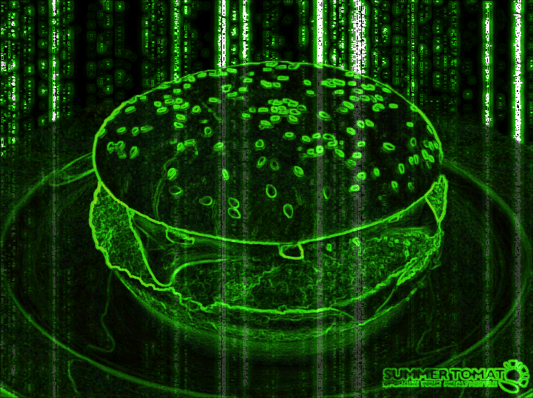
(Spoiler Alert! If you haven’t seen the original Matrix film yet, crawl out of your cave and go watch it real quick before reading. We’ll wait.)
In the classic film The Matrix, machines of the future create a sophisticated computer program that produces an alternate reality for their human slaves. The program, the Matrix, placates humans into believing they are living normal lives while their bodies are imprisoned in suspended animation.
The Matrix is plugged directly into the brains of humans. They live the Matrix, breathe the Matrix, eat the Matrix. They’ve grown up with it, and have never known any other world.
Now think about a Twinkie or a McNugget. Can you remember life without them? I can’t. These products have always been a part of my world, even though it has been a long time since I’ve eaten them. I have vivid childhood memories of both products–after school snacks with friends, my 10th birthday party–and my memories are happy.
But I’ve learned to refer to Twinkies and food from McDonald’s as products and not foods because, when you think about it, they really aren’t foods. Sure you can eat them, but that just makes them a novelty–something akin to beating up your friends in Mortal Kombat.
“Do you believe that me being stronger or faster has anything to do with my muscles in this place?” -Morpheus
Real food nourishes your body by providing essential building blocks for your cells and organs. The human body evolved alongside real food and is adapted to digest it.
Edible products on the other hand were specifically designed to fool your brain and sensory perception, but your body, cells and organs have no idea what to do with them.
Twinkies and McNuggets are engineered. They do not come from the earth and are not food. Twinkies were created in the Matrix.
Do you think that’s food you’re eating now?
This may sound like rhetorical foodie fluff, but please humor me and entertain the metaphor for a little while longer.
Food should nourish your body and contribute to your overall health. Even foods that are considered fattening–bacon comes to mind–provide nourishment so long as they are based in reality.
But what is a Twinkie? What is a Pringle? What is a McNugget?
BigMacs may look, smell and vaguely taste like food, but if what you are eating is not sustaining your health and is possibly making you sick, isn’t it time to question whether it is food at all?
These are products that were created in a laboratory. They may have started as raw materials from plants, but the plants were never grown to be eaten. Industrial corn, soybeans and the cattle raised on them have been processed and redesigned to the point where they’ve been stripped of anything that allows for them to be reasonably classified as food.
Shouldn’t we then stop calling this stuff food?
Most people will initially reject this idea. Of course food is food. But I’d argue that this opinion is just another product of our environment. Haven’t we always lived in the Matrix of industrial agriculture?
We have coexisted with McDonald’s for so long it seem preposterous to speculate it doesn’t meet the definition of food.
But let’s take a closer look:
Food –noun:
1.
Any nourishing substance that is eaten, drunk, or otherwise taken into the body to sustain life, provide energy, promote growth, etc.
2.
More or less solid nourishment, as distinguished from liquids.
3.
A particular kind of solid nourishment: a breakfast food; dog food.
4.
Whatever supplies nourishment to organisms: plant food.
5.
Anything serving for consumption or use: food for thought.
(emphasis mine)
With the exception of the last point, which is clearly philosophical, all these definitions include the word nourishment.
Nourish –verb (used with object)
1.
To sustain with food or nutriment; supply with what is necessary for life, health, and growth.
2.
To cherish, foster, keep alive, etc.: He had long nourished the dream of living abroad.
3.
To strengthen, build up, or promote: to nourish discontent among the workers; to nourish the arts in one’s community.
(emphasis mine)
If it doesn’t provide nourishment, it is not food.
But relying on dictionary definitions is both semantic and impractical. It also becomes confusing when companies market products that are not real food but have added back nutrients to give the appearance of nourishment.
The important question is how do we break free?
Being convinced that these products are not food is not enough. Like the Matrix, McDonald’s is so closely tied to your perception of reality that it can fool you even when you know it isn’t real.
Remember, when Neo makes his first attempt to jump across the building roofs. He doesn’t make it.
“Everybody falls the first time.”
That’s because the Matrix feels so real that not believing it is almost impossible. Likewise, knowing that edible products are not food and that they will in fact make you less healthy is often not enough to prevent you from eating them. Your senses are easily fooled.
But better decisions are not impossible and your food world doesn’t need to be 100% black and green. Even small steps in the right direction, back into reality, can improve your health.
The first small changes you try also make subsequent steps easier.
Unplugging from the industrial food Matrix does not need to happen all at once, but you can extract yourself from it eventually. The first step is starting to see it clearly.
“I’m trying to free your mind, Neo, but I can only show you the door. You’re the one that has to walk through it.”
Are you eating in the Matrix?
For your viewing pleasure: Morpheus is fighting Neo!
This post was inspired by commenter Martin Levac who gave me permission to roll with his awesome idea.
Many must-read articles this week, including the juice on processed OJ, the truth about factory farming and antibiotic resistance and the latest demolition of our favorite vegan propaganda book, The China Study.
Want to see all my favorite links? Be sure to follow me on on Digg. I also share links on Twitter (@summertomato) and the Summer Tomato Facebook fan page. I’m very active on all these sites and would love to connect with you.
One Year Later: The China Study, Revisited and Re-Bashed <<I’m not a fan of The China Study, and what I like about this critique is that it points out dozens of peer-reviewed papers that show the exact opposite of the claims made in the book—most co-authored by Dr. Campbell himself. Makes me wonder how he justifies these contradictions to himself. (Raw Food SOS).
Wow, please don’t skip your reading this week. There are two excellent stories about the dangers of food imports, an exposé on the bogus “nitrate free” food labels and a fascinating tale of finding zen in the kitchen. All that and more on my top 10 food and health links this week.
Want to see all my favorite links? Be sure to follow me on on Digg. I also share links on Twitter (@summertomato) and the Summer Tomato Facebook fan page. I’m very active on all these sites and would love to connect with you.
Links of the week
What’s Inside the Bun? <<Awesome piece about the bogus “nitrate free” claims on some processed meat products. (New York Times)
China’s Bizarre Food ‘Safety’ Scene, and Our Own <<Another must-read about the horrific crimes going on in the Chinese food supply, and why we aren’t exactly doing much better in the US. (New York Times)
Banned chemicals found in tons of imported fish <<BS of the week for the lack of adequate regulation, and proof that the above story was not scaremongering. Though I’m horrified by this, I’m not particularly surprised. The government is clearly not doing enough to protect you, so I’d recommend sticking to domestic wild seafood as best you can. (The Tennessean)
Is Your Meat Habit Giving You Diabetes? <<The title is misleading, but this is actually a fascinating article about the dangers of industrially farmed animals. (Mother Jones)
Sichuan Eggplant <<Eggplant season is starting and this looks delicious. I’d probably leave out the sugar (or at least half it), but that’s just me. (Simply Recipes)
This week I found a surprisingly in depth and thoughtful piece on genetically modified foods, an even more impressive food commitment by Facebook founder Mark Zuckerberg, and a few good signs that the politics of food labels are headed in the right direction—truth.
Also, for you geeks my thesis work is finally published. Here’s the deets.
Want to see all my favorite links? Be sure to follow me on on Digg. I also share links at Twitter (@summertomato) and the Summer Tomato Facebook fan page. I’m very active on all these sites and would love to connect with you.
Study Questions Treatment Used in Heart Disease <<Turns out drugs that raise HDL cholesterol aren’t as valuable as everyone hoped. But HDL is still an excellent predictor of heart disease. Seems like you’ll have to raise it the old fashioned way, with diet and exercise. (New York Times)
Groups Sue FDA Over Use of Certain Antibiotics in Animal Feed <<This is awesome, and I hope it forces some action from our government to fight the dangerous antibiotic resistant bacteria that are being bred in industrial farms. (Wall Street Journal)
Is That “Organic” Egg A Good Egg? <<I always struggle to convey the degrees of “healthy” in different eggs. Now there’s a handy scorecard to help out. (Consumerist)
Tough decisions were made this week to narrow it down to 10 stories. Love the calorie infographic, also the commentary by Dr. Ludwig on industrial food and the “small” 32 oz. soda at a SF movie theater.
Want to see all my favorite links? Be sure to follow me on on Digg, Twitter (@summertomato) or the Summer Tomato Facebook fan page. I’m very active on all these sites and would love to connect with you.
Links of the week
Where Do Americans Get Their Calories? (Infographic) <<This is REALLY cool. Notice grain consumption increased nearly 50% (just like the AHA recommends), same with added fat (aka processed vegetable oils) and sugars. Veggie intake hasn’t changed, nor has dairy, and barely “meat, egg and nuts”. Fruit has gone up. Sounds like we’re obeying the food pyramid, yet eating 25% more calories and gaining weight and disease faster than ever. Lovely. (CivilEats)
Sweet! Candy eaters surprisingly slimmer <<Interestingly, this study relied on a 24hr recall questionnaire, meaning that it didn’t actually test candy eating, but the awareness of candy eating. Mindful eating may be the key factor. (MSNBC)
Next week I’ll be celebrating my 31st birthday. If you appreciate the work I do for this site and would like to give back, I’m donating all cakes, presents and well wishes to Charity Water. Charity Water helps bring clean water to children and families in Africa who desperately need it. Follow the link to learn more.
How to make food taste better without cooking skills, the best geek food article of all time and why Twinkie’s won’t make your life better.
I read many more wonderful articles than I post here each week. If you’d like to see more or just don’t want to wait until Friday, be sure to follow me on Twitter (@summertomato) or the Summer Tomato Facebook fan page. For a complete reading list join me on Digg. I’m very active on all these sites and would love to connect with you.
Twinkie diet helps nutrition professor lose 27 pounds <<BS of the week. Is anyone here surprised that you can lose weight and improve cholesterol when you barely eat anything (even if that “thing” is complete junk food)? You shouldn’t be. And this is a great example of why we have bigger fish to fry than weight and cholesterol. (CNN)
Why I don’t cook at home <<This is cute and worth reading, but I hope Summer Tomato readers know better. (The Oatmeal)
While Warning About Fat, U.S. Pushes Cheese Sales <<Great example of how special interests can influence government policy. Personally I wouldn’t trust my health to recommendations by the US government. (New York Times)
Hard to avoid the topic of eggs and food safety these days, but the conversation is worth participating in. I also recommend Chef John’s recap of the IFBC conference (even if you don’t know what that is), and Foodiggity‘s Ketchup vs. Catsup post.
I read many more wonderful articles than I post here each week. If you’d like to see more or just don’t want to wait until Friday, be sure to follow me on Twitter (@summertomato) or the Summer Tomato Facebook fan page. For a complete reading list join me on the new Digg or StumbleUpon. I’m very active on all these sites and would love to connect with you.
Links of the week
The High Cost of Eggs <<Personally I am willing to pay many times what grocery store eggs cost for the better taste and safety, but apparently it only costs a penny per egg to bring industrial eggs up to a minimal safety standard. Is it worth it? (New York Times)
What if I had a food safety magic wand? <<If you care about the safety of your food, you should read this account of what someone who thinks about it day and night would do to fix it. (Marler Blog)
Omega-3 margarines fail to help in heart study <<For the zillionth time science show that a fake food loaded with a supposedly healthy nutrient does nothing to help in real life. Why not just eat the original healthy foods? (The Vancouver Sun)
Beer’s not to blame for weight gain <<Um, yes it is. BS of the week. Just because it doesn’t contain fat or cholesterol doesn’t mean it doesn’t have a ton of extra calories and maltose. It’s not as fattening as food, but it could easily be blamed for your weight gain. (Telegraph)
3 Reasons New Yorkers Live Longer <<I love this short post by Dr. Weil about how easy it is to extend your life by taking a few lessons from NYC. (Dr. Weil Blog)
Ketchup vs. Catsup <<It confused Springfield billionaire Mr. Burns, but Foodiggity has all the answers.
Farro Salad with Tomatoes, Mushrooms and Basil <<It’s hard to overstate how deeply I have fallen for farro this summer. Here’s a quintessential recipe I hope you try, I’m certain you’ll love it. (David Lebovitz)
I’m excited to announce this week the launch of my personal blog daryapino.com. It’s still very much a work in progress, and there’s a decent chance it may change a lot in the coming months. But since it is meant to be a more informal peek into my personal healthstyle (which I get asked about all the time (???)), I figure there’s no harm in announcing it at this point. There are a few posts up there now, including a review of Anthony Bourdain’s new book Medium Raw, to give you an idea of what to expect. Let me know what you think.
I found a ton of interesting links this week ranging from really cool scientific discoveries on the benefits of whole foods to frightening food safety issues and vegetable MRIs. I also found some proof that organic tomatoes are better for you than the tasteless kind.
I read many more wonderful articles than I post here each week. If you’d like to see more or just don’t want to wait until Friday, be sure to follow me on Twitter (@summertomato) or the Summer Tomato Facebook fan page. For a complete reading list join me on the new Digg or StumbleUpon. I’m very active on all these sites and would love to connect with you.
Links of the week
USDA Admits Link Between Antibiotic Use by Big Ag and Human Health <<The horrendous conditions that exist in industrial feedlots require the animals be given huge doses of antibiotics to stay alive long enough to be profitable survive. This overuse of medicine creates superbugs, antibiotic-resistant bacteria that are becoming a serious problem in our very own hospitals. Solution seems obvious to me. (Huffington Post)
Good cholesterol may mean little for statin users <<Interesting new data showing that statin users get no extra benefit from having high HDL “good” cholesterol. I’m a little surprised by this, and will be following this research closely. (Medline)
Ten-Year Comparison of the Influence of Organic and Conventional Crop Management Practices on the Content of Flavonoids in Tomatoes <<Translation: Organic tomatoes are more nutritious than conventional tomatoes in a well-designed 10-year study. Why this research didn’t make the news is beyond me. But of course if a poorly designed study shows no difference in the nutrition of organic foods then it’s front page material (in science we call this a negative finding and it should require EXTRA proof). So I’m calling BS of the week on the lack of press here. (Journal of Agriculture and Food Chemistry)
A rose may be a rose but perhaps a calorie’s not a calorie <<Cool study showing that whole foods use more calories during digestion than processed foods, even when the meals have the same number of total calories and are almost identical. (Weighty Matters)
The Claim: Artificial Sweeteners Can Raise Blood Sugar <<Yes, yes they can. Artificial sweeteners have never been shown to have any value, and they also taste pretty bad. I vote for natural sweeteners with real calories. Just use them sparingly. (New York Times)
Why Toasting Dried Chiles Matters <<Cool experiment on the flavor added by toasting dried chilies before using them. I’m totally trying this. (Serious Eats)
Your Salad – Is the convenience worth the risk? <<This is a subject that has been bothering me a lot lately. Industrial lettuces have been getting E.coli and salmonella like crazy this year, so even vegetarians and generally conscientious eaters are at risk unless they buy produce directly from farms (which can be impossible for many people). I don’t know what to say except rinse your bagged salads well. (Marler Blog)
Great reading this week. There are 1,001 reasons industrial food will kill you, but I also found a few great videos with DIY cooking tips. There were also a few decent science stories in the LA Times.
I read many more wonderful articles than I post here each week. If you’d like to see more or just don’t want to wait until Friday, be sure to follow me on Twitter (@summertomato) or the Summer Tomato Facebook fan page. For a complete reading list join me on the new Digg or StumbleUpon. I’m very active on all these sites and would love to connect with you.
Links of the week
FDA urges less antibiotics in meat <<I too urge less antibiotics in meat. ‘Bout time the FDA took a stand on this issue. Boo to industrial meats. (Los Angeles Times)
Quick Deviled Eggs <<The title here is deceptive. While it is indeed a fantastic video recipe for deviled eggs, the best part in my opinion is his lesson about mayo. Hint: what he uses is completely healthy. (Ruhlman)
Taking Public Transit Might Help You Stay Slim <<In my experience this is right on. When I started walking a few extra blocks to work each day, I mysteriously dropped 5 lbs without even trying. (Medline)
Phys Ed: What Exercise Science Doesn’t Know About Women <<Fitness dogma tends to ignore differences between men and women, but the science suggests male and female metabolisms differ greatly, particularly when it comes to exercise. (New York Times)
The questionable claims about resistant starch <<Good breakdown of the current state of the science on resistant starch, not that you’re thinking about trying a new fad diet. (Los Angeles Times)


 Health
 Habits
 Food
Food Weight


 Better Than Butternut: Roasted Delicata Squash Recipe
 10 Simple Ways To Eat Less Without Noticing
 Juicing: Stupid and Pretentious or Nourishing and Enlightening?
 10 Tasty Carbs That Won’t Make You Fat
 How To Start Working Out When You Don’t Like To Exercise
 Focus More on Your Brain and Less on Your Diet if You’re Serious About Losing Weight
 Home Court Habits: The Secret to Effortless Weight Control
 10 Reasons You Aren’t Losing Weight When You Think You’re Doing Everything Right
 How To Burn More Calories Without Breaking A Sweat
 The 7 Habits of Highly Effective Foodists